Key Takeaways
- After this week’s elections, OpenAI’s senior leaders discussed whether to reset next year’s data center capacity plans, the Wall Street Journal reported, and Ezra Klein raised “the end of Oracle” on the Hard Fork podcast.
- Klein’s line is hyperbole, but Oracle is the big company most exposed to a smaller OpenAI build, since S&P says OpenAI accounts for about half of its $664 billion backlog.
- Oracle spent $55.7 billion on capex in fiscal 2026, its total debt reached $167 billion, and analysts expect negative free cash flow through fiscal 2028.
- An anonymous seller is auctioning about $500 million of data center loans, including one tied to Oracle’s Stargate site in New Mexico, with bids due Nov. 19.
The midterm fallout just reached the biggest customer of Oracle (ORCL).
By Wednesday morning, senior leaders at OpenAI were discussing whether Tuesday’s results meant the company would have to reset its expectations for data center capacity next year. The Wall Street Journal reported that, citing a person familiar with the conversation.
Goldman Sachs has warned that Democratic wins at the state and local level could put 45% of planned US data center capacity at risk.
Then New York Times columnist Ezra Klein went on the paper’s Hard Fork podcast. He was laying out a contrarian take he’d seen going around: that a slower, politically paced build-out might actually be good for investors. Along the way, he raised “the end of Oracle” as one possible result.
Hyperbole? Probably. But Oracle has made it a fair question.
OpenAI’s build is mostly Oracle’s
S&P has said OpenAI accounts for about half of Oracle’s backlog, which stood at $664 billion of contracted revenue on Aug. 31.
And OpenAI leans on Oracle just as hard. Reacting to the Journal’s report on X, AI critic Ed Zitron wrote that “openai’s capex is mostly A) Oracle’s clunky, over-expensive and ever-delayed buildout.”
So when OpenAI talks about resetting its capacity plans, it’s mostly talking about Oracle’s.
TIKR tracks 41 analysts on Oracle. How many say “Buy”?
See the full breakdown of Buy, Hold, and Sell ratings on Oracle, along with Wall Street’s revenue and earnings estimates, all in one place. More than 500,000 investors use TIKR to research stocks like this one. See Oracle’s Analyst Ratings
Oracle has already spent the money
Oracle’s free cash flow went from $11.8 billion in fiscal 2024 (its years end in May) to negative $23.7 billion in fiscal 2026. Analysts expect it to stay negative for two more years:
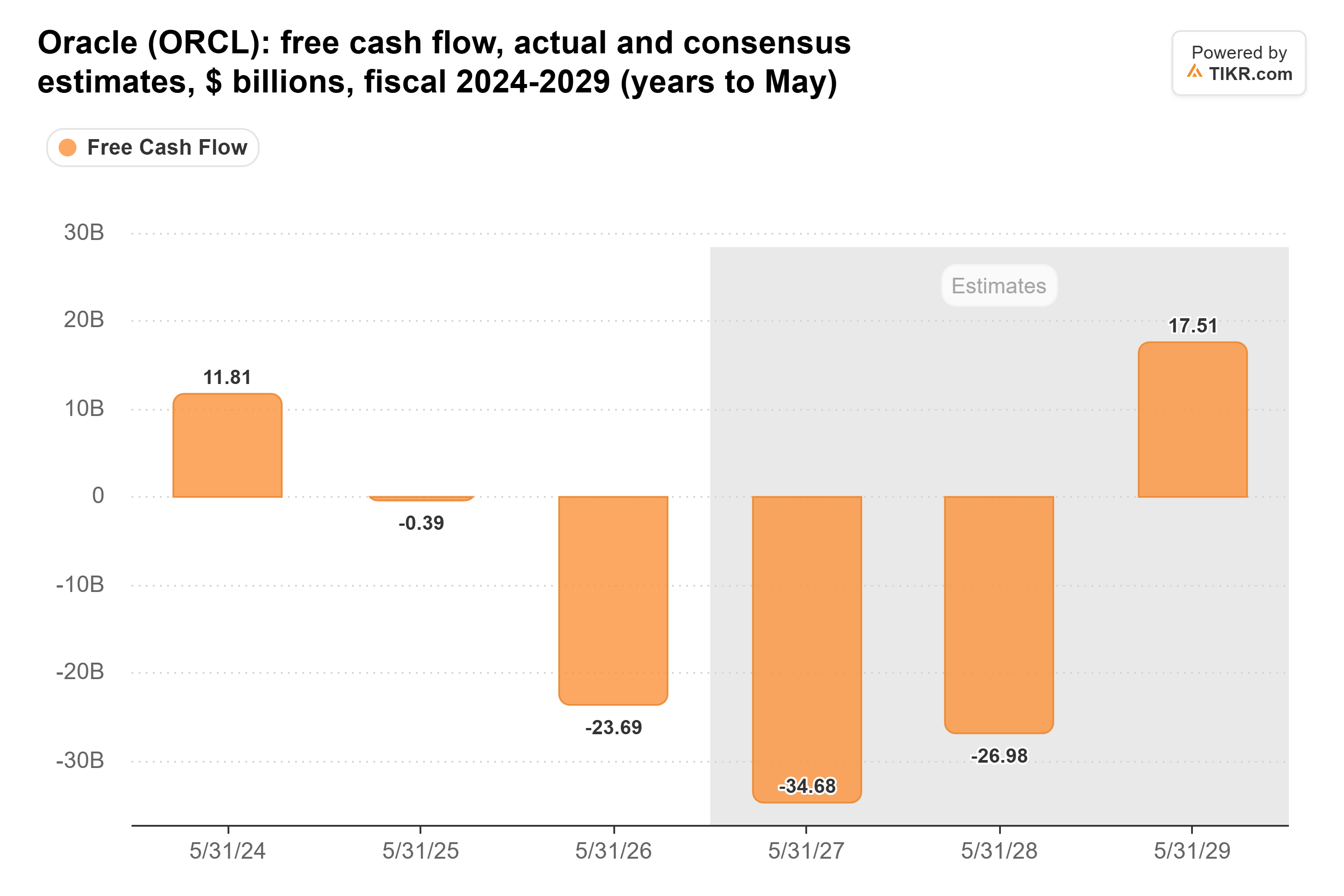
Analysts see free cash flow turning positive at $17.5 billion in fiscal 2029. That’s well below the more than $30 billion Oracle targeted for that year at its Oct. 28 Investor Day, and both figures assume OpenAI keeps taking capacity on schedule.
The cash went into capital spending, which rose from $4.5 billion in fiscal 2022 to $55.7 billion in fiscal 2026:
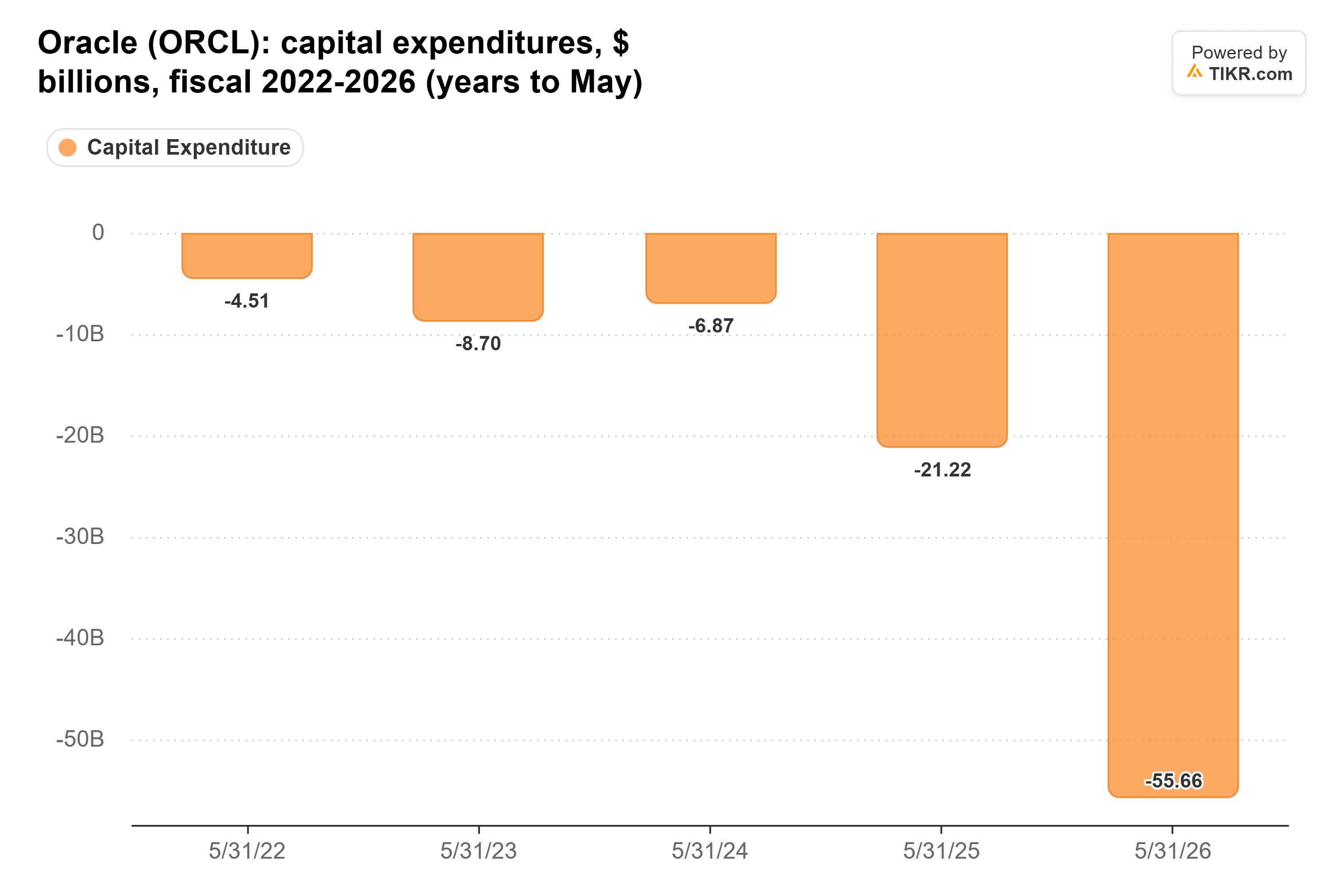
And in September, management guided to $90 billion to $95 billion of capex for fiscal 2027.
Much of that spending was borrowed. Total debt, leases included, rose from $75.9 billion in fiscal 2022 to $167 billion in fiscal 2026:
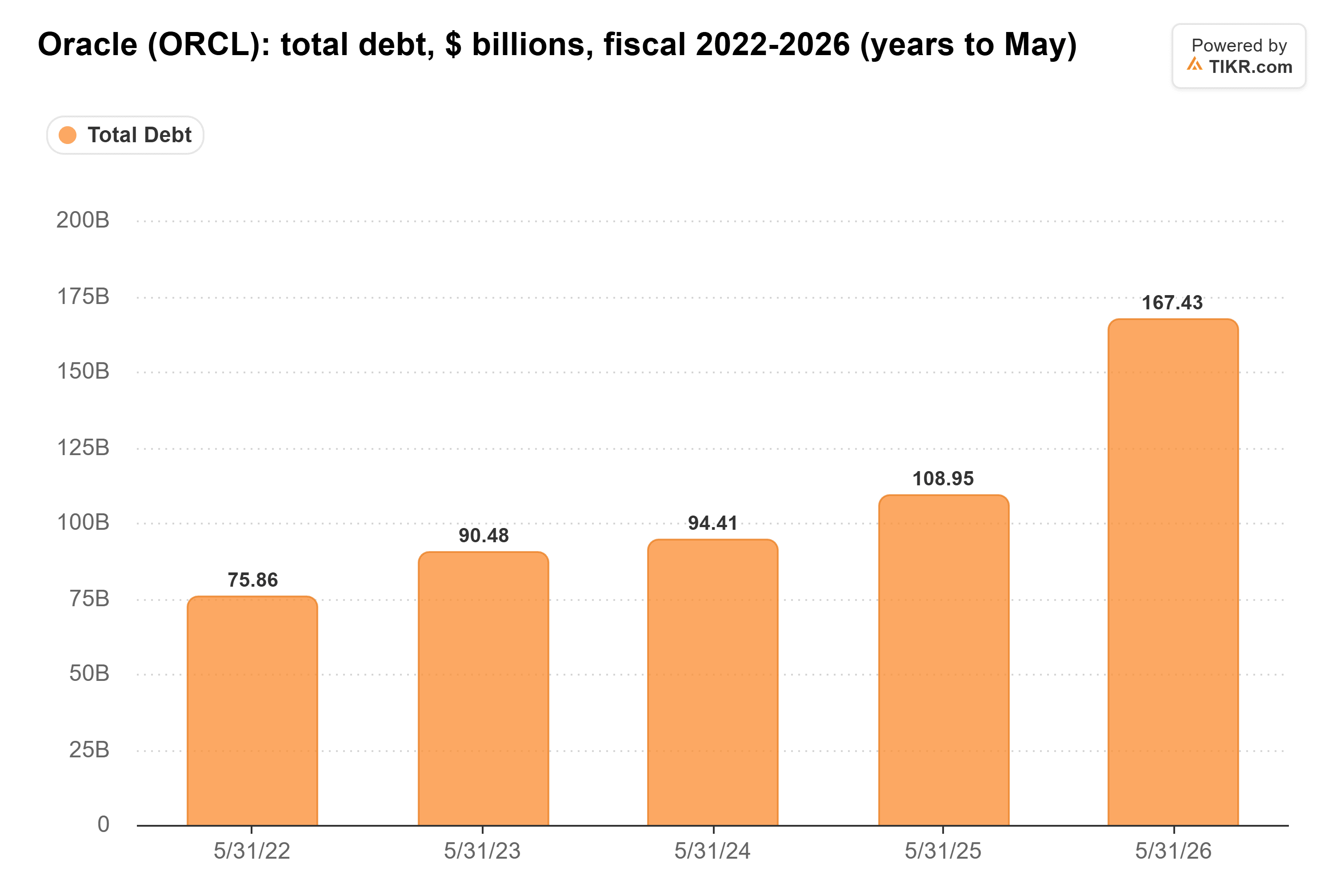
By Aug. 31, total debt was $169.1 billion. This month Oracle added $10 billion of notes, with coupons of 7% to 8.65%, as part of a $20 billion stock and bond sale. On top of that, $288 billion of data center leases haven’t started yet. They run 15 to 19 years and sit off the balance sheet.
If OpenAI takes less capacity, or takes it later, the debt and the leases stay while the revenue meant to cover them slips. S&P already rates Oracle BBB-, one notch above junk. It has said it could cut again if no path to positive free operating cash flow appears by fiscal 2029.
Somebody’s selling Stargate debt
On Thursday, Bloomberg reported that an anonymous seller had put about $500 million of data center loans, a dozen in all, up for auction at once. Bids are due Nov. 19.
One of them is a $25 million slice backing the Stargate site in New Mexico that Oracle is building with OpenAI and SoftBank. That’s the same project where Oracle sent the developer a force majeure notice in September. The rest includes loans tied to Vantage Data Centers and CyrusOne.
$25 million is small next to Oracle’s debt. But what bidders pay for it will tell us how lenders value Stargate debt after this week.
Good for the market, rough on Oracle
Klein’s bigger point was about the whole market. He said “a capex bubble is really bad for markets,” and argued that a build-out matched to how fast customers actually adopt AI might leave investors better off.
I think he’s right about the market. But Oracle is the company that pays for the slowdown, because it borrowed to build for a customer that’s now rethinking its plans.
None of this has touched a contract yet. OpenAI’s leaders only discussed whether to reset expectations, and the Journal didn’t report a decision. So far, no contract in Oracle’s backlog has been hit by the election. Oracle also has its software franchise to fall back on: support revenue alone was $19.8 billion in fiscal 2026.
So the end of Oracle is a stretch. A company with that software base won’t disappear because one customer trims a year of capacity.
Frankly, though, Oracle has tied its balance sheet to OpenAI’s plans. Until its backlog shows real breadth beyond OpenAI, I’d expect every OpenAI headline to move the stock. Of course, OpenAI could still decide to build as planned, and Oracle’s second-quarter results in mid-December will show whether the backlog held up.
So what is Oracle stock actually worth?
TIKR lets you forecast the future price of any stock in less than a minute. Just enter a few assumptions into TIKR’s valuation model and see what Oracle could be worth. Start from Wall Street consensus estimates, or adjust the inputs to reflect your own view of the business. It’s free to use.
Disclaimer:
Please note that the articles on TIKR are not intended to serve as investment or financial advice from TIKR or our content team, nor are they recommendations to buy or sell any stocks. We create our content based on TIKR Terminal’s investment data and analysts’ estimates. Our analysis might not include recent company news or important updates. TIKR has no position in any of the stocks mentioned. Thank you for reading, and happy investing!