Key Takeaways
- Enbridge and Enterprise Products Partners both yield 6% or more, and both had good news this fall: a reaffirmed outlook from Enbridge and a distribution raise from Enterprise.
- Enterprise covered its distribution 1.7x with distributable cash flow in fiscal 2025, against 1.5x for Enbridge, and it carries about half Enbridge’s leverage.
- Enbridge has raised its dividend 31 years in a row and expects about 5% average yearly growth in distributable cash flow per share over the medium term.
- Enterprise’s latest raise came in below its 4% five-year pace, and management expects more modest EBITDA growth in 2027.
Anyone hunting for a 6% yield is going to come across Enbridge (ENB) and Enterprise Products Partners (EPD). Both just gave income investors something to like.
On Oct. 8, Enterprise declared a quarterly distribution of $0.56 a unit, up 2.8% from a year earlier. Its third-quarter results on Oct. 29 showed that payout covered 1.9x by distributable cash flow. Enbridge followed on Nov. 6 by reaffirming its 2026 guidance and saying it expects to finish near the midpoint, which would be its 21st straight year of hitting its targets.
So if you could hold only one for the next 10 years, which should it be?
| Metric | Enbridge (ENB) | Enterprise Products Partners (EPD) |
|---|---|---|
| Dividend yield | 6.0% | 6.3% |
| Dividend growth, fiscal 2020-2025 | 3.1% a year (C$) | 4.0% a year |
| Distributable cash flow coverage, fiscal 2025 | 1.5x | 1.7x |
| Distributable cash flow coverage, fiscal 2026 consensus | 1.5x | 1.9x |
| Net debt / EBITDA, last 12 months | 6.3x | 3.2x |
| Interest coverage, last 12 months | 2.4x | 5.1x |
Source: TIKR, Nov. 9, 2026.
6 safe dividend stocks paying retirees 6%+ yields
There are over 100 stocks paying 6%+ annual dividends today.
But after an extensive investment review leveraging TIKR’s proprietary data, we now believe only six of them are truly safe for retirees.
They’re all yours for free as part of our new investment report, which you can access right here.
Enbridge keeps its promises, on a heavier balance sheet
Enbridge’s growth is coming from gas. Its gas transmission and distribution businesses grew by double digits in the third quarter on rate settlements, rate cases and customer growth. Lower Mainline volumes weighed on its liquids pipelines. CEO Greg Ebel put the secured growth backlog at $38 billion.
Distributable cash flow covered the dividend a comfortable 1.5x in fiscal 2025, and analysts expect the same in fiscal 2026: C$5.84 a share against C$3.88 of dividends. Coverage has stayed between 1.4x and 1.7x every year since fiscal 2017, as distributable cash flow per share rose from C$3.68 in fiscal 2017 to C$5.71 in fiscal 2025.
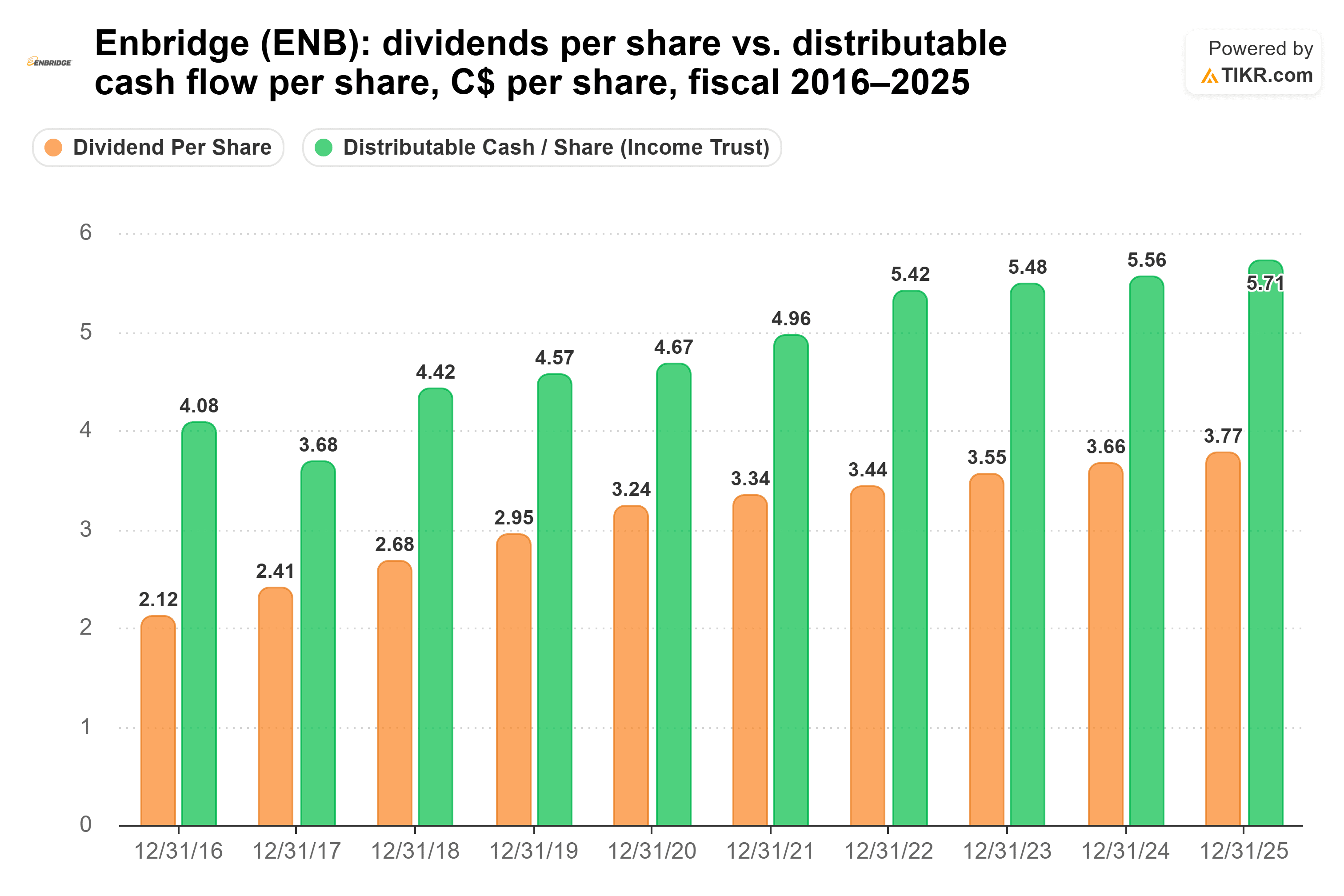
The company counts 31 consecutive years of raises. But they’ve slowed, to 3.1% a year from fiscal 2020 to fiscal 2025 (C$3.24 to C$3.77 a share), from 7.3% a year from fiscal 2015 to fiscal 2025. The latest, announced Dec. 3, 2025, was 3%.
The main risk is debt. Net debt runs a heavy 6.3x EBITDA over the last 12 months, and interest coverage is a thin 2.4x. And since Enbridge sets its dividend in Canadian dollars, the US-dollar check moves with the exchange rate, and Canada withholds tax on dividends paid to US holders.
Enterprise keeps more of its cash
Where Enbridge leans on gas pipelines and utilities, Enterprise’s growth comes from the Permian. Its Permian gas processing volumes hit a record 4.6 Bcf/d in the third quarter, up 12%, and its marine terminal volumes rose 28%. New assets placed in service over the past year, including its 11th Delaware Basin gas plant and the Bahia NGL pipeline, lifted margins in three of its four segments.
That’s the growth behind analysts’ forecast for distributable cash flow per unit to rise 14%, from $3.66 in fiscal 2025 to $4.17 in fiscal 2026. That would lift coverage from 1.7x to 1.9x. Third-quarter operational DCF was already up 27%, and last year’s consensus landed within 1% of the actual. Coverage has been 1.6x or better every year since fiscal 2018, up from 1.2x in fiscal 2016.

Management aims to spend 55% to 60% of adjusted cash flow from operations on distributions and buybacks. Its payout ratio over the 12 months to Sept. 30 was 54%, just under that range.
The risk is the pace of raises. The latest came in below the 4.0% a year Enterprise averaged from fiscal 2020 to fiscal 2025 ($1.78 to $2.17 a unit). And as an MLP, Enterprise pays distributions on units, with a K-1 at tax time.
So which dividend wins?
If I can only pick one dividend stock for the next 10 years, it’s Enterprise Products Partners. It pays more today and has grown its payout faster. At each one’s five-year rate, $10,000 in Enterprise pays about $7,579 over the 10 years, against about $6,903 for Enbridge (figured in Canadian dollars). That’s about $676 more, and at those rates Enbridge never catches up.
The bigger reason is Enterprise’s room to keep it up. It covers its distribution with more cash to spare. Its net debt has held between 3.2x and 3.4x EBITDA every year since fiscal 2021, about half Enbridge’s 6.3x.
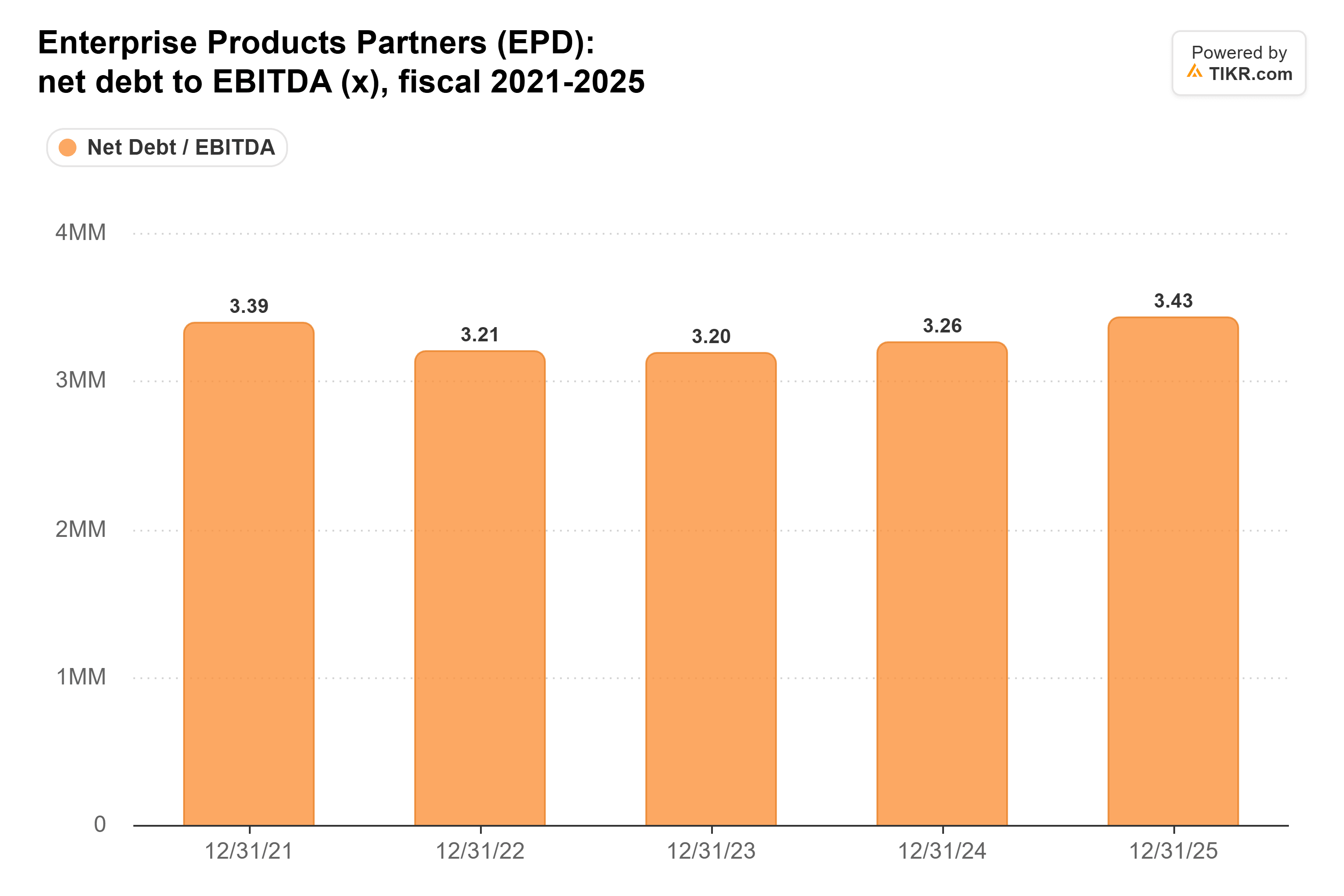
With interest coverage of 5.1x as well, Enterprise has the balance sheet to keep raising through a slower year.
Enbridge’s dividend is still a solid one. Thirty-one straight years of raises is a record management will work hard to keep. Its gas growth and backlog back its outlook for about 5% average yearly growth in distributable cash flow per share over the medium term. It’s just that, over 10 years, I’d rather own the bigger check with the bigger cushion.
Of course, management expects Enterprise’s 2027 EBITDA growth to be more modest than 2026’s, and its next raise will show whether the distribution keeps slowing.
Enjoy your retirement in style with these safe 6%+ dividend yields
Dividends can hold the key to enormous wealth. But only if you buy the right ones.
Picking the right high-yield dividend stock can be the difference between a dream retirement…and scraping by every month, waiting for the next Social Security check to clear.
We’ve identified six stocks yielding 6%+ that we believe every retiree should know about right now.
Disclaimer:
Please note that the articles on TIKR are not intended to serve as investment or financial advice from TIKR or our content team, nor are they recommendations to buy or sell any stocks. We create our content based on TIKR Terminal’s investment data and analysts’ estimates. Our analysis might not include recent company news or important updates. TIKR has no position in any of the stocks mentioned. Thank you for reading, and happy investing!