Key Stats for Eli Lilly Stock
- Current Price: $1,273.46
- Target Price (Mid): ~$2,220
- Street Target: ~$1,330
- Potential Total Return: ~74%
- Annualized IRR: ~14% / year
Now Live: Discover how much upside your favorite stocks could have using TIKR’s new Valuation Model (It’s free) >>>
What Happened?
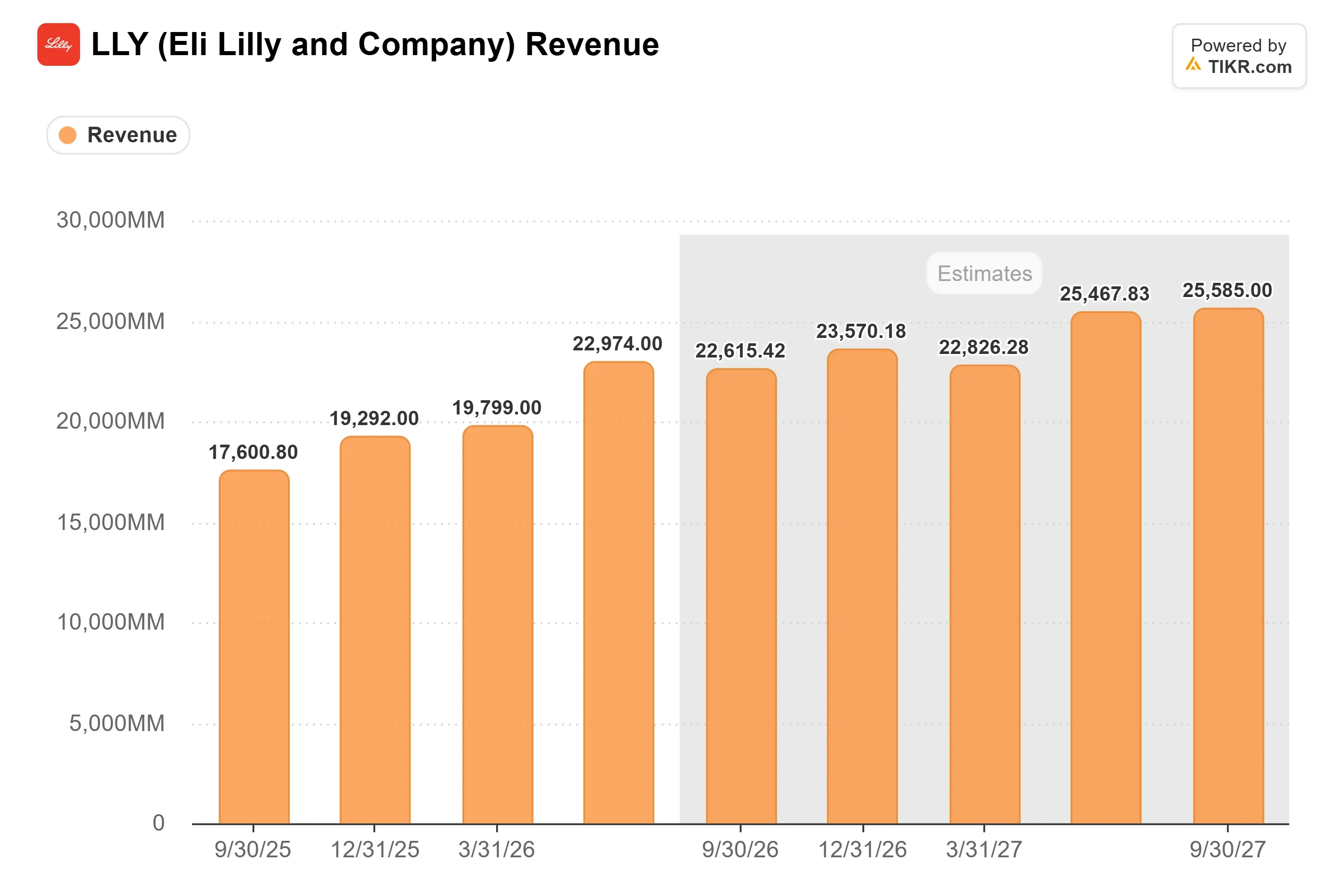
Eli Lilly (LLY) closed at $1,273.46 on October 23, down 2.54%. The pharmaceutical sector also traded lower that session, according to TradingKey. The October 29 report carries an odd setup. TIKR’s consensus sees third-quarter revenue of about $22.6 billion, slightly below Q2’s $22.97 billion, even though Q3 is the first full quarter of Medicare’s GLP-1 Bridge program, which began July 1.
Q2 Had One-Time Help, and New Patients Start Cheap
Lilly’s Q2 release explains part of the gap. It said the first half of 2026 benefited from sales-based milestones and adjustments for rebates and discounts, including a $250 million Jardiance milestone in Q2. Without those adjustments, U.S. prices would have fallen about 9% rather than 3%. Outside the U.S., prices fell 36%, mainly because Mounjaro was added to China’s National Reimbursement Drug List.
The rest is mix. Ilya Yuffa is Lilly’s Executive Vice President and President of Lilly USA and Global Customer Capabilities. At Morgan Stanley’s healthcare conference on September 14, he said Foundayo had “more than 30% share in new starts within oral GLP-1.” Most of those starts were self-pay for now, and he noted they come in “at lower price points initially until people get through to higher doses.”
Outside the U.S., Yuffa put self-pay at around 75% of the market. He said generic semaglutide is expanding the market in India and Canada while Mounjaro’s absolute volume keeps growing. In Medicare’s Bridge, the $50 copay has favored injectables, Zepbound in particular.
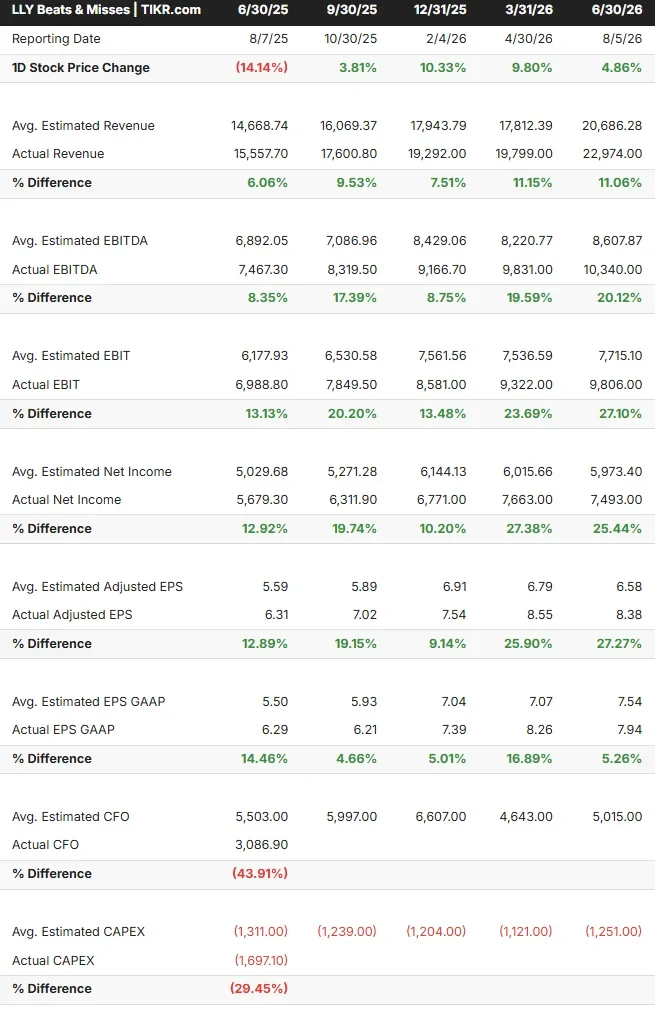
None of that points to weaker demand. Worldwide volume rose 60% in Q2 against a 13% price decline. Lilly has topped revenue consensus by 6.06% to 11.15% in each of the last five quarters, per TIKR. Applying the smallest of those beats to today’s estimate gives about $24 billion, though past beats guarantee nothing.
TIKR tracks 31 analysts on Eli Lilly. How many say “Buy”?
See the full breakdown of Buy, Hold, and Sell ratings on Eli Lilly, along with Wall Street’s revenue and earnings estimates, all in one place. More than 500,000 investors use TIKR to research stocks like this one. See Eli Lilly’s Analyst Ratings
A Lower Profit Bar and an Early Ovarian Cancer Readout
Consensus adjusted EPS of around $6.70 compares with $8.38 in Q2, with a median near $5.85. Lilly’s non-GAAP EPS includes acquired in-process R&D charges, which took $3.03 off Q2. The company also completed three acquisitions after the quarter, so deal charges may explain part of that spread.
On October 24, Lilly reported that its ovarian cancer drug sofetabart mipitecan, given with bevacizumab, produced a 79% confirmed response rate in 29 heavily pretreated patients with platinum-sensitive disease. The Phase 1 cohort used a 4 mg/kg dose, above the 3 mg/kg in the Phase 3 FRAmework-01 program. Grade 3 or worse neutropenia affected 42% of patients, and 6% stopped treatment due to side effects.
TIKR Advanced Model Analysis
- Current Price: $1,273.46
- Target Price (Mid): ~$2,220
- Potential Total Return: ~74%
- Annualized IRR: ~14% / year

The mid case serves as the central scenario. Its inputs, shown over TIKR’s 2025 to 2035 forecast window, assume revenue grows around 11% a year and net margins reach around 44%, while the P/E shrinks about 1.4% a year. The main risk is price declines outlasting volume growth and compressing the multiple faster.
The Street’s mean of about $1,330 sits about 5% above the close. It rests on 20 Buy, 6 Outperform, 3 Hold, 2 No Opinion, 1 Underperform, and 1 Sell ratings. Its high of $1,600 is about 26% above the close, and its low of $930 is about 27% below.
Conclusion
On October 29, read the volume and price split first. TIKR’s consensus implies about 28% revenue growth from a year earlier. At Q2’s 13% price decline, volume would need to rise about 48% to get there. Volume growth above that would mark the forecast dip as Q2’s one-time help fading, not demand slowing.
Also listen for employers. Yuffa said in September he expected “a number of employers” to opt in or keep coverage for 2027 through Lilly’s employer program.
So what is Eli Lilly stock actually worth?
TIKR lets you forecast the future price of any stock in less than a minute. Just enter a few assumptions into TIKR’s valuation model and see what Eli Lilly could be worth. Start from Wall Street consensus estimates, or adjust the inputs to reflect your own view of the business. It’s free to use.
Analyze Eli Lilly on TIKR Free →
Disclaimer:
Please note that the articles on TIKR are not intended to serve as investment or financial advice from TIKR or our content team, nor are they recommendations to buy or sell any stocks. We create our content based on TIKR Terminal’s investment data and analysts’ estimates. Our analysis might not include recent company news or important updates. TIKR has no position in any stocks mentioned. Thank you for reading, and happy investing!