
Key Takeaways
- Disney beat fiscal fourth-quarter estimates, raised its dividend 33% and set a goal of about $3 billion a year in cost savings by fiscal 2029.
- Its double-digit EPS growth guide for fiscal 2027 leans on cost cuts and buybacks as its Asia parks stay weak through 2027.
- A free, ad-supported Disney+ tier could add ad inventory but cut into a streaming business that earned $824 million in the quarter.
- Consensus had $7.43 of fiscal 2027 EPS before the report, below what the guide implies, and first-quarter results in early February are the next test.
Disney (DIS) beat estimates today, raised its dividend 33% and put a number on its cost cuts: about $3 billion a year in savings by fiscal 2029.
It’s also exploring a free version of Disney+ as its Asia parks weaken.
What exactly happened
Disney beat Wall Street’s fiscal fourth-quarter numbers, per Bloomberg consensus:
- Adjusted EPS of $1.77, against $1.68 expected
- Revenue of $25.9 billion, against $25.2 billion
- Record Experiences revenue of $10.1 billion, against $9.9 billion
A 53rd week helped. Without it, adjusted EPS was $1.59, still up 43% from $1.11 a year earlier. The dividend rises to $2.00 a share for fiscal 2027 from $1.50. For fiscal 2027, Disney guides high-single-digit growth in segment operating income and double-digit growth in adjusted EPS.
TIKR tracks 32 analysts on Disney. How many say “Buy”?
See the full breakdown of Buy, Hold, and Sell ratings on Disney, along with Wall Street’s revenue and earnings estimates, all in one place. More than 500,000 investors use TIKR to research stocks like this one. See Disney’s Analyst Ratings
Cost cuts do the heavy lifting
The savings help close the gap between those two growth rates.
“Most of the savings will be used to fund future growth,” CEO Josh D’Amaro said on the earnings call.
That covers a content budget of about $26 billion next year, up about $2 billion, without the bigger bill eating into margins. The roughly $9 billion of buybacks planned for fiscal 2027 does the rest.
Analysts already expected Disney’s EPS to keep climbing through fiscal 2029, the year the savings target is due:
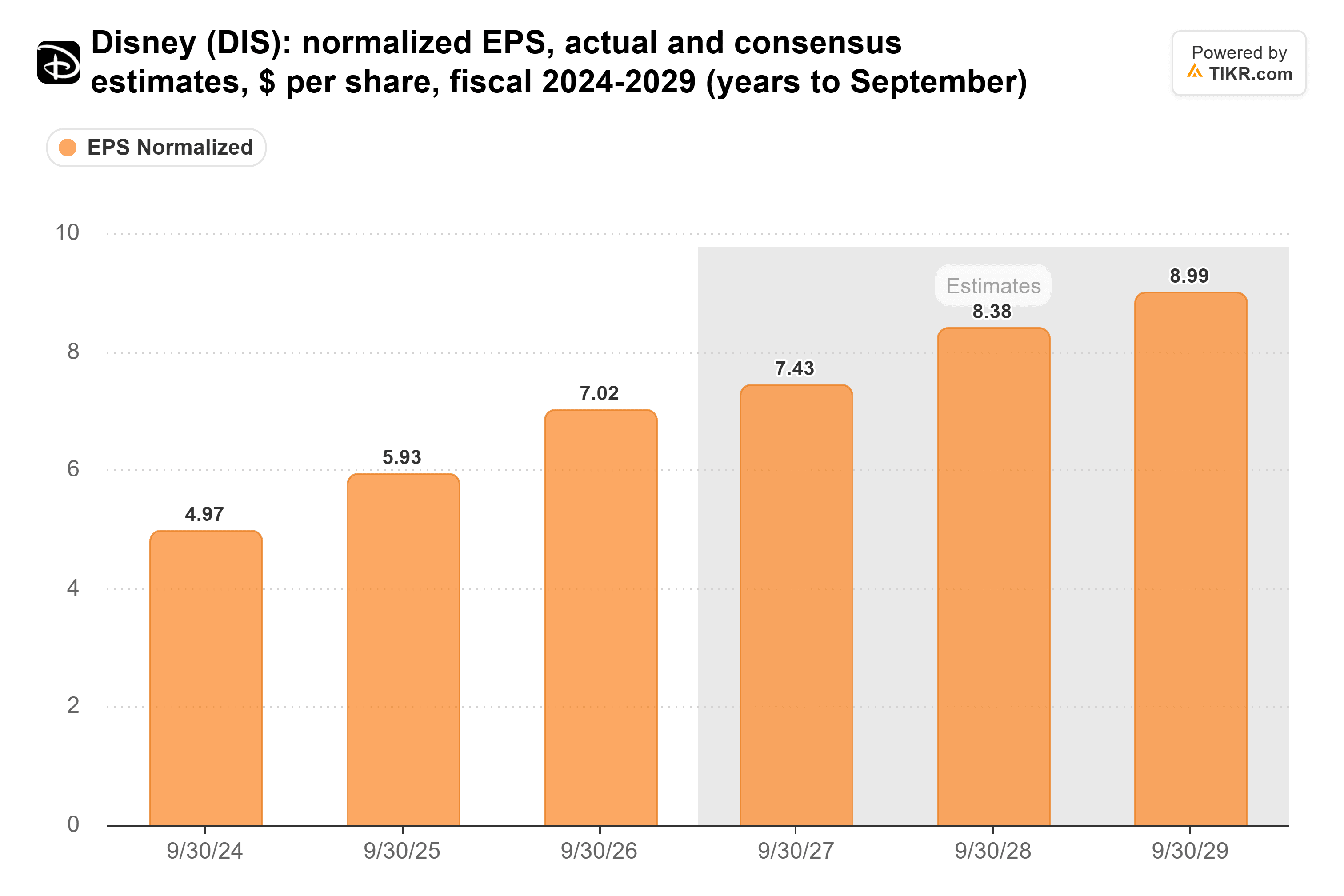
Before today’s guide, consensus had fiscal 2027 at $7.43, about 6% above fiscal 2026’s $7.02. Double-digit growth would put it higher, even without the extra week, so I’d expect the estimates to move up.
Disney’s operating margin has already nearly doubled in three years:
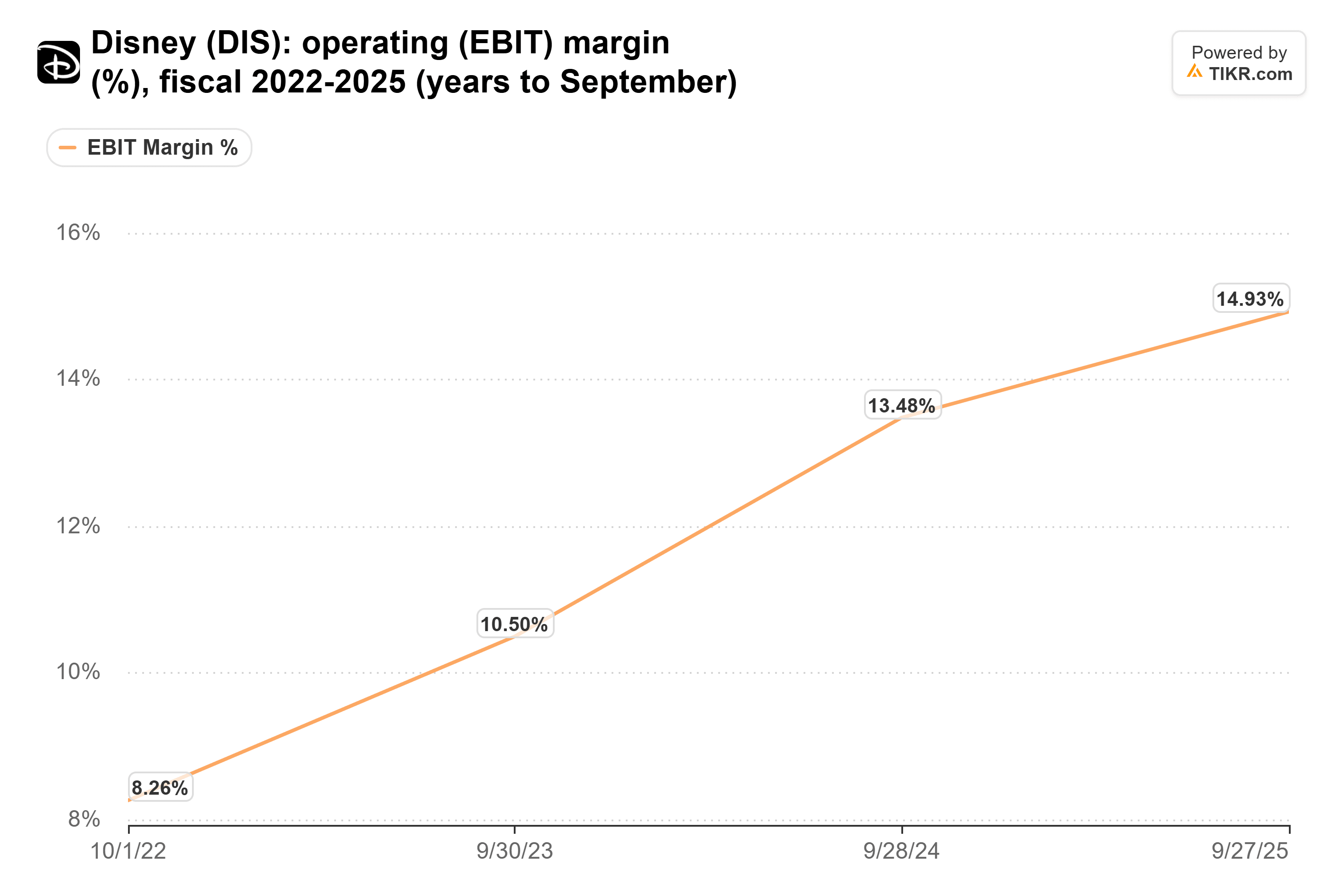
Streaming drove much of that, going from a loss of about $4 billion in fiscal 2022 to a $1.3 billion profit in fiscal 2025, per management.
Free Disney+ is a bet on ads
Disney+ and Hulu earned $824 million in the fourth quarter, up from $402 million a year earlier, which is why the free tier matters.
“We are exploring a free product, and I think it will be more price-sensitive consumer and bring in new Disney+ subscribers,” D’Amaro told investors. “It’s going to give us more ad inventory to … offer a key retention tool that, quite frankly, we currently don’t have.”
A free tier puts some of that profit at risk if paying subscribers switch to it, and since Disney stops reporting streaming profit next quarter, investors won’t see what it does. Ads are also streaming’s weakest line: Disney+ and Hulu’s ad revenue rose just 3% in the third quarter as ad rates fell 4%. The free tier only works if advertisers pay up for the extra inventory.
Asia is a drag Disney can absorb
Disneyland Paris made up for softness at Hong Kong and Shanghai in the fourth quarter, and the hit from Asia is limited. International parks, Paris included, earned $1.4 billion in fiscal 2025, about 8% of segment operating income. Disney also owns just 48% of its Hong Kong park and 43% of Shanghai’s, so its partners take part of any decline. At home, D’Amaro said first-quarter bookings are ahead of a year ago.
The way I see it, the parks are still doing their part. To hit its EPS guide, Disney is counting on two levers it controls: the $3 billion of savings and a bigger streaming ad business. That’s a sturdier setup than one that depends on Asian consumers. The first test comes with first-quarter results, likely in early February. If segment operating income lands near the $5.4 billion Disney guides, the plan is on track.
So what is Disney stock actually worth?
TIKR lets you forecast the future price of any stock in less than a minute. Just enter a few assumptions into TIKR’s valuation model and see what Disney could be worth. Start from Wall Street consensus estimates, or adjust the inputs to reflect your own view of the business. It’s free to use.
Disclaimer:
Please note that the articles on TIKR are not intended to serve as investment or financial advice from TIKR or our content team, nor are they recommendations to buy or sell any stocks. We create our content based on TIKR Terminal’s investment data and analysts’ estimates. Our analysis might not include recent company news or important updates. TIKR has no position in any of the stocks mentioned. Thank you for reading, and happy investing!