


Key Takeaways
- NVIDIA posted record revenue of $115.8 billion, up 103%, yet its stock fell 23% that week.
- Chamath Palihapitiya says NVIDIA’s “over earning era” may be over, and its 8.7x forward P/E suggests the market agrees.
- Aswath Damodaran puts a typical chip company’s operating margin at 40%, against about 67% at NVIDIA.
- Even at a 40% margin, the stock would trade around 15x forward earnings, and tight supply should slow any decline.
NVIDIA (NVDA) just had the biggest quarter in its history. Revenue was $115.8 billion for the quarter ended Oct. 25, up 103% from a year ago.
The stock fell 23% that week, closing at $125.53 on Nov. 20. It was the seventh straight weekly drop, the longest streak since 2008.
Chamath Palihapitiya explained why on the All-In podcast: “This I think is why NVIDIA is trading down is this realization that the over earning era of NVIDIA may be over.” He sees AI buyers spreading spending across GPUs from AMD (AMD) and custom accelerators from Broadcom (AVGO). Even Taiwan Semiconductor (TSM), which makes NVIDIA’s chips, sets how fast NVIDIA can grow.
Jensen Huang’s resignation as CEO, announced Nov. 12, didn’t help, and neither did Reuters’ Nov. 20 report that SEC enforcement staff are examining NVIDIA’s accounting.
Record Earnings at a Bargain-Bin Multiple
Consensus normalized EPS climbs from $9.67 for the year ending January 2027 to $21.77 for the year ending January 2029:

NVIDIA trades at 8.7x forward earnings, its lowest in five years and far below its 35.4x five-year average:
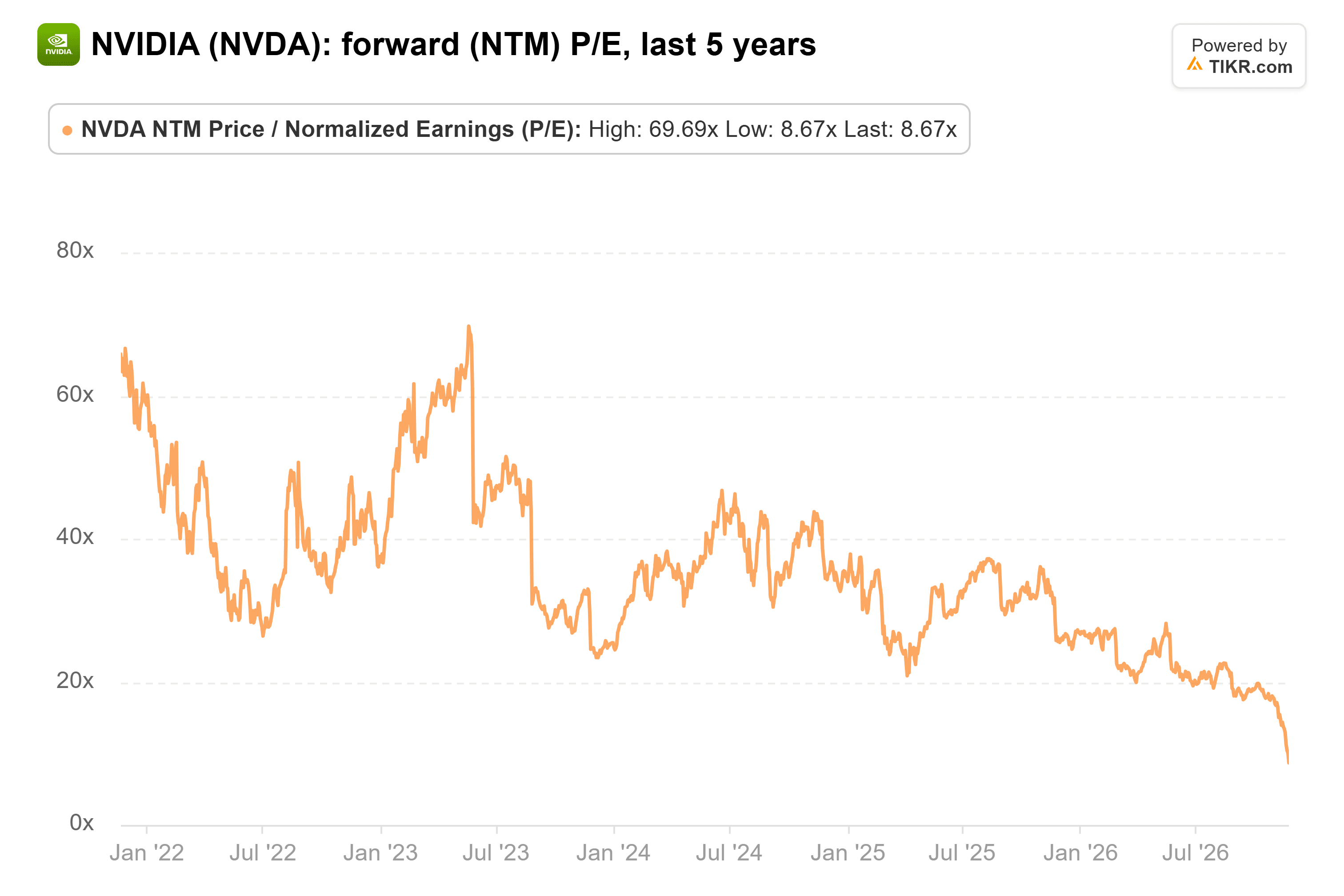
A multiple that low on rising estimates suggests investors think today’s profits won’t last.
Seventy Can’t Stay 70
NYU Stern professor Aswath Damodaran put numbers on it on Prof G Markets: “a typical chip company has operating margins of 40,” and “NVIDIA operating margins are 70.” He expects the gap to close as Meta and Microsoft build their own chips.
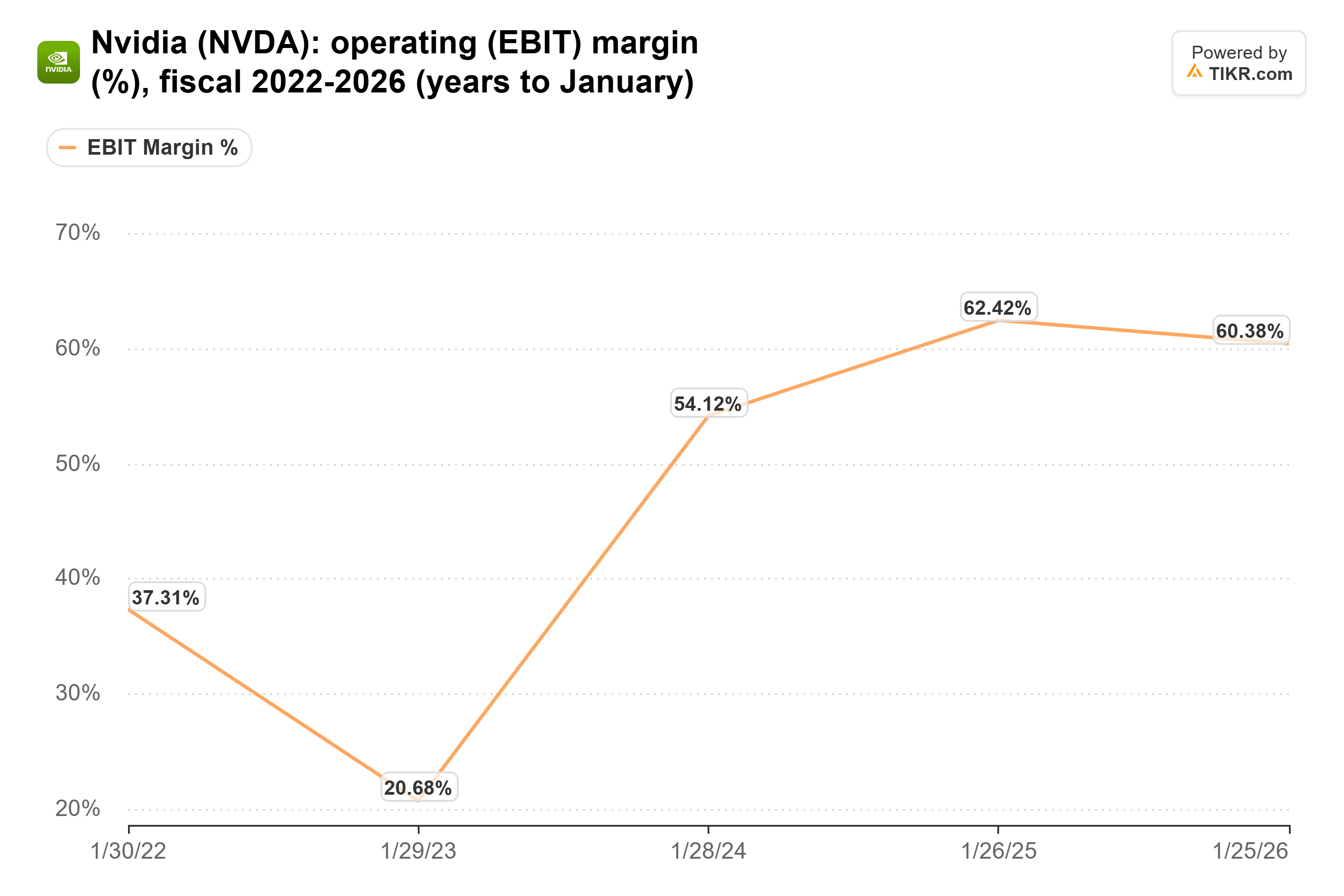
NVIDIA’s operating margin has topped 54% in each of the last three fiscal years, after 20.7% in fiscal 2023:
TIKR Tracks 63 Analysts on NVIDIA. How Many Say “Buy”?
See the full breakdown of Buy, Hold, and Sell ratings on NVIDIA, along with Wall Street’s revenue and earnings estimates, all in one place. More than 500,000 investors use TIKR to research stocks like this one. See NVIDIA’s Analyst Ratings
In the October quarter, NVIDIA’s operating margin hit 67%. AMD’s company-wide GAAP operating margin was 21%, even as its Data Center revenue rose 97% to $8.5 billion. Custom chips are growing faster still, with Broadcom’s AI chip revenue up 221% to $16.7 billion in its quarter ended Aug. 2.
Cut that 67% margin to 40% on the same sales, and operating profit falls about 40%. At the Nov. 20 close, that puts the stock at roughly 15x forward earnings.
Tight Supply Buys NVIDIA Time
Margins may not shrink soon, though. On Nov. 17, management raised its outlook for the year ending January 2028 to about 75% revenue growth, from 70%, and said it is working with TSMC to “narrow the supply and demand gaps.” Buyers who can’t get enough chips have little room to push back on price.
TSMC’s board approved about $40.9 billion of capital spending on Nov. 10. That buildout eases the squeeze, and brings the competition that pulls margins down later.
The Bad News Looks Priced In for NVIDIA Stock
Chamath has the market’s logic right, and a 70% margin won’t last forever. But at roughly 15x even on a typical chip-company margin, the stock already prices in much of that decline, and tight supply should keep it gradual.
The next test is the January-quarter report in late February. Management guided gross margin to bottom at 71% to 72% that quarter, then recover to 72% to 73% the following year. If that holds, the plateau should last longer than the market expects.
So What Is NVIDIA Stock Actually Worth?
TIKR lets you forecast the future price of any stock in less than a minute. Just enter a few assumptions into TIKR’s valuation model and see what NVIDIA could be worth. Start from Wall Street consensus estimates, or adjust the inputs to reflect your own view of the business. It’s free to use.
Disclaimer:
Please note that the articles on TIKR are not intended to serve as investment or financial advice from TIKR or our content team, nor are they recommendations to buy or sell any stocks. We create our content based on TIKR Terminal’s investment data and analysts’ estimates. Our analysis might not include recent company news or important updates. TIKR has no position in any of the stocks mentioned. Thank you for reading, and happy investing!


