Key Takeaways
- Of 456 big funds that have filed 13Fs for the quarter ended Sept. 30, 10 bought Eli Lilly and 18 sold. Cathie Wood’s ARK Invest was among the buyers, and Stanley Druckenmiller’s Duquesne Family Office was among the sellers.
- The biggest buy was GQG Partners’ new $878 million Lilly stake, which it opened in the same quarter it cut its AbbVie position by 99%.
- Analysts expect Lilly’s normalized EPS to more than double from 2025 to 2028, yet its 31x forward P/E is well below its five-year average of 40x.
- The buyers have the better case on the business, though Wall Street’s average target is only 3% above the share price.
Big funds split on Eli Lilly (LLY) last quarter, and the sellers outnumbered the buyers almost two to one.
The counts cover 456 big funds that have filed 13Fs for the quarter ended Sept. 30. That means funds readers know, or ones holding $1 billion or more of US stocks, with quant and index funds left out. Ten of them bought Lilly, either opening a position or adding 20% or more. Another 18 sold out or cut their stakes by 20% or more, and 81 held the stock at the quarter’s end.
Cathie Wood’s ARK Invest was among the buyers, according to its 13F filed Nov. 13. Stanley Druckenmiller’s Duquesne Family Office was among the sellers, according to its 13F filed Nov. 16.
GQG made the biggest bet
The biggest buyer by far was GQG Partners, which manages $164 billion. Its 13F for the quarter, filed Nov. 13, shows a new stake of 758,906 Lilly shares worth $878 million at the quarter’s end, or 1.6% of its 13F stocks. In the same quarter, GQG cut its AbbVie (ABBV) stake by 99%, to 21,295 shares.
Kinetic Partners Management, which manages $4.7 billion, added 39% to its stake. That made Lilly its fifth-largest holding, at 5.4% of its 13F stocks. ARK added 40%, bringing it to 107,838 shares worth $125 million at the quarter’s end, a small position at 0.7% of its 13F stocks.
TIKR tracks 31 analysts on Eli Lilly. How many say “Buy”?
See the full breakdown of Buy, Hold, and Sell ratings on Eli Lilly, along with Wall Street’s revenue and earnings estimates, all in one place. More than 500,000 investors use TIKR to research stocks like this one. See Eli Lilly’s Analyst Ratings
The biggest sellers still own plenty
Polen Capital, which manages $24 billion, was the biggest seller. Its 13F, filed Nov. 13, shows it cut its Lilly stake by 45%, which is $344 million of stock at quarter-end prices. Its remaining 369,339 shares were still worth $427 million, making Lilly its ninth-largest holding at 4.6% of its 13F stocks.
Edgewood Management, which manages $22 billion, cut 44% and still held $250 million of Lilly. Alphinity Investment Management cut 28% and kept Lilly as its fourth-largest holding, at 5.5%. Alphinity’s 13F holds $4.5 billion of US stocks.
Druckenmiller cut harder. Duquesne sold 69% of its stake, leaving 3,800 shares worth $4 million, or 0.1% of its 13F stocks. Six of the 18 sellers bought Meta Platforms or added 20% or more to it in the same quarter.
Lilly’s stock is up 24% from its Sept. 30 close, which counts in the buyers’ favor so far. Still, a 13F shows only what each fund held on that day, so it can’t tell us what anyone paid or why they moved.
The numbers back the buyers
Start with earnings. Analysts expect Lilly’s normalized EPS to more than double from 2025 to 2028:
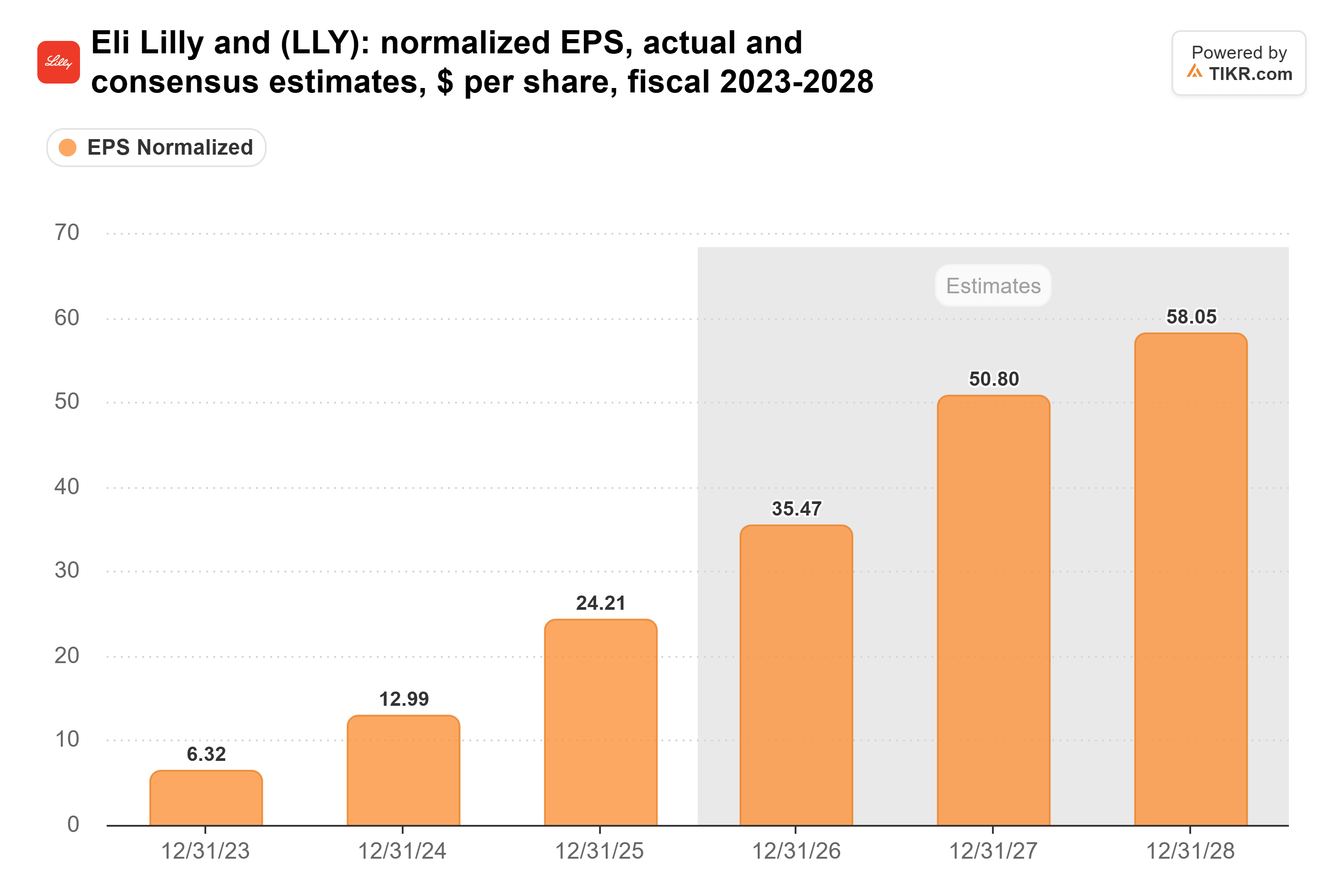
Those estimates are rising. Since late October, the 2027 estimate has gone up to $50.80 from $47.22, and the 2028 estimate to $58.05 from $54.41. The increases followed Lilly’s move to raise its 2026 revenue guidance to $91 billion-$92 billion.
The multiple has moved the other way. Lilly trades at 31x forward earnings, well below its five-year average of 40x:
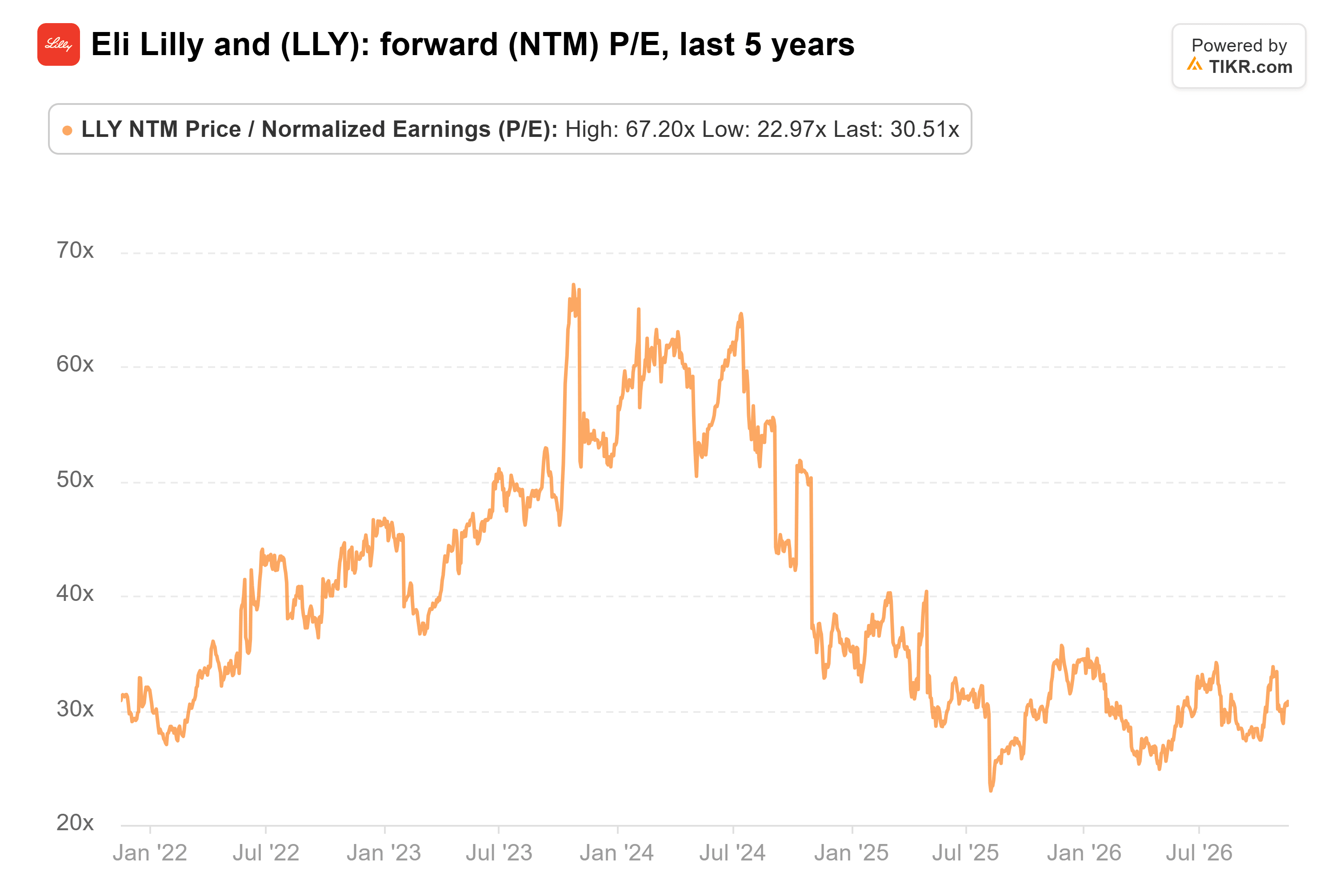
The multiple peaked at 67x in October 2023 and hit a low of 23x in August 2025. So GQG ended the quarter more heavily in the pricier drugmaker: AbbVie trades at about 19x forward earnings.
The sellers’ best argument is Wall Street’s own target. The consensus price target has climbed all year, reaching $1,469 from $1,007 a year ago:
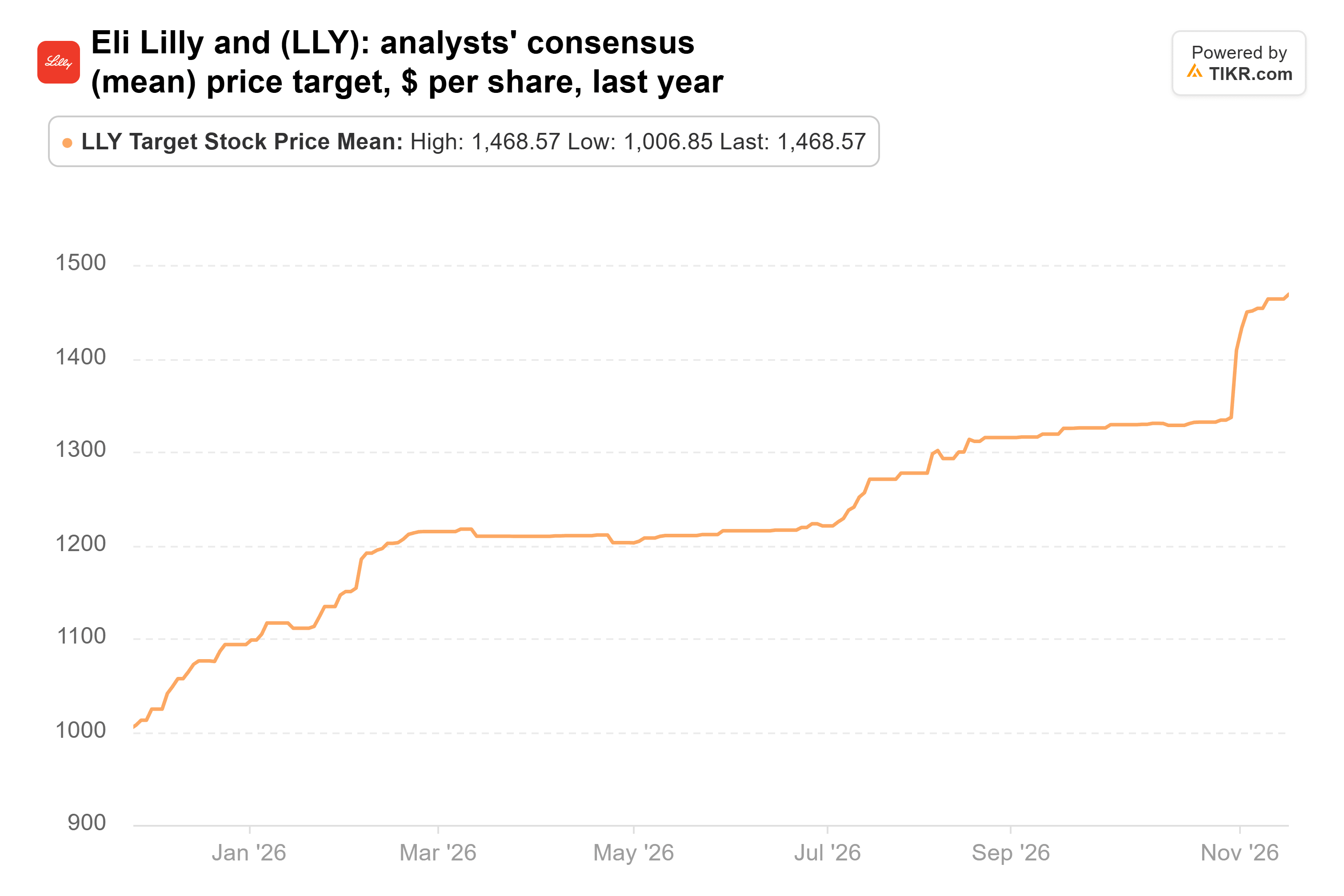
That’s only 3% above today’s price, and the 31 analysts’ targets range from $940 to $1,700.
I’d go with the buyers
The main risk is that Lilly depends on one molecule. Mounjaro and Zepbound made up 64.7% of its revenue in the first half of 2026, and generic drugmakers filed to copy both in July. On top of that, Democrats won back Congress on Nov. 3, and they have generally been more willing to push on drug prices.
Even so, I side with the buyers. Analysts keep raising their estimates for a company that’s expected to more than double its earnings in three years, and the stock trades well below its own five-year average multiple. The sellers have a fair point that the Street sees little upside after the run, and the biggest of them kept large stakes anyway. But analysts have raised their targets all year, and as long as estimates keep rising, they have room to raise them again.
Lilly will give its long-term targets for margins and spending at its investment community update on Dec. 7. The next round of 13Fs, due in mid-February, will show whether the sellers kept selling.
So what is Eli Lilly stock actually worth?
TIKR lets you forecast the future price of any stock in less than a minute. Just enter a few assumptions into TIKR’s valuation model and see what Eli Lilly could be worth. Start from Wall Street consensus estimates, or adjust the inputs to reflect your own view of the business. It’s free to use.
Disclaimer:
Please note that the articles on TIKR are not intended to serve as investment or financial advice from TIKR or our content team, nor are they recommendations to buy or sell any stocks. We create our content based on TIKR Terminal’s investment data and analysts’ estimates. Our analysis might not include recent company news or important updates. TIKR has no position in any of the stocks mentioned. Thank you for reading, and happy investing!