Key Takeaways
- Broadcom (AVGO) surged 5.5% on November 12 following NVIDIA (NVDA) CEO Jensen Huang’s departure, before retreating to $333.40 on November 16.
- Advanced Micro Devices (AMD) also rallied, while Alphabet (GOOG) provides Broadcom with exposure to Google’s custom AI chips through a supply agreement extending up to 2031.
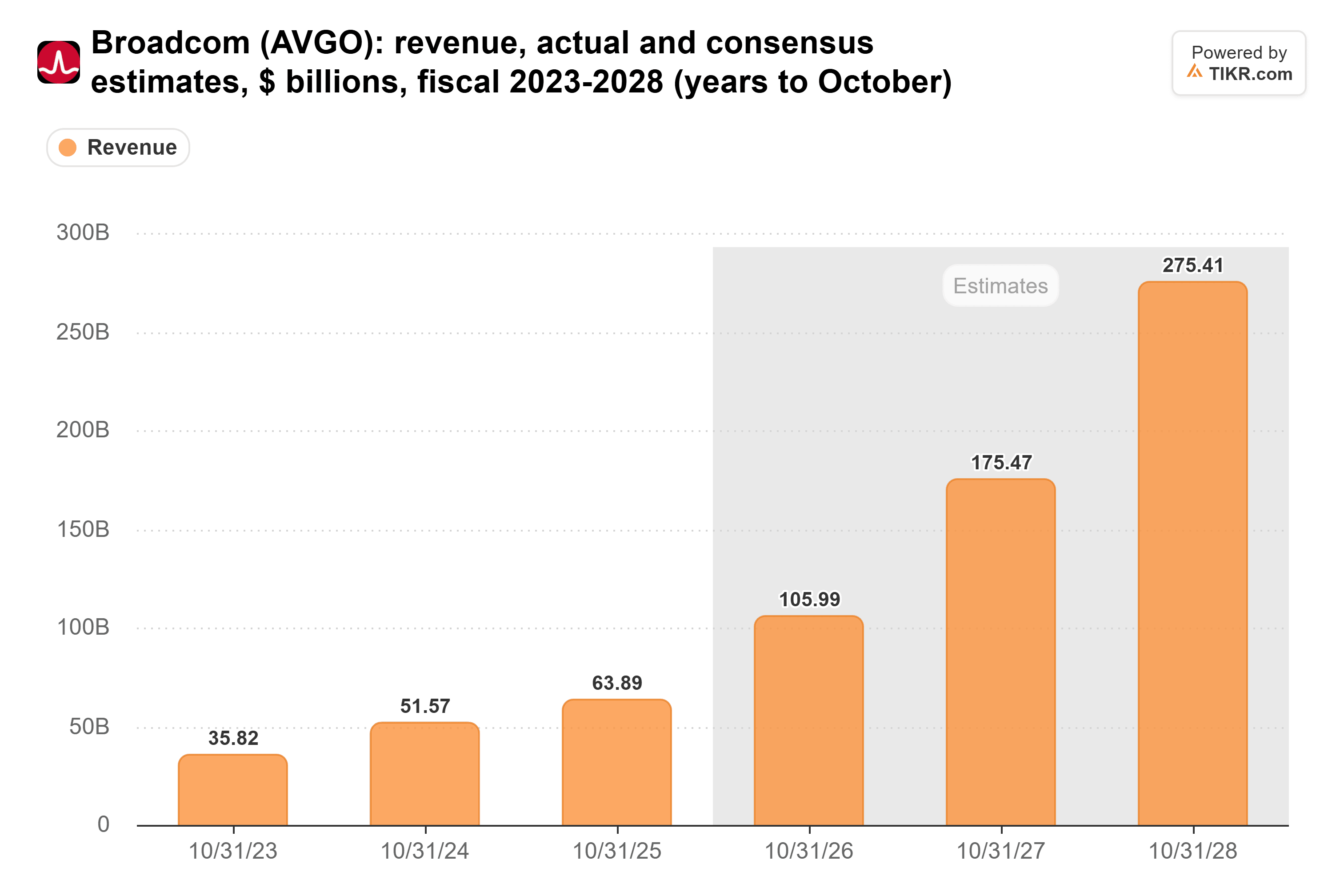
- Broadcom’s revenue could grow from $63.9 billion in fiscal 2025 to approximately $275 billion in fiscal 2028, according to TIKR consensus estimates as of November 4.
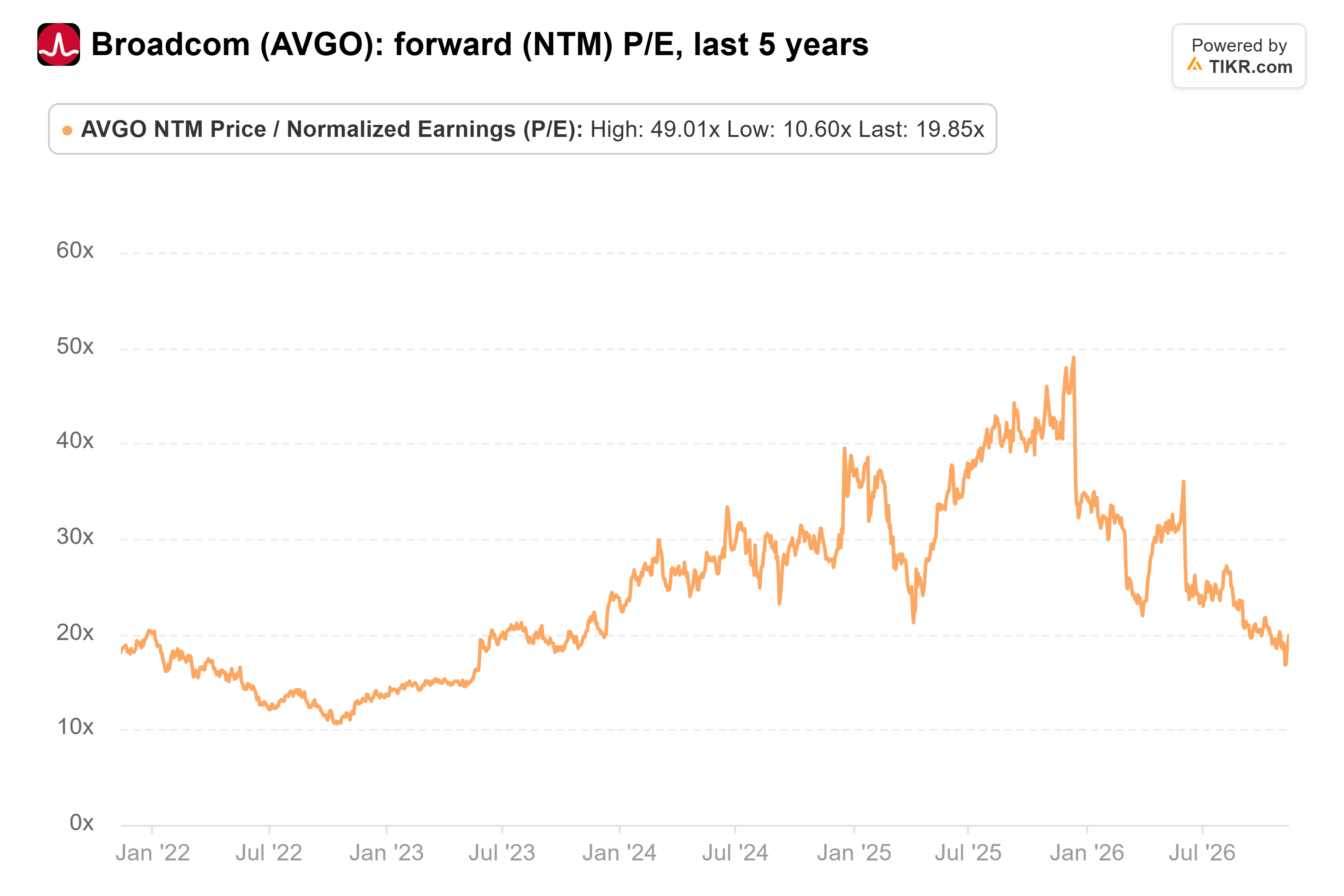
- Broadcom traded at 19.9x forward earnings on November 11, below its five-year average of 24.4x, but customer concentration and ambitious growth expectations remain significant risks.
What Happened?
Broadcom (AVGO) jumped 5.5% on November 12, closing at $364.36 after NVIDIA (NVDA) announced Jensen Huang’s departure as CEO, prompting investors to reassess which AI chipmakers could benefit.
Advanced Micro Devices (AMD) also rose approximately 5.7%, while Alphabet (GOOG) remains central to Broadcom’s AI opportunity through Google’s custom tensor processing units (TPUs).
Broadcom subsequently gave back those gains, closing at $333.40 on November 16, approximately 8.5% below its November 12 closing price.
In its November 12 announcement, NVIDIA confirmed Huang’s resignation and appointed CFO Colette Kress as interim CEO.
The leadership change also intensified debate about China’s access to advanced American AI chips.
One investor argued in a November 12 Reddit post that Broadcom was the better opportunity because its custom processors primarily serve major US cloud customers.
The poster wrote, “AVGO is the best play over AMD for Huangs ouster at NVDA.”
The China argument has become more relevant following new US restrictions on overseas access to advanced AI computing.
On November 16, the Trump administration introduced new restrictions targeting overseas data centers that provide significant computing capacity to customers in high-risk countries, including China.
The new rules restrict overseas data centers that provide substantial AI computing capacity to companies in China and introduce additional licensing requirements for advanced chip exports to several countries, including Malaysia, Singapore, and Thailand.
For Broadcom, the potential advantage is its focus on custom AI processors and networking equipment rather than competing solely in the merchant GPU market.
Under an April agreement with Google, Broadcom will develop future generations of Google’s TPUs and supply networking components for AI infrastructure through up to 2031.
The company’s third-quarter results demonstrate the scale of that opportunity.
Revenue increased 86% year over year to $29.6 billion, while AI semiconductor revenue surged 221% to $16.7 billion.
CEO Hock Tan said, “Demand for our custom AI accelerators and networking continues to be very strong.”
TIKR consensus estimates as of November 4 projected Broadcom’s revenue would rise from $63.9 billion in fiscal 2025 to approximately $275 billion in fiscal 2028, representing more than fourfold growth.
Still, Broadcom isn’t completely insulated from China.
Shipments to China and Hong Kong represented approximately 17% of fiscal 2025 revenue, although shipment destinations don’t necessarily identify the company’s ultimate customers.
And the new export restrictions aren’t automatically a win for Broadcom. They could affect customers’ deployment strategies across the broader AI industry.
Is Broadcom Stock Undervalued or Overvalued?
Broadcom looks relatively attractive against its historical forward earnings multiple, but that discount isn’t enough on its own to establish that the stock is undervalued.
According to TIKR, Broadcom traded at approximately 19.9x forward earnings on November 11, below its five-year average of 24.4x and December 2025 peak near 49x.
AMD traded at approximately 36.7x forward earnings on the same date, compared with its three-year average of 38.7x.

Broadcom trades at a substantially lower multiple, although differences in profitability, earnings growth, and business mix complicate the comparison.
The bigger concern is customer concentration.
According to Broadcom’s third-quarter fiscal 2026 filing, its five largest end customers accounted for approximately 55% of revenue, up from 40% a year earlier.
That dependence means delayed AI deployments, reduced customer spending, or financing difficulties could significantly affect its growth outlook.
Over the next 12 months, Google’s TPU deployments, hyperscaler capital spending, and Broadcom’s ability to convert AI infrastructure commitments into profits will be important earnings drivers.
Broadcom looks more attractive than AMD on this historical valuation comparison, but NVIDIA’s leadership disruption alone doesn’t guarantee additional orders or stronger earnings.
Ultimately, Broadcom’s investment case depends on delivering the growth investors already expect while managing the risks of relying on a small number of major AI customers.
So what is Broadcom stock actually worth?
TIKR lets you forecast the future price of any stock in less than a minute. Just enter a few assumptions into TIKR’s valuation model and see what Broadcom could be worth. Start from Wall Street consensus estimates, or adjust the inputs to reflect your own view of the business. It’s free to use.
Disclaimer:
Please note that the articles on TIKR are not intended to serve as investment or financial advice from TIKR or our content team, nor are they recommendations to buy or sell any stocks. We create our content based on TIKR Terminal’s investment data and analysts’ estimates. Our analysis might not include recent company news or important updates. TIKR has no position in any of the stocks mentioned. Thank you for reading, and happy investing!