Key Takeaways
- PepsiCo declared a $1.48 quarterly dividend on Nov. 18, part of a 4% raise to $5.92 a year, while British American Tobacco yields 5.6% to PepsiCo’s 4.3%.
- PepsiCo’s dividend grew 6.9% a year from fiscal 2020 to fiscal 2025, against 2.2% a year for British American Tobacco.
- Over the latest 12 months, British American Tobacco paid out 78% of its free cash flow in dividends and PepsiCo 75%, but PepsiCo carries far less debt.
- British American Tobacco is reportedly closing its South African cigarette plant because of illicit trade, and Bernstein downgraded PepsiCo on Nov. 17 over weak North American volumes.
If you’re buying a dividend stock to hold for 20 years, you want a check that keeps growing, from a company that can still afford it in 2046.
British American Tobacco (BTI) pays the bigger check today, with a 5.6% yield. PepsiCo (PEP) yields 4.3%, but it declared another raised dividend on Nov. 18.
So if I can only pick one for the next two decades, which one gets my money?
| Metric | British American Tobacco (BTI) | PepsiCo (PEP) |
|---|---|---|
| Dividend yield | 5.6% | 4.3% |
| Dividend per share, fiscal 2025 | £3.34 | $5.62 |
| Dividend growth, fiscal 2020-2025 | 2.2% a year | 6.9% a year |
| Cash dividend payout ratio (TTM) | 78% | 75% |
| Net debt/EBITDA | 2.9x | 2.0x |
| Interest coverage | 5.2x | 14.9x |
| Forward P/E | 12x | 17x |
Source: TIKR, at today’s prices. TTM is each company’s latest reported 12 months.
6 safe dividend stocks paying retirees 6%+ yields
There are over 100 stocks paying 6%+ annual dividends today.
But after an extensive investment review leveraging TIKR’s proprietary data, we now believe only six of them are truly safe for retirees.
They’re all yours as part of our new investment report. Learn more about how to get access right here.
BAT pays more, and raises it slowly
BAT’s newer products are driving its growth. Management expects its New Categories to grow at a mid-teens rate this year, and EPS growth toward the middle of its 5% to 8% range.
Dividends took 50% to 55% of free cash flow from fiscal 2021 to fiscal 2024. Then free cash flow fell to £5.79 billion in fiscal 2025 from £9.64 billion in fiscal 2024:
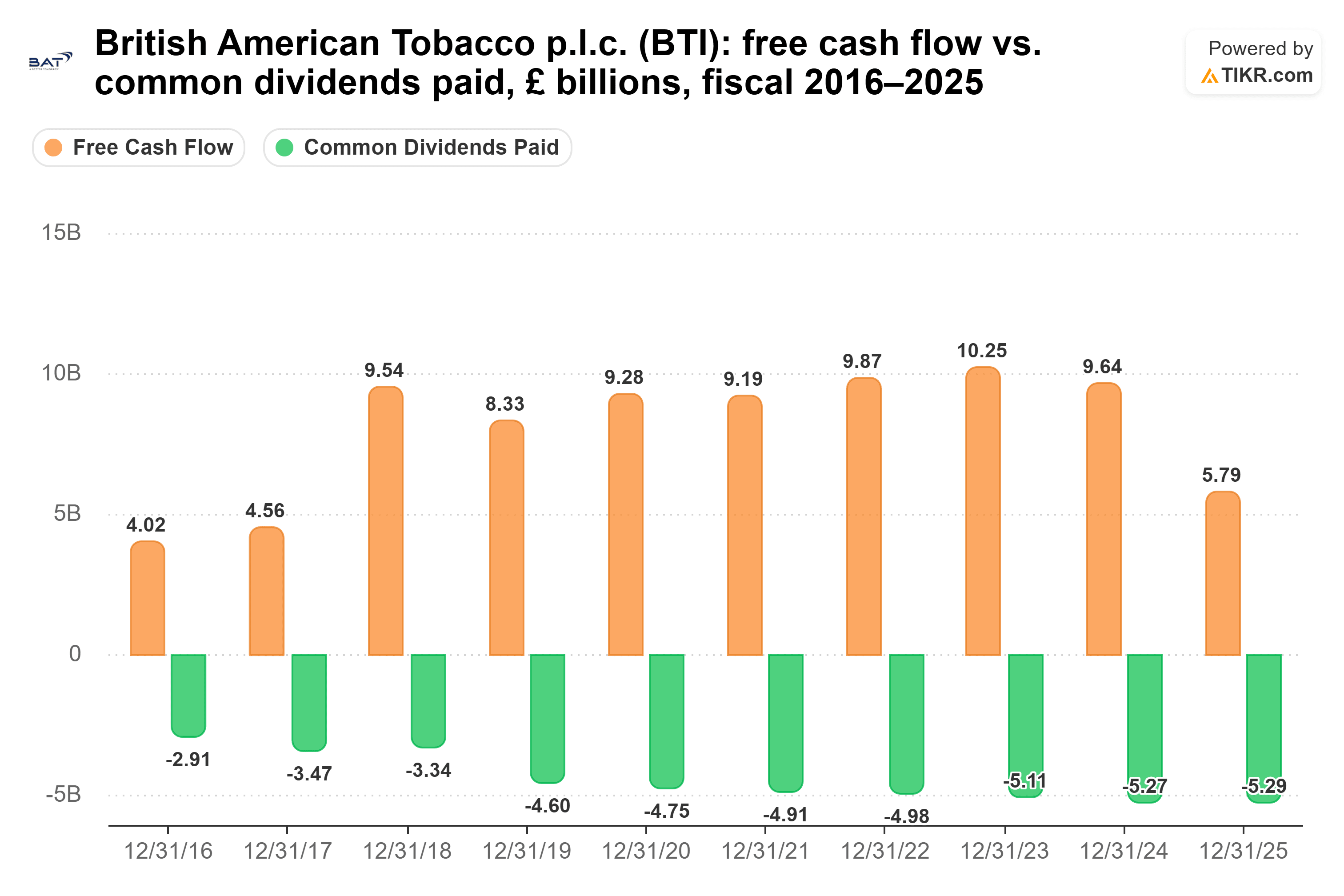
That pushed the cash dividend payout ratio to a risky 91% in fiscal 2025. Over the 12 months to June 30, 2026, it was back to 78%, and management expects cash conversion above 95% this year.
The dividend went from £2.99 a share in fiscal 2020 to £3.34 in fiscal 2025, or 2.2% a year. Those figures are in pounds, so the dollars a US holder collects also move with the exchange rate.
Illicit trade is the big risk. On Oct. 16, BAT was reported to be closing its South African cigarette plant, where illicit cigarettes are estimated to hold about 75% of the market.
PepsiCo grows its check faster
PepsiCo’s dividend went from $4.02 a share in fiscal 2020 to $5.62 in fiscal 2025, or 6.9% a year. The $1.48 quarterly dividend it declared on Nov. 18 continues the raise to $5.92 a year from $5.69 that started with the June payment, a 4% increase.
That growth has leaned hard on PepsiCo’s cash flow. Free cash flow was $7.62 billion in fiscal 2016 and $7.67 billion in fiscal 2025, while dividends paid rose from $4.23 billion to $7.64 billion:
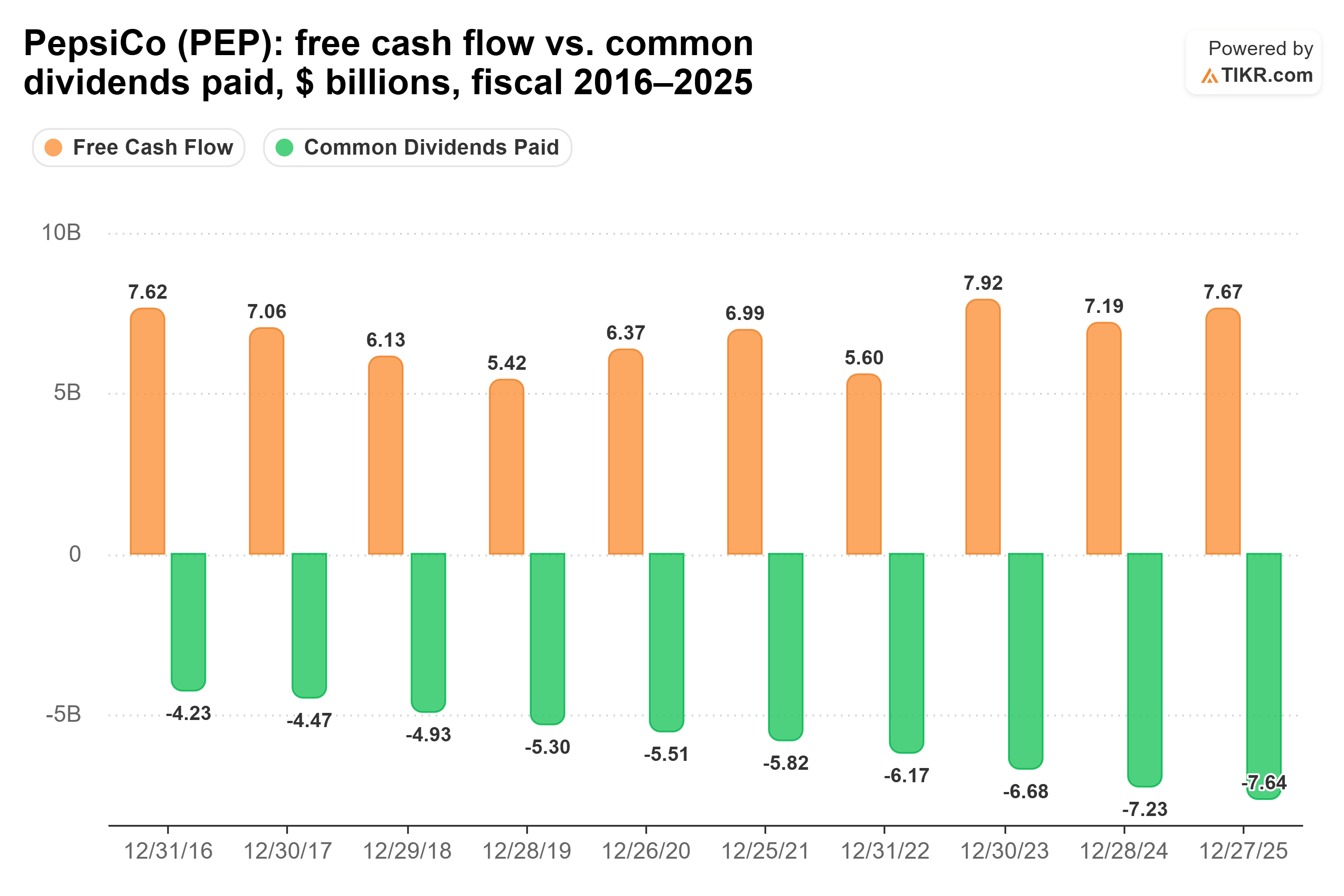
Dividends took a risky 99.6% of free cash flow in fiscal 2025. Over the latest 12 months, the payout ratio fell to a more comfortable 75%.
PepsiCo now expects net revenue to grow about 6% in fiscal 2026. It cut its core EPS guidance to 2.5%-3.5% from the low end of 5%-7%, as strength overseas runs into weak North American drinks and rising input costs. “We’re not satisfied with the performance in the U.S.,” CEO Ramon Laguarta said on the October call.
On Nov. 17, Bernstein downgraded PepsiCo to Underperform from Market Perform and cut its target to $128 from $131. It expects earnings misses as Frito-Lay North America and PepsiCo Beverages North America volumes fall.
So which dividend wins?
I’d hold PepsiCo for the next 20 years.
Over two decades, what matters most is whether the dividend can keep growing. PepsiCo has the faster-growing dividend, revenue that’s still climbing, and a far sturdier balance sheet: 2.0x net debt to EBITDA and 14.9x interest coverage, against 2.9x and 5.2x for BAT.
At each stock’s five-year rate, $10,000 in PepsiCo would pay about $1,536 in year 20, a 15.4% yield on your original cash, against about $853 for BAT. PepsiCo’s income passes BAT’s around 2032. Over the full 20 years, PepsiCo pays about $17,495 in all, against BAT’s $13,935. (BAT’s income is figured from its dividend in pounds.) PepsiCo’s latest raise was 4%, below its 6.9% pace, so that crossover could come later.
And you’re not paying up for PepsiCo. It trades at 17x forward earnings, well below its 10-year average of 21x:

This isn’t to say BAT’s dividend is in trouble. It pays the bigger check today, and it’s cheaper at 12x forward earnings. It’s just that, over 20 years, I’d rather own the faster-growing check backed by the stronger balance sheet.
Of course, PepsiCo still has to fix North America. If next year’s raise falls short of this year’s 4%, BAT’s bigger check will start to look better.
Forget PepsiCo: 6 safe 6%+ dividend yields you can buy right now
Dividends can hold the key to enormous wealth. But only if you buy the right ones.
Picking the right high-yield dividend stock can be the difference between a dream retirement…and scraping by every month, waiting for the next Social Security check to clear.
We’ve identified six stocks yielding 6%+ that we believe every retiree should know about right now. (And PepsiCo isn’t one of them.)
Disclaimer:
Please note that the articles on TIKR are not intended to serve as investment or financial advice from TIKR or our content team, nor are they recommendations to buy or sell any stocks. We create our content based on TIKR Terminal’s investment data and analysts’ estimates. Our analysis might not include recent company news or important updates. TIKR has no position in any of the stocks mentioned. Thank you for reading, and happy investing!