Key Takeaways
- BP yields 4.7% and Bristol Myers Squibb yields 4.1%, and both reported third-quarter results at the end of October.
- BP’s dividend took 31% of its free cash flow over the last reported twelve months, against 55% at Bristol Myers Squibb.
- Bristol Myers Squibb’s dividend per share grew 5.3% a year from fiscal 2015 to fiscal 2025, while BP’s fell from $0.40 to $0.33.
- Over 20 years, $10,000 in Bristol Myers Squibb pays more at its 5-year growth rate, and BP pays more at the pace each dividend grew in fiscal 2025.
BP (BP) completed the sale of 65% of its Castrol lubricants business on Nov. 2, collecting $6 billion after tax.
Bristol Myers Squibb (BMY) had its own good news a few days earlier. It raised its 2026 revenue guidance on Oct. 29, as its newer drugs grew faster than its older ones lost sales to generics.
Both yield more than 4%. But a dividend I hold for 20 years has to get through every oil crash and every lost patent along the way. So which one gets my dividend dollars?
| Metric | BP (BP) | Bristol Myers Squibb (BMY) |
|---|---|---|
| Dividend yield | 4.7% | 4.1% |
| Dividend growth, 5 years | 0.6% a year (fiscal 2020-2025) | 6.2% a year (fiscal 2020-2025) |
| Dividend growth, 10 years | -1.9% a year (fiscal 2015-2025) | 5.3% a year (fiscal 2015-2025) |
| Cash dividend payout ratio (TTM) | 31% | 55% |
| Net debt/EBITDA | 0.53x | 1.71x |
| Interest coverage | 5.98x | 9.87x |
Source: TIKR. Payout ratios for the twelve months to June 30, 2026 (BP) and Sept. 30, 2026 (Bristol Myers Squibb).
6 safe dividend stocks paying retirees 6%+ yields
There are over 100 stocks paying 6%+ annual dividends today.
But after an extensive investment review leveraging TIKR’s proprietary data, we now believe only six of them are truly safe for retirees.
They’re all yours for free as part of our new investment report, which you can access right here.
BP is paying down debt fast
BP’s third quarter of 2026 brought $14.8 billion of operating cash flow, and net debt fell $8.4 billion in the quarter to $13.9 billion. “So the dividend is the first call on capital,” CEO Meg O’Neill said on BP’s third-quarter call. The coverage backs her up: the dividend took a comfortable 31% of free cash flow over the twelve months to June 30, 2026. For US holders, the third-quarter dividend of 8.660 cents a share, up from 8.32 cents a year earlier, comes to $0.5196 per ADS.
Free cash flow has stayed above the dividend every year since fiscal 2021, but not before that:
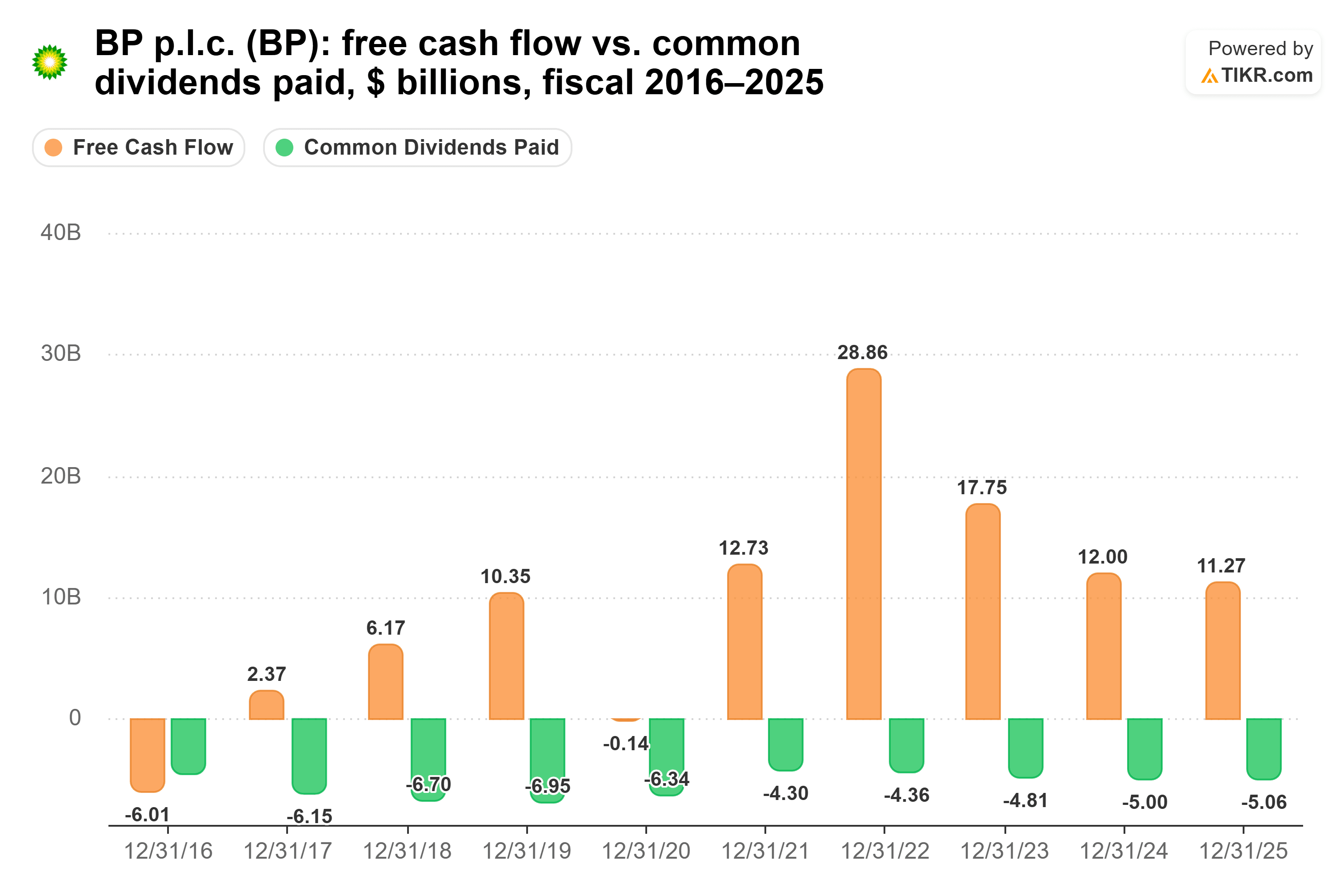
It fell short in four of the ten fiscal years shown, fiscal 2020 included (-$0.14 billion against $6.34 billion paid). Dividends paid then dropped to $4.30 billion in fiscal 2021. The dividend per share was still lower in fiscal 2025 ($0.33) than in fiscal 2015 ($0.40). And O’Neill said BP intends “to prioritize the use of excess cash flow to address our remaining Deepwater Horizon liabilities in full.”
Bristol Myers is outgrowing its generics
Bristol Myers Squibb’s cash has been far steadier than BP’s. Its third-quarter revenue rose 7% from a year earlier to $13.1 billion. Its Growth Portfolio climbed 12% to $7.7 billion and Eliquis grew 26%, more than offsetting generic competition that cut Revlimid sales 47%. Free cash flow has covered the dividend in every fiscal year since 2017:
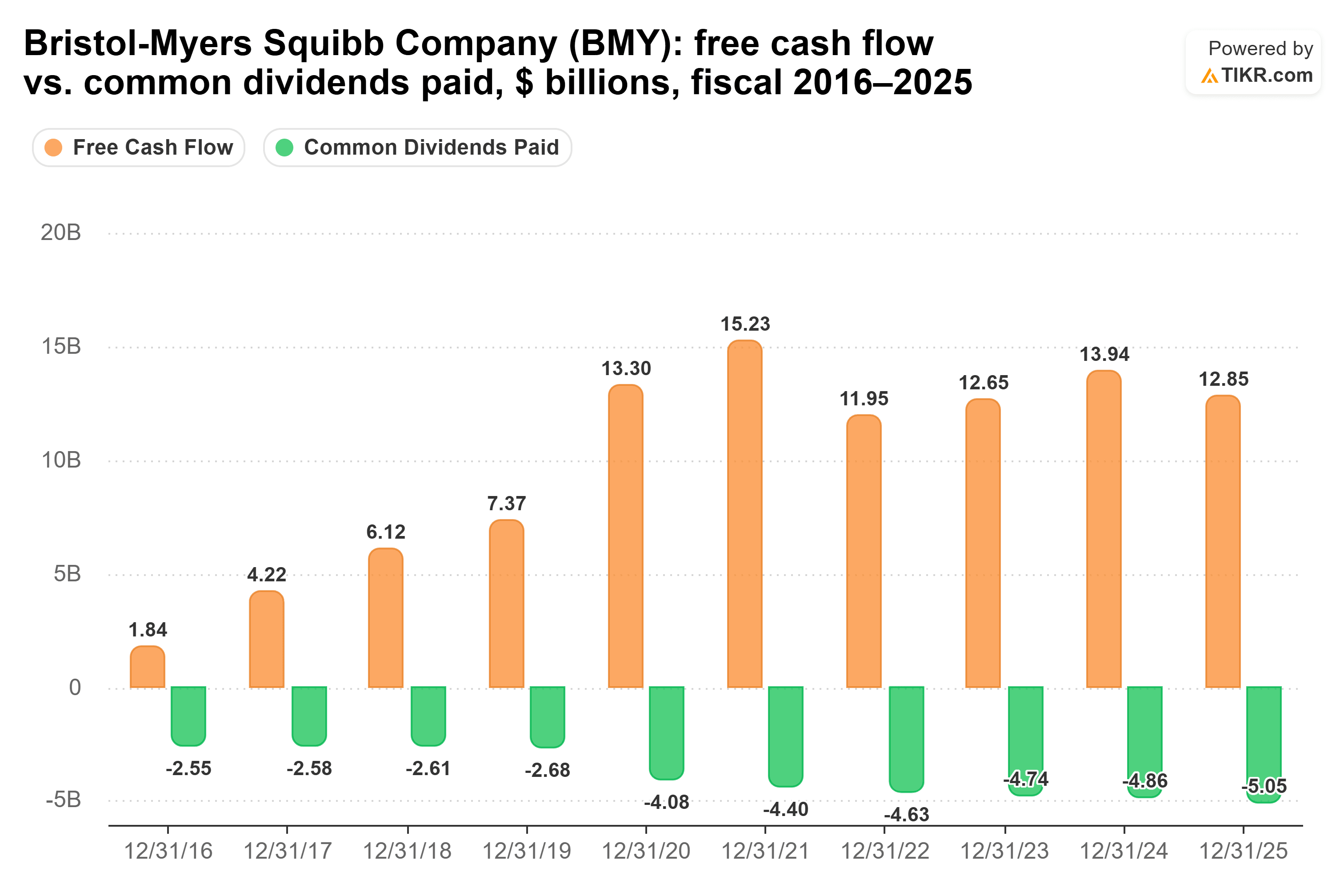
Over the decade, the dividend per share grew 5.3% a year, from $1.49 in fiscal 2015 to $2.49 in fiscal 2025. The cushion is thinner now. Free cash flow fell from $12.9 billion in fiscal 2025 to $9.29 billion over the twelve months to Sept. 30, 2026, lifting the cash dividend payout ratio from 39% to 55%. CFO David Elkins said business development “remains a priority” alongside “our commitment to the dividend,” so a big deal would compete for the same cash. And the company expects Eliquis revenue to step down by $1.5 billion to $2 billion in 2027.
So which dividend wins?
Bristol Myers Squibb gets my dividend dollars for the next 20 years. Over that long, I care most about whether the check survives the bad years. Bristol Myers’ free cash flow covered its dividend in nine of the last ten fiscal years, and BP’s covered it in six. At its 5-year growth rate, $10,000 in Bristol Myers pays about $15,472 over the 20 years, against about $9,972 from BP.
The math flips at each dividend’s pace now. BP raised its dividend per share 6.5% in fiscal 2025, while Bristol Myers raised its dividend just 2.9%. At those rates, BP pays about $18,152 over 20 years against about $10,897. BP also has the wider coverage, the lighter debt and the bigger yield today.
It’s just that BP needs two decades of friendly oil prices to keep raising at that pace, and it hasn’t had them before. The last time its free cash flow fell short, its dividend shrank the next year. I’d rather lean on Bristol Myers’ growing drug sales.
Of course, Bristol Myers expects its readout for milvexian in atrial fibrillation in the first quarter of 2027. A miss would leave less to replace the Eliquis sales it expects to lose.
Forget Bristol Myers Squibb: 6 safe 6%+ dividend yields you can buy right now
Dividends can hold the key to enormous wealth. But only if you buy the right ones.
Picking the right high-yield dividend stock can be the difference between a dream retirement…and scraping by every month, waiting for the next Social Security check to clear.
We’ve identified six stocks yielding 6%+ that we believe every retiree should know about right now. (And Bristol Myers Squibb isn’t one of them.)
Disclaimer:
Please note that the articles on TIKR are not intended to serve as investment or financial advice from TIKR or our content team, nor are they recommendations to buy or sell any stocks. We create our content based on TIKR Terminal’s investment data and analysts’ estimates. Our analysis might not include recent company news or important updates. TIKR has no position in any of the stocks mentioned. Thank you for reading, and happy investing!