Key Takeaways
- Bloom Energy fell as much as 12% on Nov. 25 in a broad AI selloff, the morning the cost of insuring Oracle’s debt hit a record, before closing down 2.25%.
- The warrant Bloom gave Oracle left a $306.5 million asset that comes off revenue only as Oracle-related systems ship.
- Only $17.3 million had come off by Sept. 30, 2026, so most of the payoff depends on Oracle building its sites.
- Vertiv sells into the same build-out, and Bloom’s fourth-quarter report early next year will show how much more of the Oracle asset has shipped.
Bloom Energy (BE) fell as much as 12% on Wednesday, Nov. 25, as the AI selloff deepened. It then recovered most of the loss with the broader market and closed down 2.25% at $152.89. The day’s coverage blamed tariff threats, doubts about AI spending and a slide in Asian chip stocks. Baird also cut its price target to $263 from $351. Separately, on Nov. 24, Hunterbrook Media said it had tracked China-linked scandium fuel cell parts to a warehouse Bloom uses. Hunterbrook’s affiliated fund has disclosed a short position in Bloom, and Bloom rejected Hunterbrook’s earlier scandium claims in a July filing.
But one thing matters more for Bloom. The cost of insuring the debt of Oracle (ORCL) hit a record 356 basis points, according to S&P Global Market Intelligence. Oracle shares fell as much as 9% before closing down 5.13%. Vertiv (VRT), another power and cooling supplier to AI data centers, fell as much as 8% before closing nearly flat.
Bloom already paid for the Oracle business
Bloom issued Oracle a warrant on April 9, 2026, for up to 3.53 million shares at $113.28, as part of their fuel-cell supply deal. Oracle exercised it without cash on May 1, and Bloom issued 2.15 million shares. That count includes 248,798 extra shares Bloom added to get Oracle to settle that way. By April, Oracle had already contracted 1.2 gigawatts of Bloom’s fuel cells under a master agreement for up to 2.8 gigawatts.
Bloom valued those shares at $323.9 million and booked them as a customer consideration asset, deducted from revenue as Oracle-related systems ship. By Sept. 30, 2026, only $17.3 million had come off, which leaves $306.5 million. Bloom won’t get most of what it paid for until Oracle’s sites go up.
Those sites matter because analysts expect Bloom’s revenue to more than triple, from $2.02 billion in 2025 to $7.19 billion in 2027.
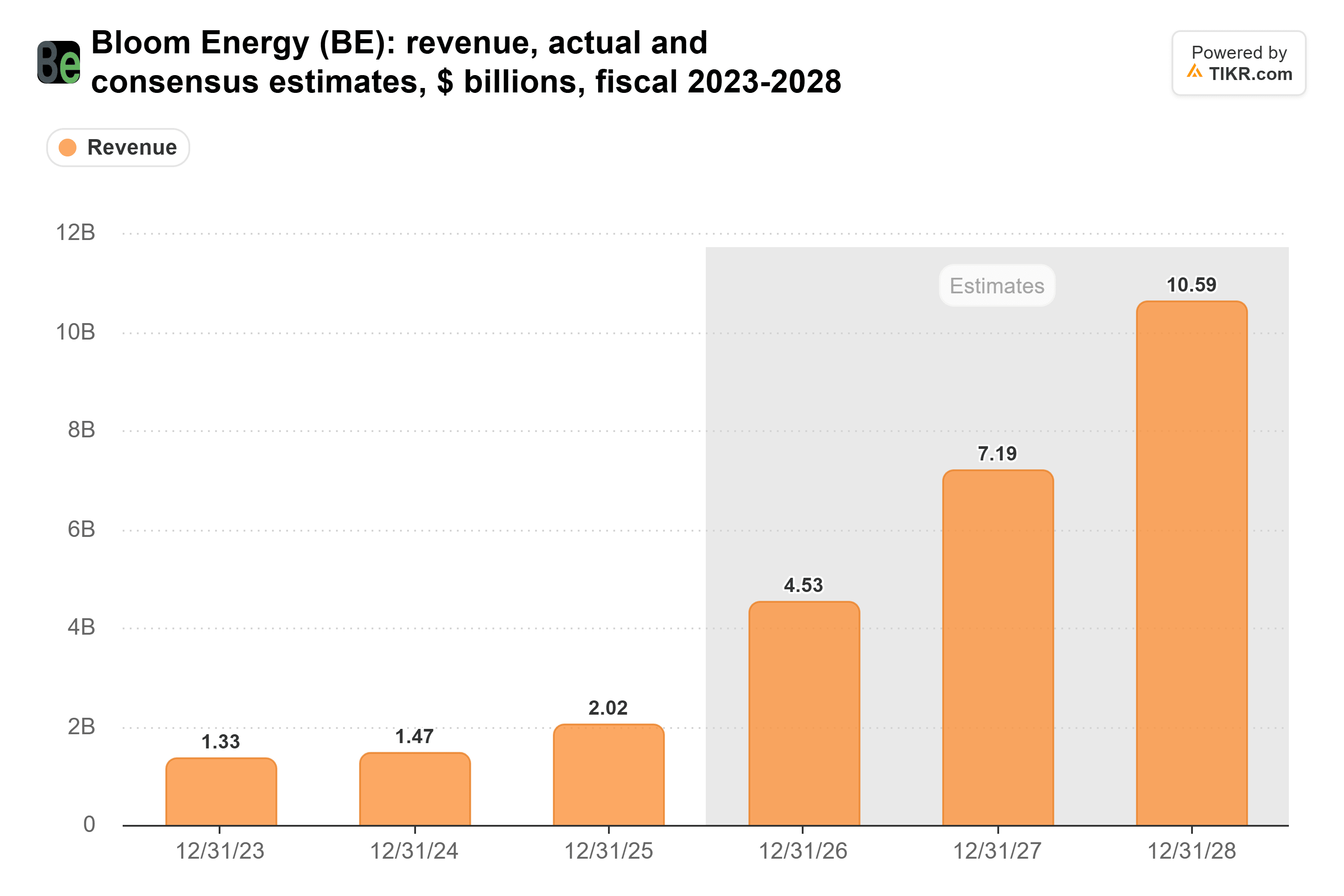
Those estimates were set before the latest selloff, and they assume big customers like Oracle keep building.
TIKR tracks 29 analysts on Bloom Energy. How many say “Buy”?
See the full breakdown of Buy, Hold, and Sell ratings on Bloom Energy, along with Wall Street’s revenue and earnings estimates, all in one place. More than 500,000 investors use TIKR to research stocks like this one. See Bloom Energy’s Analyst Ratings
Oracle’s build-out is eating its cash
Oracle’s free cash flow has been negative in seven of the last eight quarters:
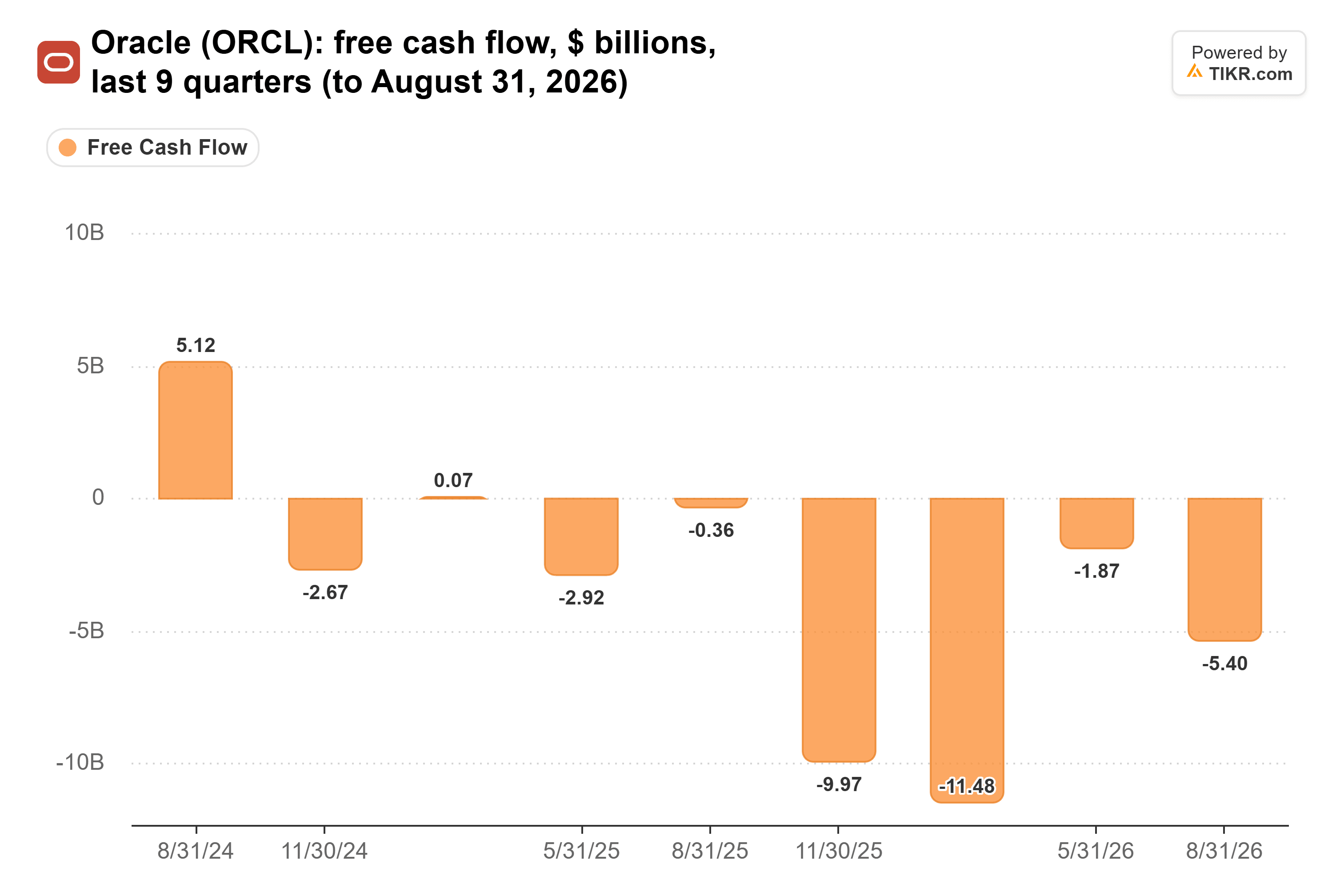
Over the four quarters to Aug. 31, 2026, Oracle’s free cash flow came to negative $28.7 billion. George Noble, managing partner of Noble Capital Advisors, said on the Nov. 25 episode of Prof G Markets that his fund has been short CoreWeave. On Oracle, he said: “I think there’s a reasonable chance Oracle goes bankrupt.”
Brookfield helps, but Oracle still has to build
Oracle’s credit doesn’t always hit Bloom directly. Bloom’s 10-Q describes the warrant as consideration paid to “a customer’s customer.” Its biggest buyers are often financiers that own the systems. Two customers made up 43% and 26% of its third-quarter revenue, and the second was Bloom’s related-party ventures with Brookfield. On June 30, Brookfield raised its financing framework for Bloom projects fivefold, to $25 billion. If financiers like those own the systems at Oracle’s sites, Bloom gets paid by them, one step removed from Oracle’s bonds.
But the warrant asset comes off only as Oracle’s systems ship, whoever pays. If Oracle slows down, the shares Bloom gave away are already gone.
Vertiv’s link is less direct, with no contract like Bloom’s. It reported a huge quarter on Oct. 28: third-quarter net sales rose 61% to $4.31 billion, and it raised its 2026 net sales guidance to $14.65 billion at the midpoint. The question is whether customers who borrow to build keep ordering at that pace.
Watch the Oracle asset
The Nov. 25 swing looked more like the AI selloff than a verdict on Oracle, and the accounting won’t sink Bloom. The $306.5 million left is about 4% of the $7.19 billion of revenue analysts expect in 2027. The bigger exposure is the 1.2 gigawatts of Oracle orders behind it.
At 32x forward earnings as of the Nov. 24 close, Bloom trades well below the 76x it averaged at quarter-ends from September 2023 to September 2026. That discount holds up only if the estimates do.
Bloom’s fourth-quarter report early next year is the next test. If the Oracle deductions climb well past $17.3 million, Oracle’s sites are going up on schedule. If they barely move, Oracle may be slowing down, and that is the risk that matters most.
So what is Bloom Energy stock actually worth?
TIKR lets you forecast the future price of any stock in less than a minute. Just enter a few assumptions into TIKR’s valuation model and see what Bloom Energy could be worth. Start from Wall Street consensus estimates, or adjust the inputs to reflect your own view of the business. It’s free to use.
Disclaimer:
Please note that the articles on TIKR are not intended to serve as investment or financial advice from TIKR or our content team, nor are they recommendations to buy or sell any stocks. We create our content based on TIKR Terminal’s investment data and analysts’ estimates. Our analysis might not include recent company news or important updates. TIKR has no position in any of the stocks mentioned. Thank you for reading, and happy investing!