Key Takeaways
- Steve Eisman says 70% of Microsoft, Amazon and Alphabet’s AI revenue comes from Anthropic and OpenAI.
- That makes the hyperscalers’ AI growth a concentrated bet on whether two customers can keep raising money.
- Microsoft’s capex reached $116 billion in fiscal 2026, and Broadcom’s AI chip growth depends on the same buildout.
- Anthropic’s $93.5 billion IPO eases the risk for now, which leaves OpenAI, about 45% of Microsoft’s backlog at the end of 2025, as the lab to watch.
Microsoft (MSFT), Amazon (AMZN) and Alphabet (GOOG) have spent hundreds of billions of dollars on AI data centers. According to Steve Eisman, most of the AI revenue meant to pay for them comes from just two customers.
On the Nov. 27 weekly wrap of his podcast, The Real Eisman Playbook, the investor made famous by The Big Short said:
“According to varied Wall Street reports, 70% of the three large hyperscalers AI revenue is from just Anthropic and OpenAI.”
That’s a lot of eggs in two baskets.
One of those baskets, Anthropic (ANT), went public this month. The same two labs also matter to Broadcom (AVGO), which designs Google’s TPU chips, supplies TPU computing capacity to Anthropic and has started shipping OpenAI’s first custom AI chip.
Two labs, $2 trillion of promises
Eisman’s bigger worry is what the two labs have promised to pay. He says both lose a lot of money, have no moats and are now in a price war, and that their compute commitments sit in footnotes, off everyone’s balance sheet.
His summary: “combined, they have $2 trillion in future commitments. They are the Achilles heel of the AI story.”
If either lab stumbles, he expects the whole buildout to feel it: “If either Anthropic or OpenAI fail, then AI CapEx would slow down enormously.”
TIKR tracks 58 analysts on Microsoft. How many say “Buy”?
See the full breakdown of Buy, Hold, and Sell ratings on Microsoft, along with Wall Street’s revenue and earnings estimates, all in one place. More than 500,000 investors use TIKR to research stocks like this one. See Microsoft’s Analyst Ratings
The bill is already here
The spending those labs are supposed to pay for has already been made. Microsoft’s capital spending grew almost 5x in four fiscal years:
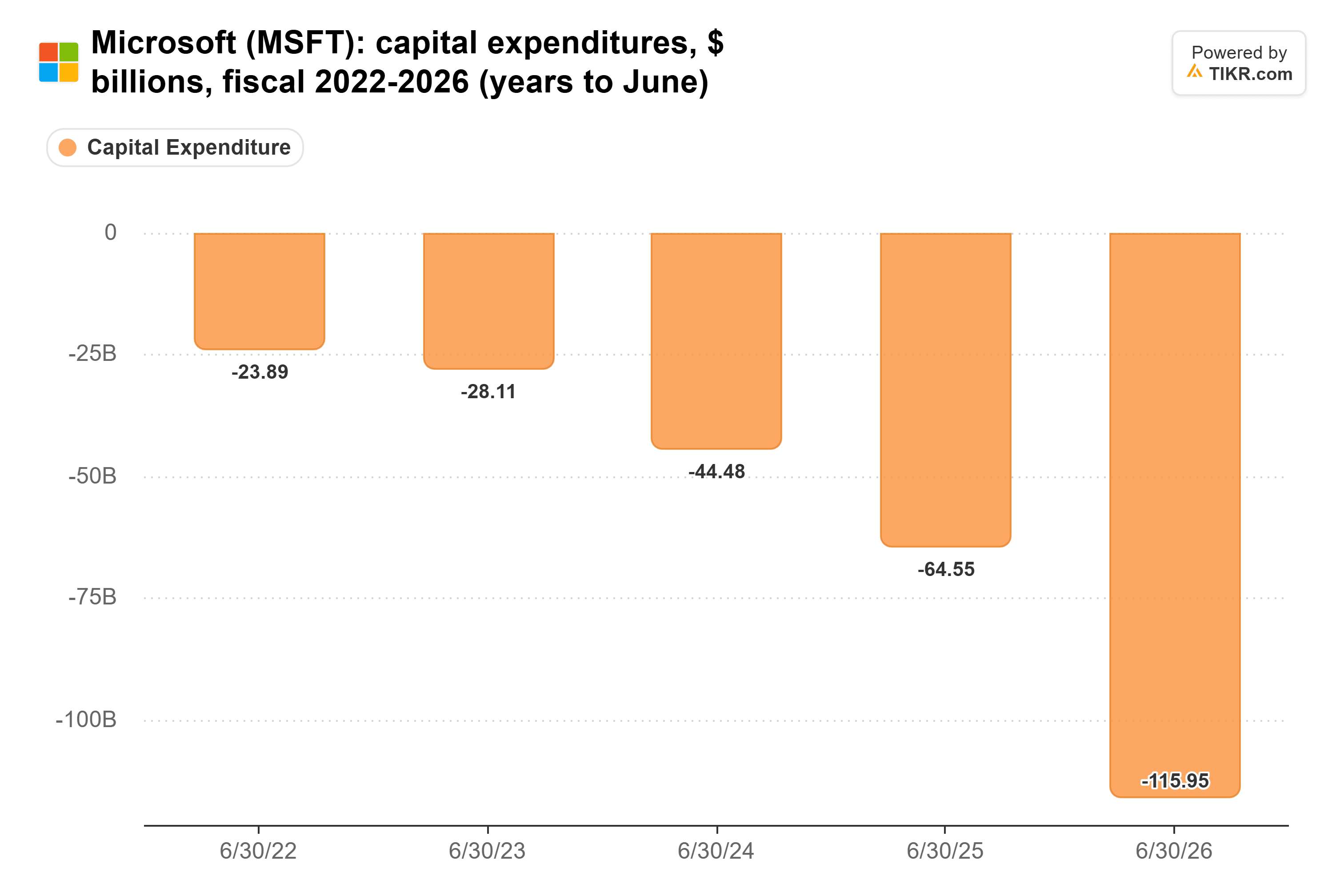
That counts only cash spent on property and equipment. Microsoft’s own capex figure is bigger, because it also includes finance leases for data center sites.
Amazon’s free cash flow was still positive in 2025, but it fell to $7.7 billion from $32.9 billion in 2024:
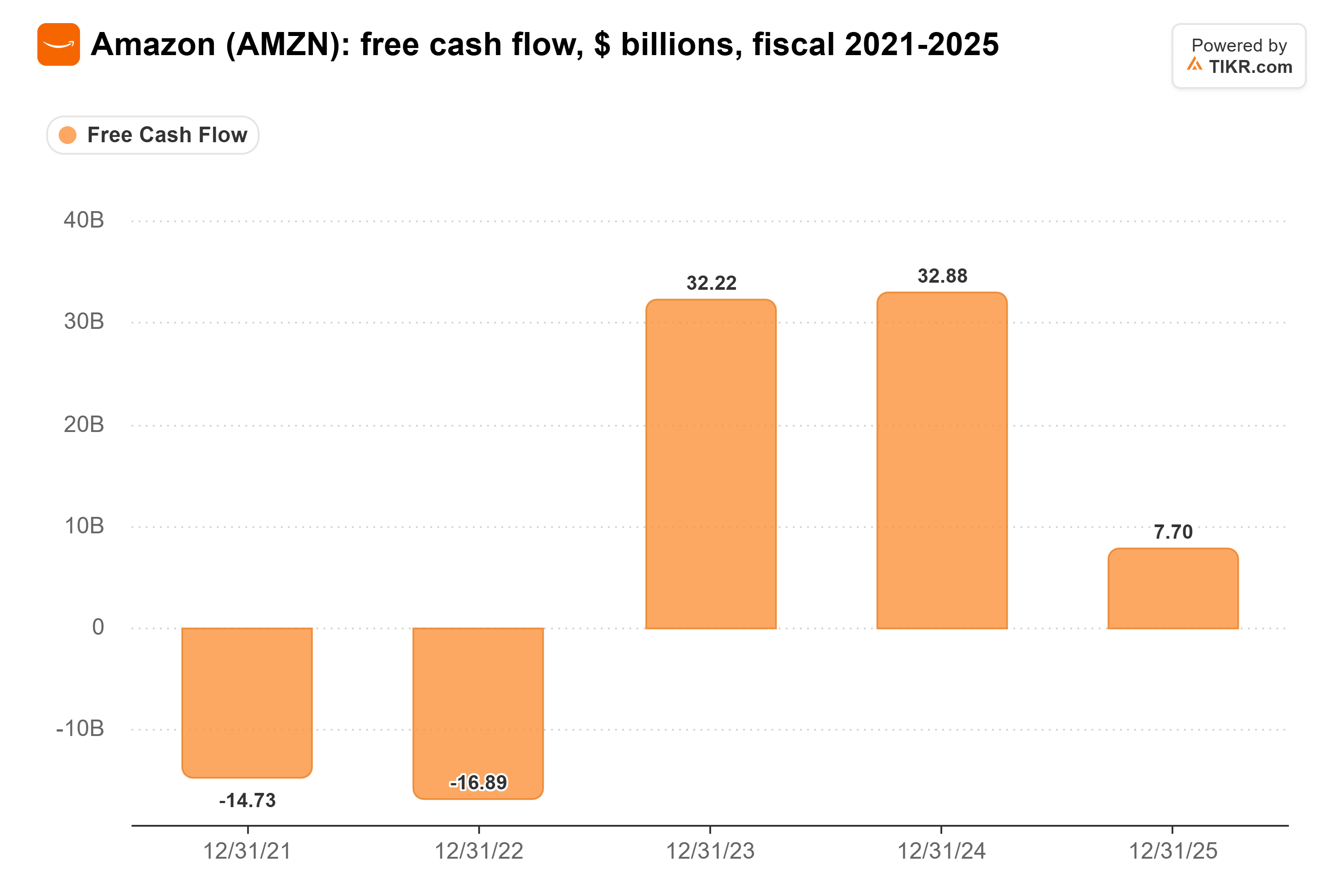
It has since turned negative. On its own measure, Amazon reported a free cash outflow of $42.4 billion for the 12 months to Sept. 30, 2026. That is the kind of turn Eisman means when he says most hyperscalers have gone cash-flow negative.
Alphabet’s capex grew nearly 4x from 2021 to 2025:

Microsoft’s revenue is safer than its backlog
Management said nearly 90% of fiscal 2026 Microsoft Cloud revenue came from customers other than frontier model companies. That’s a wider base than Eisman’s AI revenue, since it includes Microsoft 365, but it puts the frontier labs at only about a tenth of today’s sales.
That tenth is growing, though. Microsoft’s latest quarterly filing shows $10.0 billion of revenue from its OpenAI arrangements in the September quarter alone, compared with $24.1 billion for all of fiscal 2026.
The backlog is a different picture. At the end of 2025, OpenAI made up about 45% of Microsoft’s $625 billion commercial backlog, or roughly $280 billion of contracted revenue still to come. Excluding OpenAI, the backlog grew 25% in the year to June 2026, against 84% in total. So most of the fastest growth in Microsoft’s future revenue comes from one lab. By Sept. 30, the total backlog stood at $677 billion, up 73%.
Anthropic just bought some time
Anthropic’s IPO raised $93.5 billion at $83 a share once underwriters bought their extra shares, the company said in a regulatory filing. Seven companies bought another $26 billion of stock at the same price. That’s a lot of cash to put toward compute bills.
Public investors were more cautious than the order book. The stock opened its Nov. 19 debut at $111.50 but closed at $97.17, 17% above the IPO price.
OpenAI is still private, so both labs have to keep raising money until their revenue catches up with what they’ve committed to spend.
Broadcom faces the same question from the chip side. Its AI semiconductor revenue was $16.7 billion in the quarter ended Aug. 2, up 221% from a year earlier. When it reports after the close on Dec. 9, the question is how much of that growth comes from the two labs.
Eisman looks right about where the risk is, and for now it sits in the hyperscalers’ backlogs more than in their current revenue. The next test is whether Microsoft’s backlog outside OpenAI keeps growing near 25% when it reports again in late January.
So what is Microsoft stock actually worth?
TIKR lets you forecast the future price of any stock in less than a minute. Just enter a few assumptions into TIKR’s valuation model and see what Microsoft could be worth. Start from Wall Street consensus estimates, or adjust the inputs to reflect your own view of the business. It’s free to use.
Disclaimer:
Please note that the articles on TIKR are not intended to serve as investment or financial advice from TIKR or our content team, nor are they recommendations to buy or sell any stocks. We create our content based on TIKR Terminal’s investment data and analysts’ estimates. Our analysis might not include recent company news or important updates. TIKR has no position in any of the stocks mentioned. Thank you for reading, and happy investing!