Key Takeaways
- Of the 460 big funds that have filed 13Fs for the quarter ended Sept. 30, 9 bought Merck (MRK) and 15 sold, led by Harris Associates’ sale of about $1.08 billion of shares.
- Some of the same funds were also moving money in Eli Lilly (LLY) and Johnson & Johnson (JNJ), which trade at much higher multiples of forward earnings than Merck.
- Analysts expect Merck to earn $8.96 a share in 2027, flat with 2025, and Keytruda’s key U.S. patent expires in December 2028.
- For now, the sellers have the better case, and Merck’s 2027 guidance in early February is the next test.
If you own Merck, the big money split on it last quarter, and the sellers moved far more of it.
Of the 460 big funds that have filed 13Fs for the quarter ended Sept. 30 (well-known funds, or ones with $1 billion or more of US stocks, quant and index funds aside), nine bought Merck, either opening a stake or adding 20% or more. Another 15 sold out or cut by 20% or more, and 51 held it at the quarter’s end.
Some of them were reshuffling their drug stocks, too. Integral Health Asset Management added Merck and sold out of Eli Lilly. Jeremy Grantham’s GMO, one of the biggest sellers, holds far more Johnson & Johnson than Merck: $1.84 billion against $730 million at the quarter’s end.
The sellers moved the real money
Bill Nygren’s Harris Associates, which manages $109 billion and runs the Oakmark funds, made the biggest move. Its 13F for the quarter ended Sept. 30, filed Nov. 16, shows it cut Merck 62%, from 12.07 million shares to 4.64 million.
That’s about $1.08 billion of stock at quarter-end prices. The shares it kept were worth $675 million, 0.9% of its 13F holdings.
GMO, which manages $81 billion, cut its stake 26% to 5.02 million shares, about $256 million at quarter-end prices, per its 13F filed Nov. 13.
Mondrian Investment Partners cut 60%, about $129 million, and ARGA Investment Management and Farallon Capital Management sold out.
None of the nine buyers added more than $20 million.
TIKR tracks 28 analysts on Merck. How many say “Buy”?
See the full breakdown of Buy, Hold, and Sell ratings on Merck, along with Wall Street’s revenue and earnings estimates, all in one place. More than 500,000 investors use TIKR to research stocks like this one. See Merck’s Analyst Ratings
The buyers made Merck a bigger bet
The buyers are much smaller firms, but some made Merck a big position. Norris Perne & French, which manages $2.69 billion, raised its stake 78% to 311,151 shares, about $20 million added at quarter-end prices, per its 13F filed Oct. 23. Merck is now its No. 13 holding, at 2.0% of its 13F holdings.
Integral Health Asset Management, which manages $1.87 billion, added 29% to reach 450,000 shares, about $15 million more, per its 13F filed Nov. 16. That makes Merck its No. 5 holding, at 4.0% of its 13F holdings.
Prices since then haven’t helped the buyers. Since Sept. 30, Merck is down 3%, while Lilly is up 20% and J&J is up 4%. That’s the price change alone: a 13F doesn’t show what anyone paid.
Merck’s earnings go sideways until 2028
Merck’s problem is the calendar. Keytruda brought in $31.7 billion of Merck’s $65.0 billion of sales in 2025. The drug’s key U.S. patent expires in December 2028, and Merck expects Medicare’s set price for it to start in January 2029.
Analysts don’t expect much earnings growth before then:

The 2026 dip comes mostly from $5.93 a share of charges for buying Cidara and Terns. 2027 is the bigger worry.
Its $8.96 consensus is flat with 2025’s $8.98, and it was $9.26 in late October.
On the Q3 call, CFO Caroline Litchfield flagged over $2 billion of generic headwinds for 2027. She also said of analysts’ estimates that “some have incorporated the messaging that we’ve given, many have not yet.”
Investors still pay more than usual for those earnings:
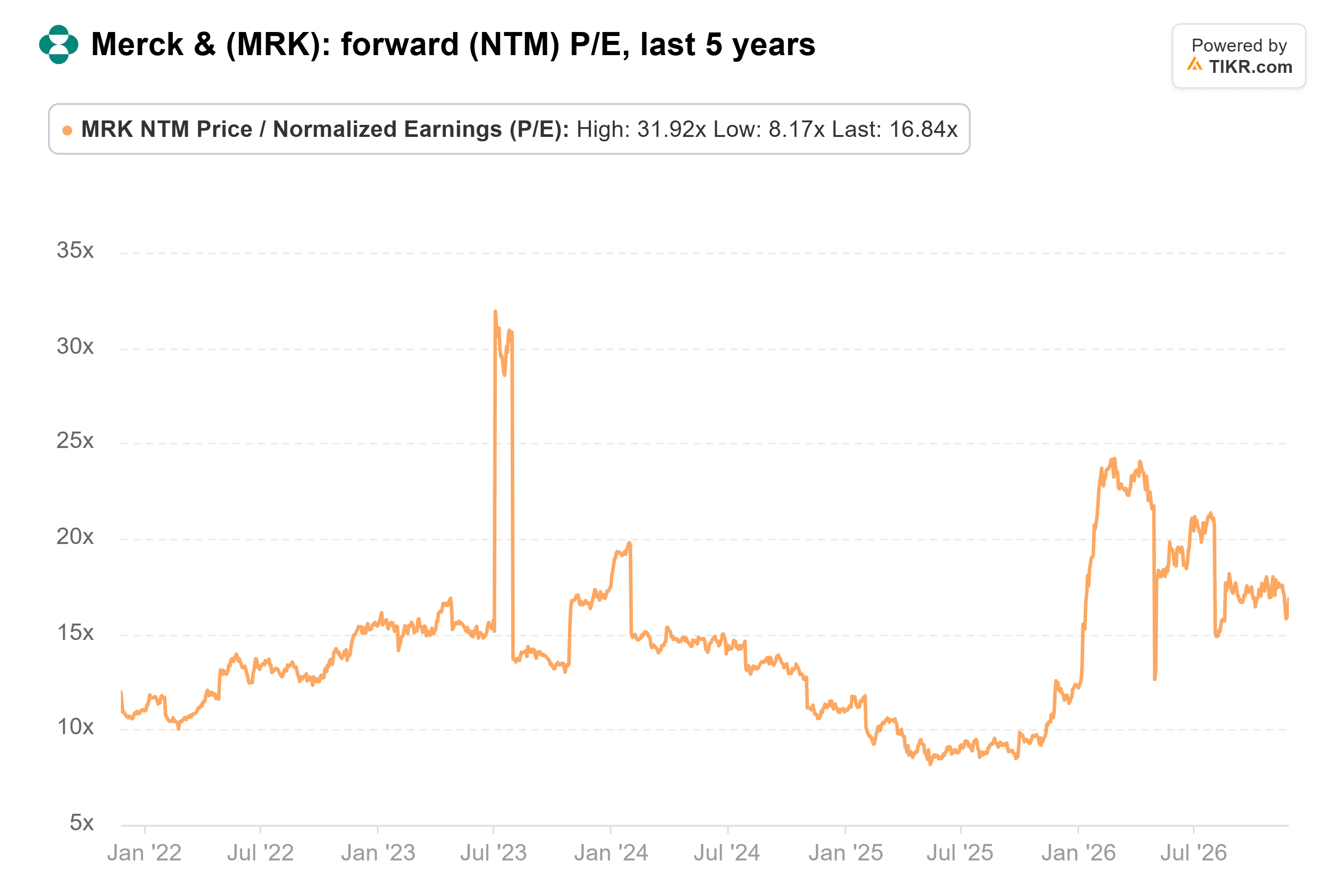
At 17x forward earnings, Merck sits above its five-year average of 14x, though well below Lilly at about 30x and J&J at about 25x.
The Street’s average target has climbed with the stock:
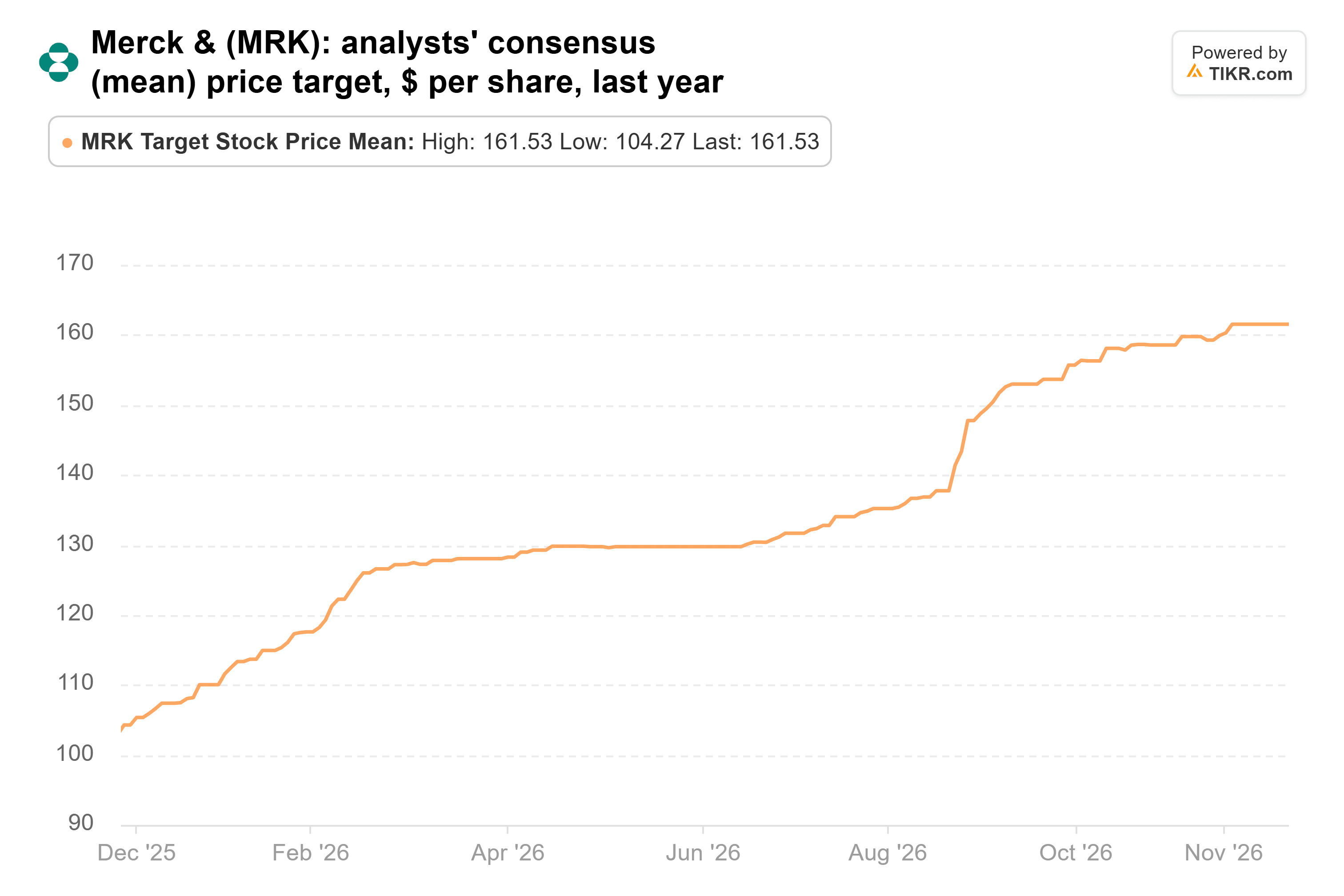
The average target is $161.53 today, up from $104.27 a year ago and 16% above the last close.
By our math, that target is about 16x 2028’s $9.96 consensus. Today’s price is about 14x, right at the stock’s five-year average.
The sellers have the better case for now
The buyers have a real case.
Keytruda Qlex, the under-the-skin version with a U.S. patent to 2043, grew from $35 million in sales in Q4 2025 to $463 million in Q2 2026.
A German appeals court overturned an injunction against it on Nov. 19. Alongside Keytruda, Merck’s personalized cancer vaccine cut the risk of melanoma recurrence or death by 42%. And the 2.5% dividend took a well-covered 66% of free cash flow over the 12 months to Sept. 30.
But the pipeline has had setbacks too. Merck stopped developing nemtabrutinib, a blood cancer drug, after a Phase 3 trial review.
Still, I side with the sellers. Earnings won’t grow until 2028, estimates are still slipping and Keytruda’s patent ends that December, so paying 17x leaves little room for another setback. At 14x 2028’s estimates, Merck looks fairly priced to me, and that’s a thin cushion a year before the patent runs out.
Merck’s Q4 report in early February should bring its 2027 guidance. If Merck guides 2027 EPS at or above the $8.96 consensus, the buyers will have the better of it. The funds’ next 13Fs, for the December quarter, are due by mid-February.
So what is Merck stock actually worth?
TIKR lets you forecast the future price of any stock in less than a minute. Just enter a few assumptions into TIKR’s valuation model and see what Merck could be worth. Start from Wall Street consensus estimates, or adjust the inputs to reflect your own view of the business. It’s free to use.
Disclaimer:
Please note that the articles on TIKR are not intended to serve as investment or financial advice from TIKR or our content team, nor are they recommendations to buy or sell any stocks. We create our content based on TIKR Terminal’s investment data and analysts’ estimates. Our analysis might not include recent company news or important updates. TIKR has no position in any of the stocks mentioned. Thank you for reading, and happy investing!