Key Takeaways
- U.S. Bancorp yields 3.9% after raising its quarterly dividend 3.8% in June, while Huntington Bancshares yields 4.3% and held its dividend flat in October.
- Coverage is close: analysts’ fiscal 2026 estimates put each bank’s dividend at 40% of normalized EPS.
- U.S. Bancorp’s dividend grew 4.0% a year from fiscal 2020 to fiscal 2025, against 0.7% a year for Huntington’s.
- The risks to watch are U.S. Bancorp’s sudden change of chief risk officer and Huntington’s higher charge-offs.
Any retiree hunting for dividend income from bank stocks is going to look at U.S. Bancorp (USB) and Huntington Bancshares (HBAN). On June 24, U.S. Bancorp raised its quarterly dividend 3.8% to $0.54 a share.
On Oct. 22, Huntington kept its quarterly dividend at $0.155 a share. That still leaves it with a 4.3% yield, against 3.9% for U.S. Bancorp. A retiree wants a check they can count on, so the choice comes down to two things: the bigger yield today, or the dividend that keeps growing.
| Metric | U.S. Bancorp (USB) | Huntington Bancshares (HBAN) |
|---|---|---|
| Dividend yield | 3.9% | 4.3% |
| Annual dividend | $2.16 | $0.62 |
| Dividend growth, fiscal 2020-2025 | 4.0% a year | 0.7% a year |
| Dividend growth, fiscal 2015-2025 | 7.3% a year | 9.5% a year |
| Payout ratio of normalized EPS, fiscal 2025 | 44% | 42% |
| Payout ratio of normalized EPS, fiscal 2026 consensus | 40% | 40% |
| Price/tangible book | 1.9x | 1.5x |
Source: TIKR and StockAnalysis. Yields at the current dividend rate and today’s prices.
6 safe dividend stocks paying retirees 6%+ yields
There are over 100 stocks paying 6%+ annual dividends today.
But after an extensive investment review leveraging TIKR’s proprietary data, we now believe only six of them are truly safe for retirees.
They’re all yours as part of our new investment report. Learn more about how to get access right here.
U.S. Bancorp raises through the rough years
U.S. Bancorp’s third-quarter net revenue hit a record $7.97 billion, up from $7.33 billion a year earlier. Diluted EPS rose 9.8% to $1.34. Capital markets revenue jumped 69.3%, driven by the BTIG acquisition, while mortgage banking revenue fell 13.9% on higher rates.
The dividend rose every fiscal year from 2016 to 2025, including the years normalized EPS fell:

The dividend took as much as 59% of normalized EPS in fiscal 2023. That fell to a comfortable 44% in fiscal 2025. CFO John Stern said on the third-quarter call that the bank is “very much committed to the 70% to 75% payout from a capital distribution standpoint.” That target counts buybacks too, so the dividend sits well inside it.
On Oct. 23, Chief Risk Officer Jodi L. Richard resigned, effective immediately. Chief Credit Officer Troy W. Remington is filling in while the bank searches for a successor. That’s a sudden exit and worth watching, though it doesn’t change the earnings behind the dividend.
Huntington’s check has sat at $0.62 since 2022
Huntington’s dividend is about as well covered as U.S. Bancorp’s, but it hasn’t grown in years. Huntington raised quickly through fiscal 2019. It then paid $0.60 a share in fiscal 2020 and 2021, and $0.62 in every year from fiscal 2022 through fiscal 2025:
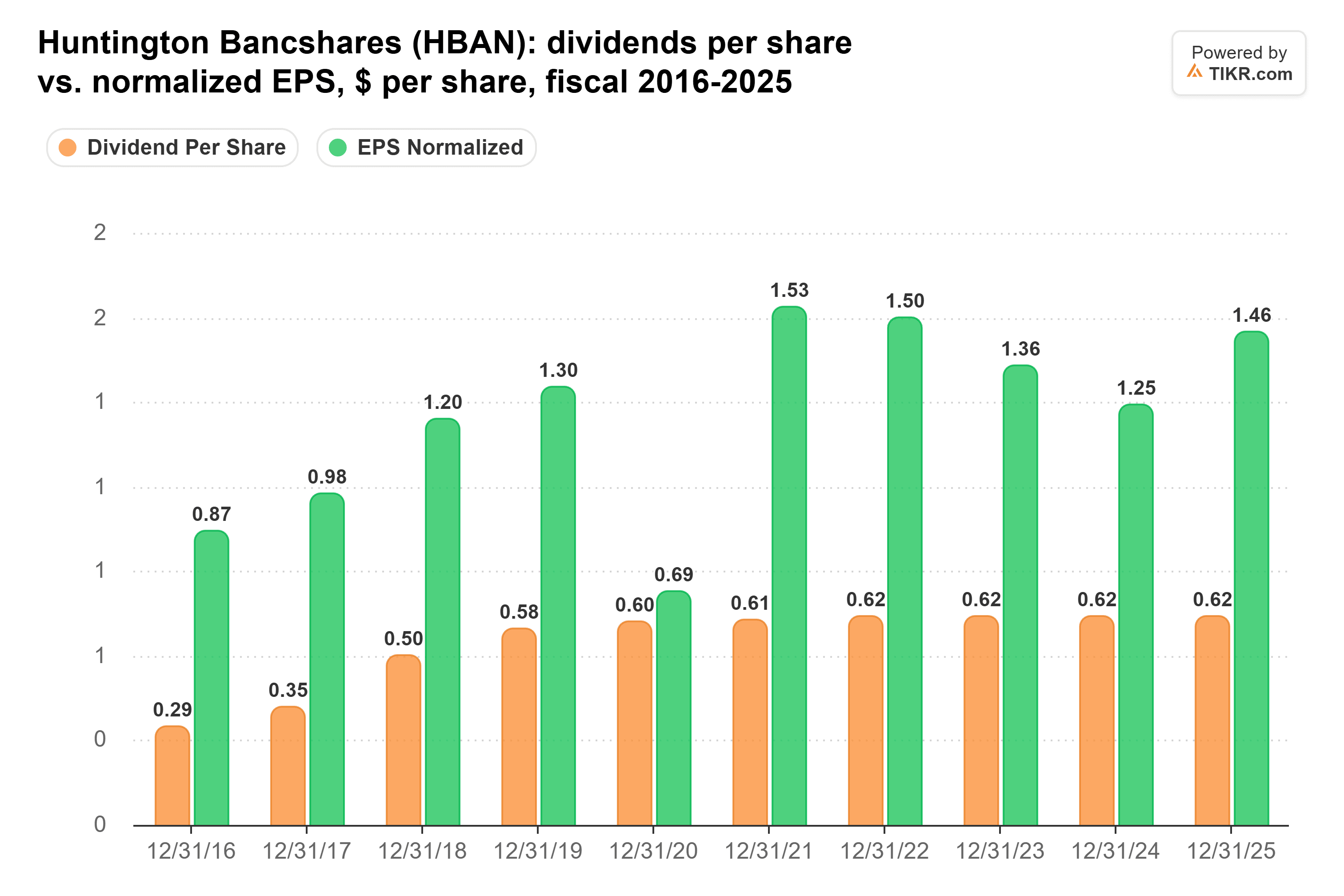
In fiscal 2020, normalized EPS fell to $0.69, and the dividend took a stretched 87% of it. In fiscal 2025 it took a comfortable 42%.
Management explained the order it spends in on the third-quarter call: “Our top priority remains supporting high-return organic growth. Next, we support a strong dividend yield.” Buybacks come after that. Huntington has repurchased $409 million of stock this year and plans $1.8 billion to $1.9 billion between this year and next.
Third-quarter net income rose 15% to $721 million, but diluted EPS fell to $0.33 from $0.41 a year earlier. Net charge-offs rose to $146 million from $75 million, partly because of one commercial loan. Huntington is also pulling back from auto, mortgage and commercial real estate loans where pricing doesn’t pay for the risk. As Chairman and CEO Stephen Steinour put it on the call: “We don’t change our underwriting. We haven’t changed it in 17 years.”
So which dividend wins?
For retirees, U.S. Bancorp is the better dividend stock. Both dividends are well covered, so I’m weighing growth. U.S. Bancorp’s dividend grew 4.0% a year from fiscal 2020 to fiscal 2025, from $1.68 to $2.04 a share. Huntington’s grew 0.7% a year over the same years, from $0.60 to $0.62.
Here’s what that means for $10,000 at those rates:
- U.S. Bancorp: pays $390 a year now and about $553 in year 10. Call it a 5.5% yield on your cash today.
- Huntington: pays $434 now and about $460 in year 10.
U.S. Bancorp’s check passes Huntington’s in about three years, around 2030. Analysts expect the earnings behind it to keep climbing:

The jump to $5.34 in fiscal 2026 has backing, since management now expects 2026 net revenue to grow 8% to 9%.
Huntington is still a reasonable pick. It pays the bigger check today, it covers it just as comfortably, and it trades at 1.5x tangible book against U.S. Bancorp’s 1.9x. Management also guides 2027 EPS to $1.75 to $1.83. But for years, Huntington has put its spare capital into deals and buybacks, while U.S. Bancorp has raised its dividend every year. Over a long retirement, I’d rather own the check that grows.
Of course, if Huntington hits that 2027 guidance and starts raising again, I’d take another look.
Forget U.S. Bancorp: 6 safe 6%+ dividend yields you can buy right now
Dividends can hold the key to enormous wealth. But only if you buy the right ones.
Picking the right high-yield dividend stock can be the difference between a dream retirement…and scraping by every month, waiting for the next Social Security check to clear.
We’ve identified six stocks yielding 6%+ that we believe every retiree should know about right now. (And U.S. Bancorp isn’t one of them.)
Disclaimer:
Please note that the articles on TIKR are not intended to serve as investment or financial advice from TIKR or our content team, nor are they recommendations to buy or sell any stocks. We create our content based on TIKR Terminal’s investment data and analysts’ estimates. Our analysis might not include recent company news or important updates. TIKR has no position in any of the stocks mentioned. Thank you for reading, and happy investing!