Key Takeaways
- Pfizer yields 5.7% and Amgen 2.2%, so $10,000 in each pays $570 and $220 a year today.
- Pfizer’s dividend used 89% of its free cash flow over the twelve months to June 2026, against 52% at Amgen.
- Amgen grew its dividend 8.3% a year from fiscal 2020 to fiscal 2025, against 2.5% a year at Pfizer.
- Both companies raised their 2026 guidance on Nov. 3, but analysts expect Pfizer’s normalized EPS to fall through fiscal 2028.
Retirees hunting for dividend income tend to land on the big drugmakers. On Nov. 3, Pfizer (PFE) and Amgen (AMGN) both beat estimates for the third quarter and raised their full-year guidance.
The dividends behind those reports look very different, though. Pfizer yields 5.7%, more than twice Amgen’s 2.2%, while Amgen’s dividend has grown more than three times as fast over the last five years.
So for a retiree who needs a check they can count on, which is the better dividend stock?
| Metric | Pfizer (PFE) | Amgen (AMGN) |
|---|---|---|
| Dividend yield | 5.7% | 2.2% |
| Annual dividend | $1.72 | $10.08 |
| Dividend growth, fiscal 2020-2025 | 2.5% a year | 8.3% a year |
| Cash dividend payout ratio (TTM) | 89% | 52% |
| Net debt/EBITDA (LTM) | 2.0x | 2.5x |
| Interest coverage (LTM) | 7.0x | 4.1x |
Source: TIKR and StockAnalysis, Nov. 5, 2026.
6 safe dividend stocks paying retirees 6%+ yields
There are over 100 stocks paying 6%+ annual dividends today.
But after an extensive investment review leveraging TIKR’s proprietary data, we now believe only six of them are truly safe for retirees.
They’re all yours for free as part of our new investment report, which you can access right here.
Pfizer’s dividend has almost no cushion
Pfizer’s third-quarter revenue was $16.6 billion, relatively flat from a year earlier operationally. Its launched and acquired products grew 32% and Eliquis grew 25%, offsetting a 63% drop in Paxlovid. On Nov. 3, Pfizer raised its 2026 revenue guidance to $62.0-$64.0 billion, from $60.5-$62.5 billion.
But Pfizer’s dividend used 89% of its free cash flow over the twelve months to June 28, 2026, which leaves a thin cushion. In fiscal 2023 and fiscal 2025, the dividend was bigger than Pfizer’s free cash flow:
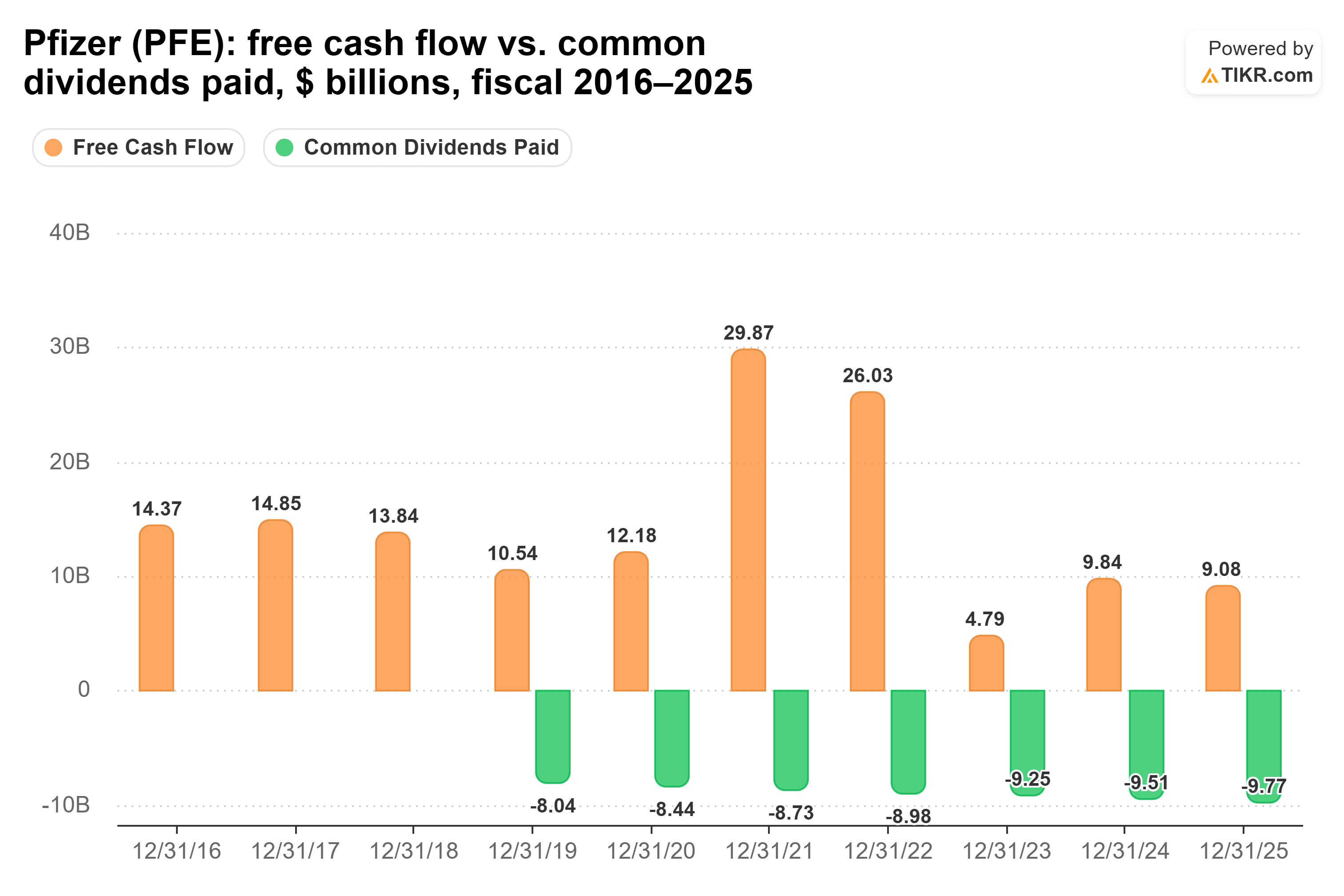
Fiscal 2025’s ratio was a risky 108%.
CEO Albert Bourla said of the dividend on Pfizer’s second-quarter call in August: “We feel extremely confident that we will — even the most stretched scenarios that we are running, we will be able to maintain our dividend.”
So far, Pfizer has done exactly that. Its Oct. 6 declaration of $0.43 a share was its 352nd consecutive quarterly dividend, and it holds the annual rate at $1.72, where it was in fiscal 2025.
Pfizer also faces lost exclusivity on IBRANCE, XTANDI and, outside the US, Eliquis. CFO Cecile Guegan said on the Nov. 3 call that 2027’s guidance will reflect two of its products coming under Medicare price setting.
Amgen’s dividend has room to grow
Amgen offers the opposite trade-off: a smaller yield with far more cash behind it. Its third-quarter revenue rose 8% to $10.4 billion, and it raised its 2026 revenue guidance for the third time this year, to $38.9-$39.7 billion.
Repatha, EVENITY, TEZSPIRE, IMDELLTRA and its biosimilars are growing. Prolia and XGEVA sales fell 45% and 47% as biosimilars launched against them. Amgen expects no step-down in its operating margin in 2027.
Its dividend used a comfortable 52% of free cash flow over the twelve months to June 30, 2026. Free cash flow has topped dividends paid in every fiscal year from 2016 to 2025:
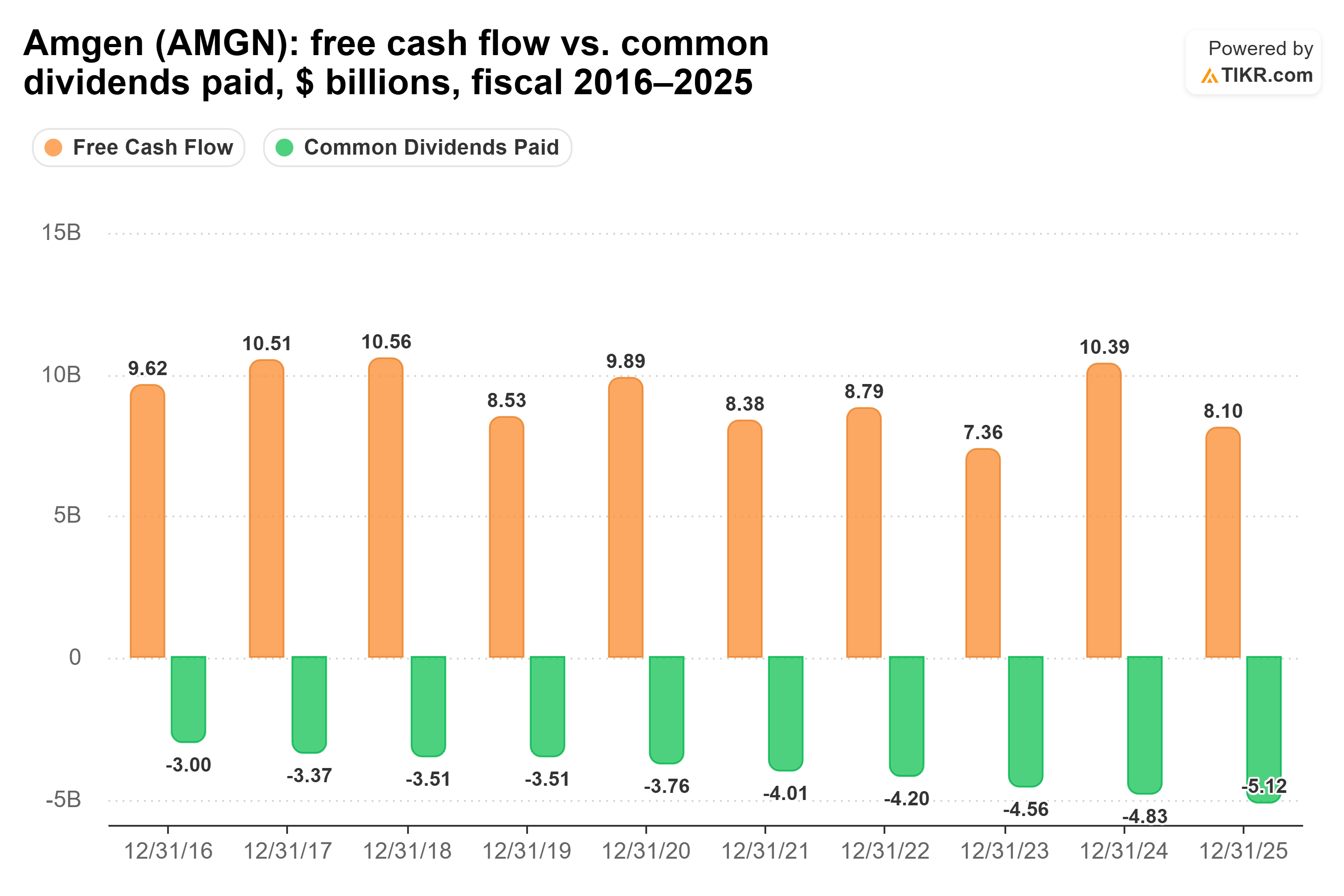
Its highest ratio of the last five fiscal years, 63% in fiscal 2025, still left plenty of room.
Amgen’s quarterly dividend of $2.52 a share is 6% above the same quarter of 2025.
The risk is debt. Amgen had $54.0 billion of it against $13.2 billion of cash at Sept. 30.
So which dividend wins?
For retirees, Amgen is the better dividend stock. Its payout leaves roughly half its free cash flow to spare, and the business behind it is still raising guidance.
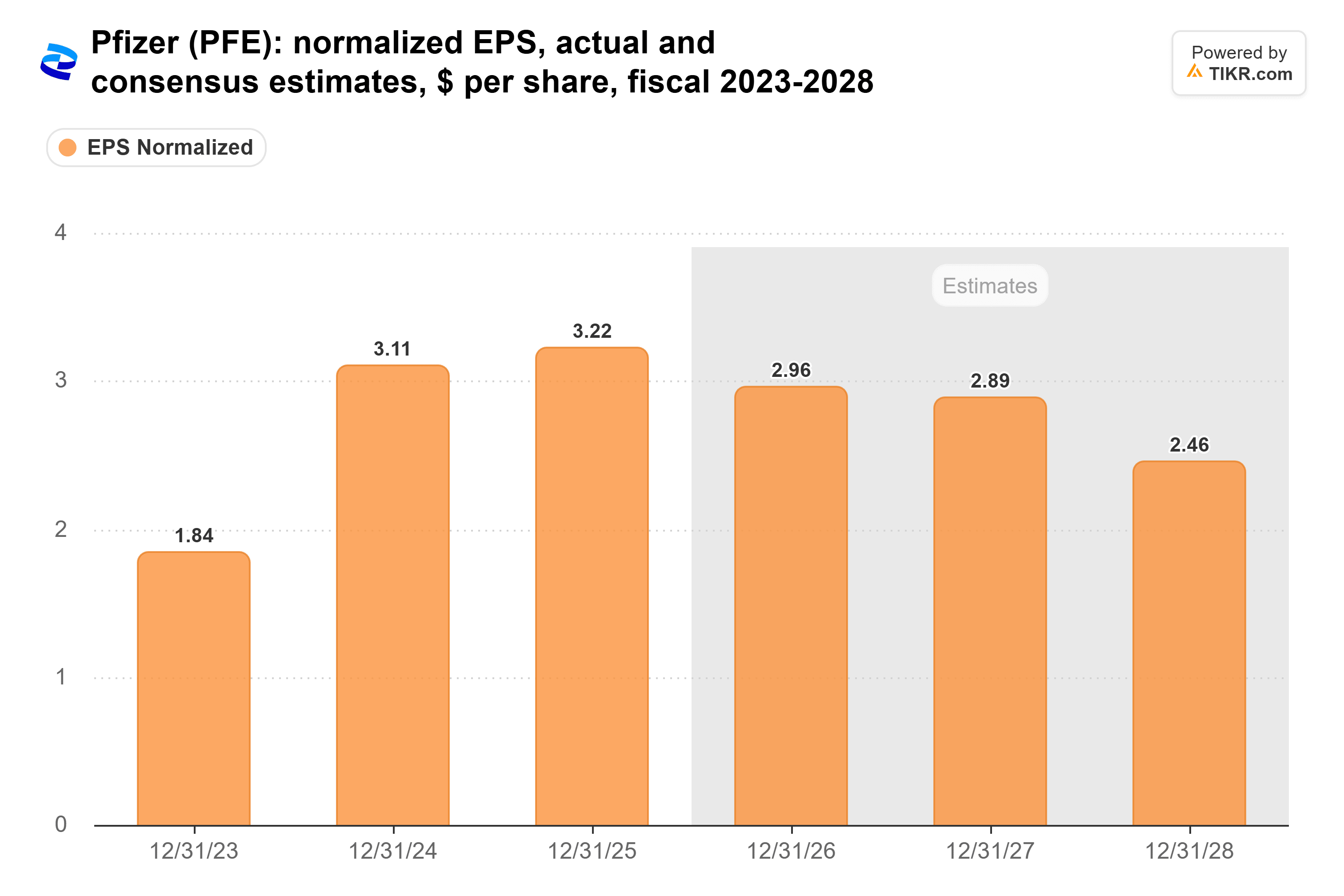
Analysts expect Pfizer’s normalized EPS to fall from $3.22 in fiscal 2025 to $2.46 by fiscal 2028:
Pfizer still makes a strong case. Put $10,000 in it, and it pays $570 a year today against $220 from Amgen. At its 5-year rate, it pays about $712 in year 10, a 7.1% yield on the original $10,000, against about $450, or 4.5%, from Amgen. At those rates, Amgen’s income wouldn’t pass Pfizer’s until about 2044.
Pfizer also has the stronger balance sheet and trades at 11x forward earnings against Amgen’s 20x. It expects to deliver nearly all of its $7.2 billion of cost savings by the end of 2026.
Still, Pfizer’s dividend outran its free cash flow in two of the last three fiscal years, and its earnings are expected to shrink. Amgen’s smaller check has room to keep growing, and I’d rather count on that.
Of course, Pfizer’s 2027 guidance will show how much the lost exclusivity and Medicare price setting cost it. If its new products and cost cuts keep free cash flow comfortably above the dividend, I’d trust its bigger check a lot more.
Forget Amgen: 6 safe 6%+ dividend yields you can buy right now
Dividends can hold the key to enormous wealth. But only if you buy the right ones.
Picking the right high-yield dividend stock can be the difference between a dream retirement…and scraping by every month, waiting for the next Social Security check to clear.
We’ve identified six stocks yielding 6%+ that we believe every retiree should know about right now. (And Amgen isn’t one of them.)
Disclaimer:
Please note that the articles on TIKR are not intended to serve as investment or financial advice from TIKR or our content team, nor are they recommendations to buy or sell any stocks. We create our content based on TIKR Terminal’s investment data and analysts’ estimates. Our analysis might not include recent company news or important updates. TIKR has no position in any of the stocks mentioned. Thank you for reading, and happy investing!