Key Takeaways
- AT&T yields 5.0% and plans to hold its dividend at $1.11 a share a year, while Kimberly-Clark yields 4.9% and says it has raised its dividend for 54 straight years.
- AT&T’s dividend took 44% of its free cash flow over the twelve months to Sept. 30, 2026, against 87% at Kimberly-Clark.
- Kimberly-Clark closed its Kenvue acquisition on Nov. 2, taking on new debt and issuing 281.1 million new shares that collect the same dividend.
- AT&T’s spectrum purchase from EchoStar lifted its debt, and management doesn’t expect to reach its 2.5x leverage target until 2029.
If you’re buying a dividend stock to hold for 20 years, you need two things from it: a check that keeps coming, and a check that grows.
AT&T (T) yields 5.0%, and on Oct. 21 it said it plans to keep its dividend at $1.11 a share a year.
Kimberly-Clark (KMB) yields 4.9% and has the longer record. The company counts 92 straight years of dividends and 54 straight years of raises. It closed its Kenvue acquisition on Nov. 2, and three days later it declared its regular $1.28 quarterly dividend, unchanged from the quarter before.
So which check would I rather collect for the next 20 years?
| Metric | AT&T (T) | Kimberly-Clark (KMB) |
|---|---|---|
| Dividend yield | 5.0% | 4.9% |
| Annual dividend | $1.11 | $5.12 |
| Dividend growth, fiscal 2020-2025 | -11.8% a year | 3.3% a year |
| Cash dividend payout ratio (TTM to Sept. 30, 2026) | 44% | 87% |
| Net debt/EBITDA (LTM) | 3.3x | 1.2x |
| Interest coverage (LTM) | 3.9x | 13.1x |
Source: TIKR; annual dividends from StockAnalysis.
6 safe dividend stocks paying retirees 6%+ yields
There are over 100 stocks paying 6%+ annual dividends today.
But after an extensive investment review leveraging TIKR’s proprietary data, we now believe only six of them are truly safe for retirees.
They’re all yours as part of our new investment report. Learn more about how to get access right here.
AT&T has room to spare
AT&T’s business is growing where it’s investing. Third-quarter 2026 revenue rose 5.3% from the year-ago quarter to $32.3 billion. CEO John Stankey made the case on the third-quarter call: “the most durable customer combination in our industry is a fiber-fed broadband customer with a great wireless service on top of it, bar none.”
That business brings in far more cash than the dividend needs:
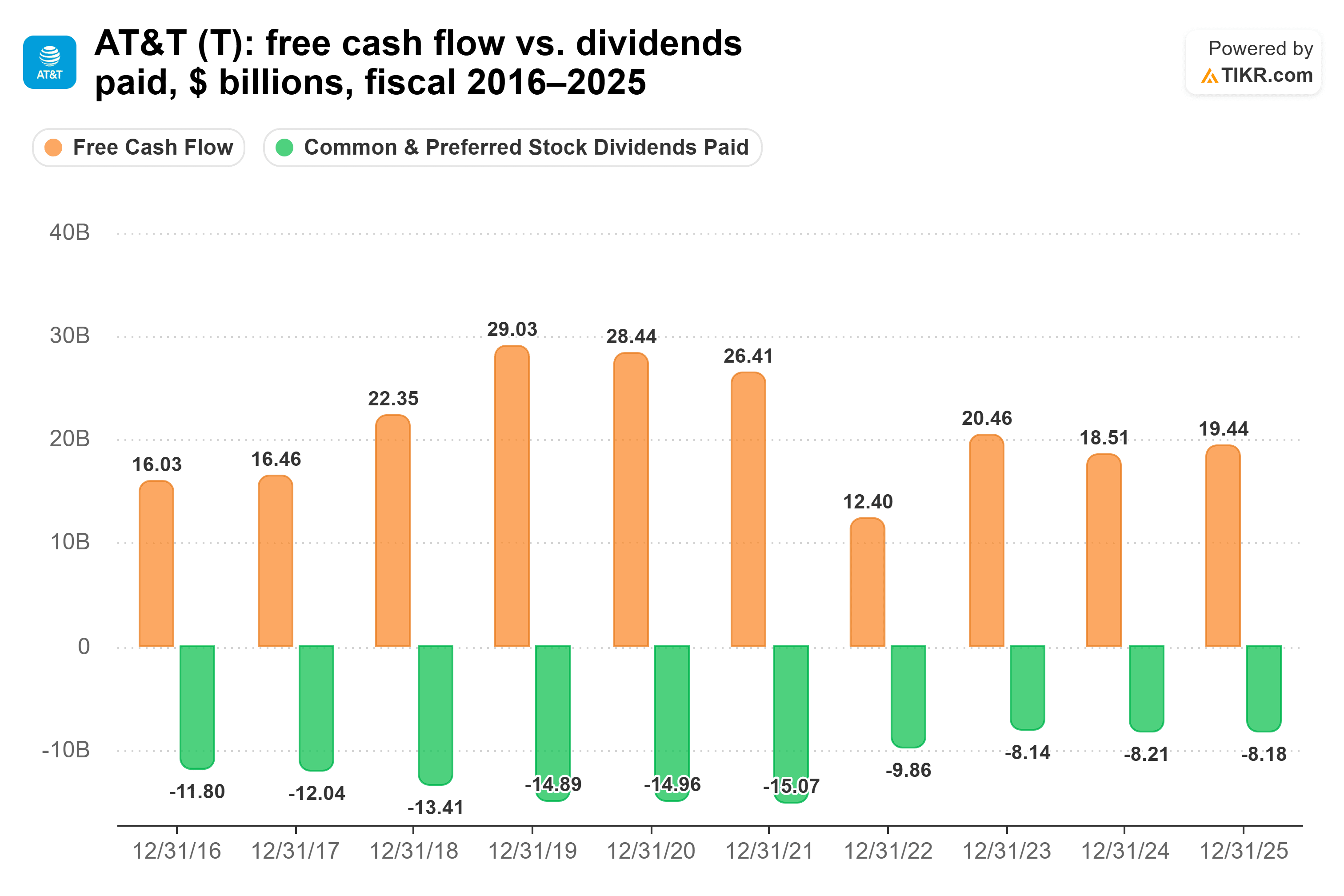
Free cash flow was $19.4 billion in fiscal 2025, against $8.18 billion of dividends paid. That leaves the dividend well-covered at 44% of free cash flow over the twelve months to Sept. 30, 2026. Management guides to free cash flow of $18 billion or more in 2026, rising to $21 billion or more in 2028.
A 20-year holder has to weigh the past, though. Dividends per share fell from $2.08 in fiscal 2020 to $1.11 in fiscal 2025. The other weak spot is debt: the $23 billion EchoStar purchase lifted net debt to 3.3x EBITDA.
Kimberly-Clark bets big on Kenvue
Kimberly-Clark looks almost like AT&T in reverse: a long record of raises, with less room under them. Third-quarter 2026 net sales fell 0.4% from the year-ago quarter to $4.1 billion.
The raises have kept coming even as free cash flow fell behind:
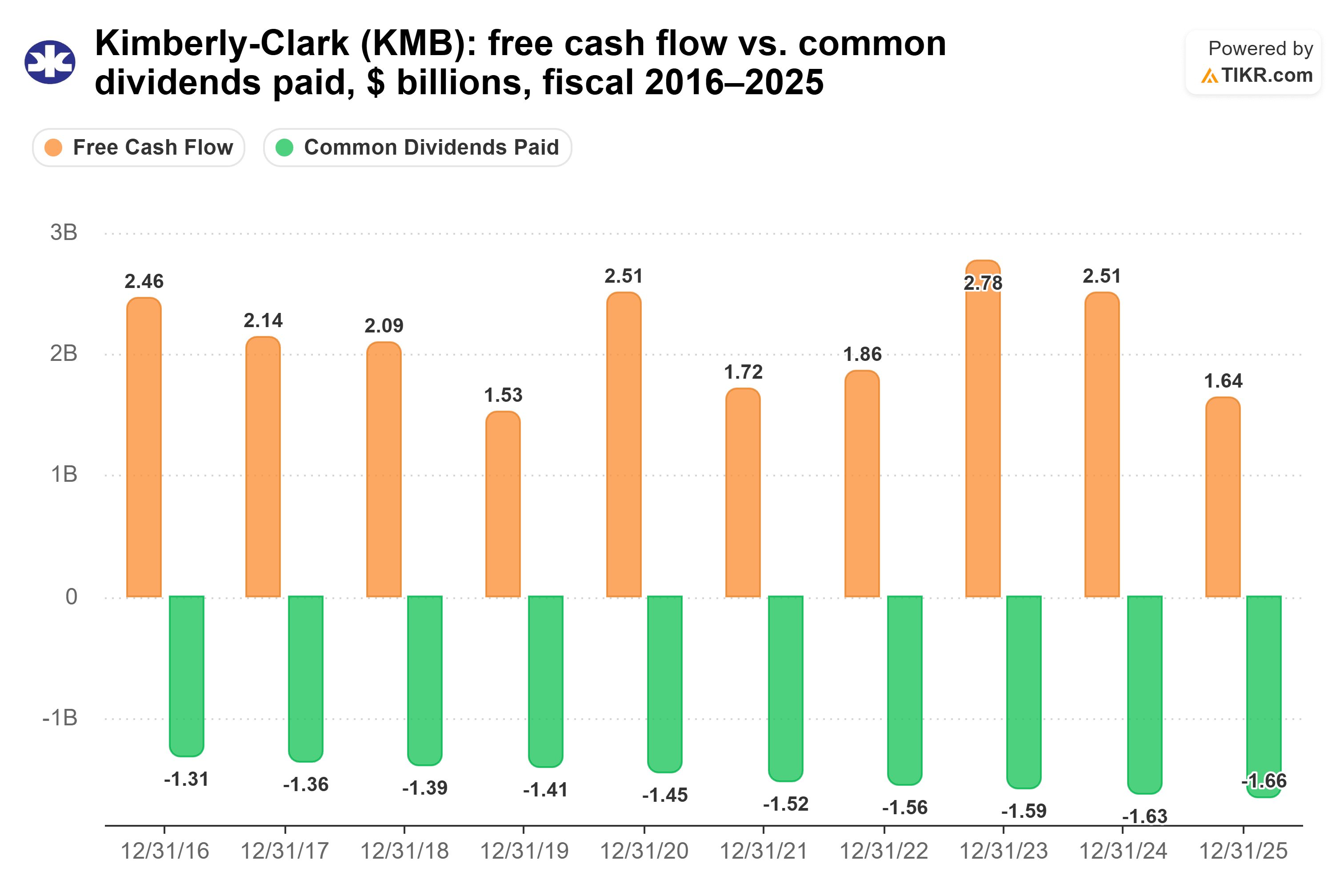
Dividends paid rose every year, from $1.31 billion in fiscal 2016 to $1.66 billion in fiscal 2025. Free cash flow went from $2.46 billion to $1.64 billion over the same years, so the fiscal 2025 dividend took 101% of it. Over the twelve months to Sept. 30, 2026, the ratio was a tight 87%.
Those figures come from before Kenvue. Kimberly-Clark paid about $6.7 billion in cash, funded partly by $4.9 billion of notes priced on Oct. 20 at rates of 5.10% to 5.80%. It also issued 281.1 million shares, which add $1.44 billion a year to the dividend bill at $1.28 a quarter. CEO Mike Hsu said he wants “the integration to be boring for the organization and also for our customers.”
So which dividend wins?
If I can only hold one for the next 20 years, I’m taking AT&T. Its check took 44% of free cash flow, and the business behind it is growing revenue and adding fiber customers.
The cost of that choice is income growth. At each dividend’s pace now, $10,000 in Kimberly-Clark would pay about $13,546 over the 20 years, against about $10,000 from AT&T. That’s $500 a year for as long as AT&T holds the $1.11. Kimberly-Clark only gets there by raising 3.3% a year for two decades, on a dividend that took more than all of its free cash flow in fiscal 2025.
This isn’t to say Kimberly-Clark’s dividend is in trouble. Management will work very hard to keep a streak of 54 straight raises. Kenvue adds cash flow, and Kimberly-Clark went into the deal at 1.2x net debt to EBITDA, with a target of about 2x by the end of the deal’s second year. It’s just that, for 20 years, I’d rather own the check with room to spare than one that still has to grow into its cushion.
Of course, AT&T has to bring its debt back to 2.5x by 2029 for that cushion to stay intact. Kimberly-Clark’s first quarters with Kenvue will show whether the bigger company covers its bigger dividend bill.
Forget AT&T: 6 safe 6%+ dividend yields you can buy right now
Dividends can hold the key to enormous wealth. But only if you buy the right ones.
Picking the right high-yield dividend stock can be the difference between a dream retirement…and scraping by every month, waiting for the next Social Security check to clear.
We’ve identified six stocks yielding 6%+ that we believe every retiree should know about right now. (And AT&T isn’t one of them.)
Disclaimer:
Please note that the articles on TIKR are not intended to serve as investment or financial advice from TIKR or our content team, nor are they recommendations to buy or sell any stocks. We create our content based on TIKR Terminal’s investment data and analysts’ estimates. Our analysis might not include recent company news or important updates. TIKR has no position in any of the stocks mentioned. Thank you for reading, and happy investing!