Key Takeaways
- AMD shares jumped 6% after Jensen Huang resigned as Nvidia’s CEO, and Broadcom rose with it.
- IonQ, SoundHound and Oklo fell instead, as investors cut back on the riskiest AI bets.
- Nvidia’s crisis gives its customers a reason to lean on AMD, but AMD says demand is already higher than its supply.
- Analysts already expect AMD’s revenue to nearly triple from 2025 to 2027, and the stock trades above its five-year average forward P/E.
Advanced Micro Devices (AMD) is up 6% today, and Broadcom (AVGO) is up 6%, after Nvidia said before the open that CEO Jensen Huang had resigned, effective immediately. CFO Colette Kress is interim CEO.
The news sent the most speculative corners of the AI trade the other way. IonQ (IONQ) is down 7%, SoundHound AI (SOUN) is down 5% and Oklo (OKLO) is down 3%. None of them had bad news of its own: Oklo announced definitive HALEU fuel contracts with Centrus this morning, and SoundHound put out a positive customer announcement. D-Wave Quantum fell 5% too. Investors are treating Huang’s exit as Nvidia’s problem, and as a reason to trim their riskiest AI bets, IonQ and SoundHound included.
AMD is the obvious hedge
The Wall Street Journal reported after Wednesday’s close that Nvidia’s board could meet that day on Huang’s future, following allegations about his personal conduct. Before today’s open, William Blair upgraded AMD to Outperform from Market Perform, saying the risk/reward has shifted its way, and BofA raised its target to $700 from $650. A CEO search days before Nvidia’s Nov. 17 report gives every big buyer a reason to hedge, and AMD is the most direct one to buy from. Broadcom offers the other way out, through hyperscalers’ custom chips: its AI semiconductor revenue rose 221% to $16.7 billion in its fiscal third quarter, ended Aug. 2.
TIKR tracks 53 analysts on AMD. How many say “Buy”?
See the full breakdown of Buy, Hold, and Sell ratings on AMD, along with Wall Street’s revenue and earnings estimates, all in one place. More than 500,000 investors use TIKR to research stocks like this one. See AMD’s Analyst Ratings
Demand was never AMD’s problem
CEO Lisa Su said on AMD’s third-quarter call that “demand is higher than supply.” And Wall Street already expects revenue to climb from $34.6 billion in 2025 to $95.9 billion in 2027:
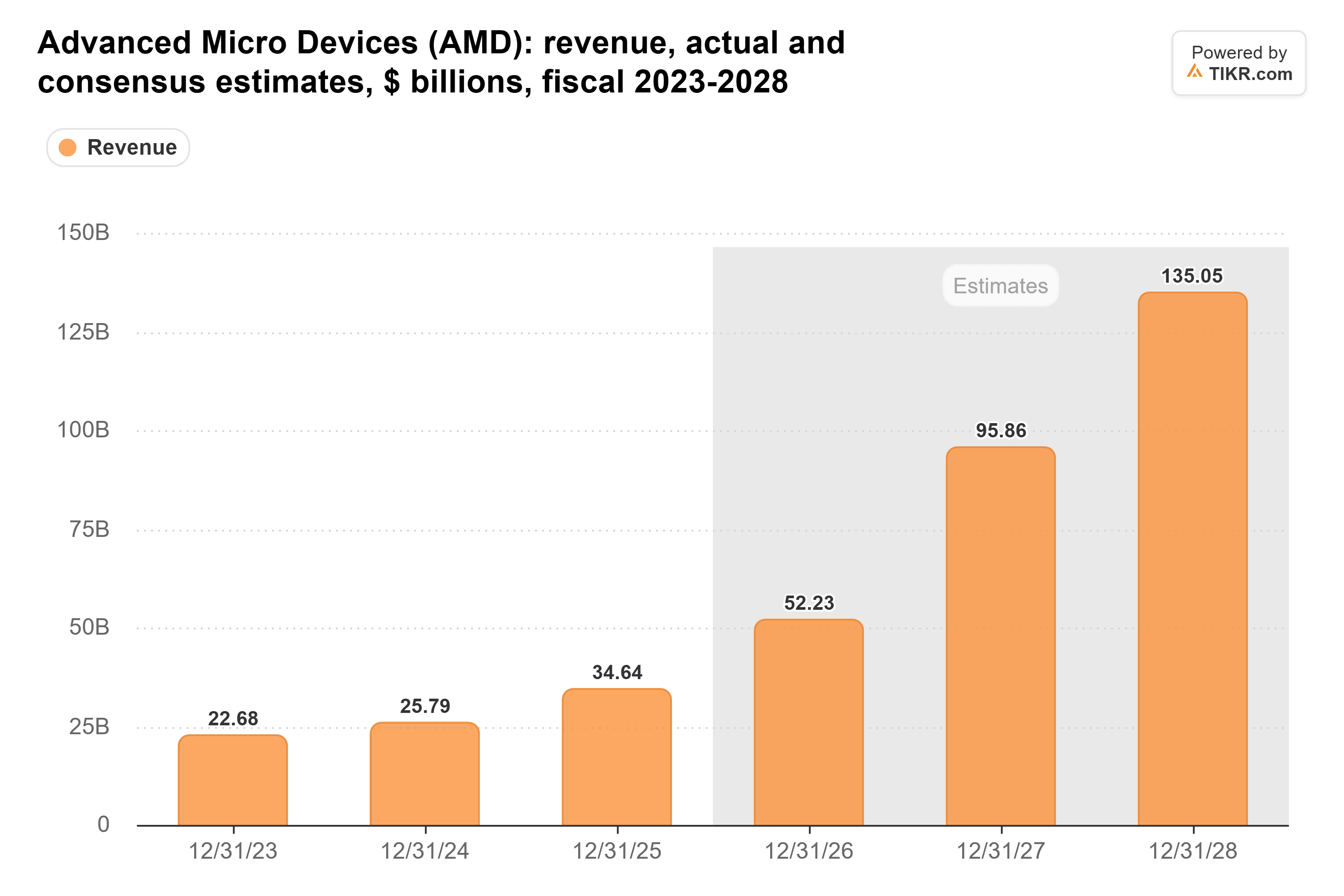
Today’s news shouldn’t move those estimates much, since AMD can only sell what it can make. Any share it wins from Nvidia shows up further out.
I wouldn’t chase this one
AMD traded at 37x forward earnings at Wednesday’s close, above its five-year average of 35x, and today’s jump takes it even higher:
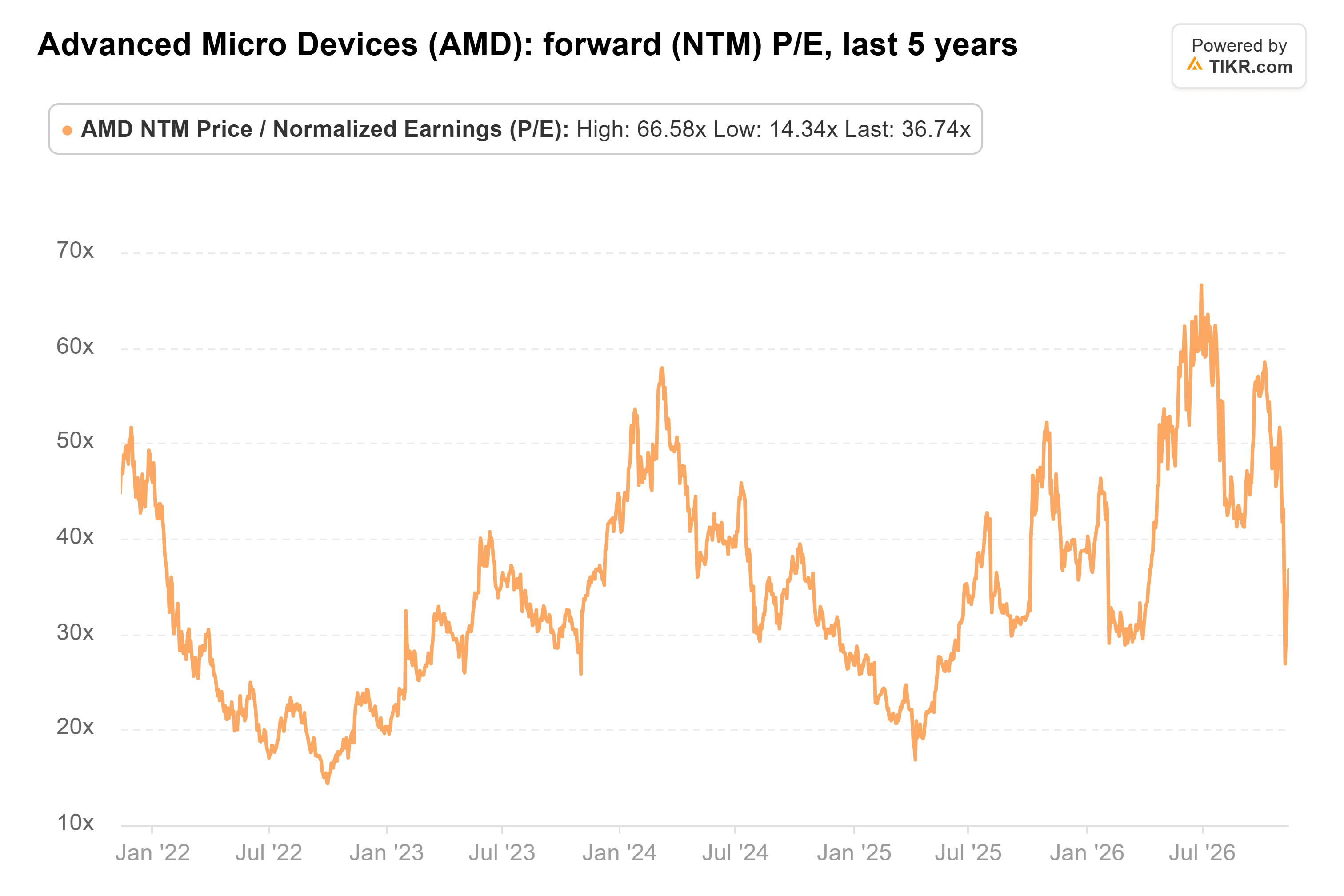
The way I see it, Nvidia’s turmoil strengthens AMD’s case as the second supplier over the next few years. But investors are already paying for revenue to nearly triple by 2027, and the $659 consensus target sat just 19% above Wednesday’s close before today’s jump. Nvidia’s Nov. 17 report, Kress’s first as interim CEO, will show whether any customer is actually shifting orders.
So what is AMD stock actually worth?
TIKR lets you forecast the future price of any stock in less than a minute. Just enter a few assumptions into TIKR’s valuation model and see what AMD could be worth. Start from Wall Street consensus estimates, or adjust the inputs to reflect your own view of the business. It’s free to use.
Disclaimer:
Please note that the articles on TIKR are not intended to serve as investment or financial advice from TIKR or our content team, nor are they recommendations to buy or sell any stocks. We create our content based on TIKR Terminal’s investment data and analysts’ estimates. Our analysis might not include recent company news or important updates. TIKR has no position in any of the stocks mentioned. Thank you for reading, and happy investing!