Key Takeaways
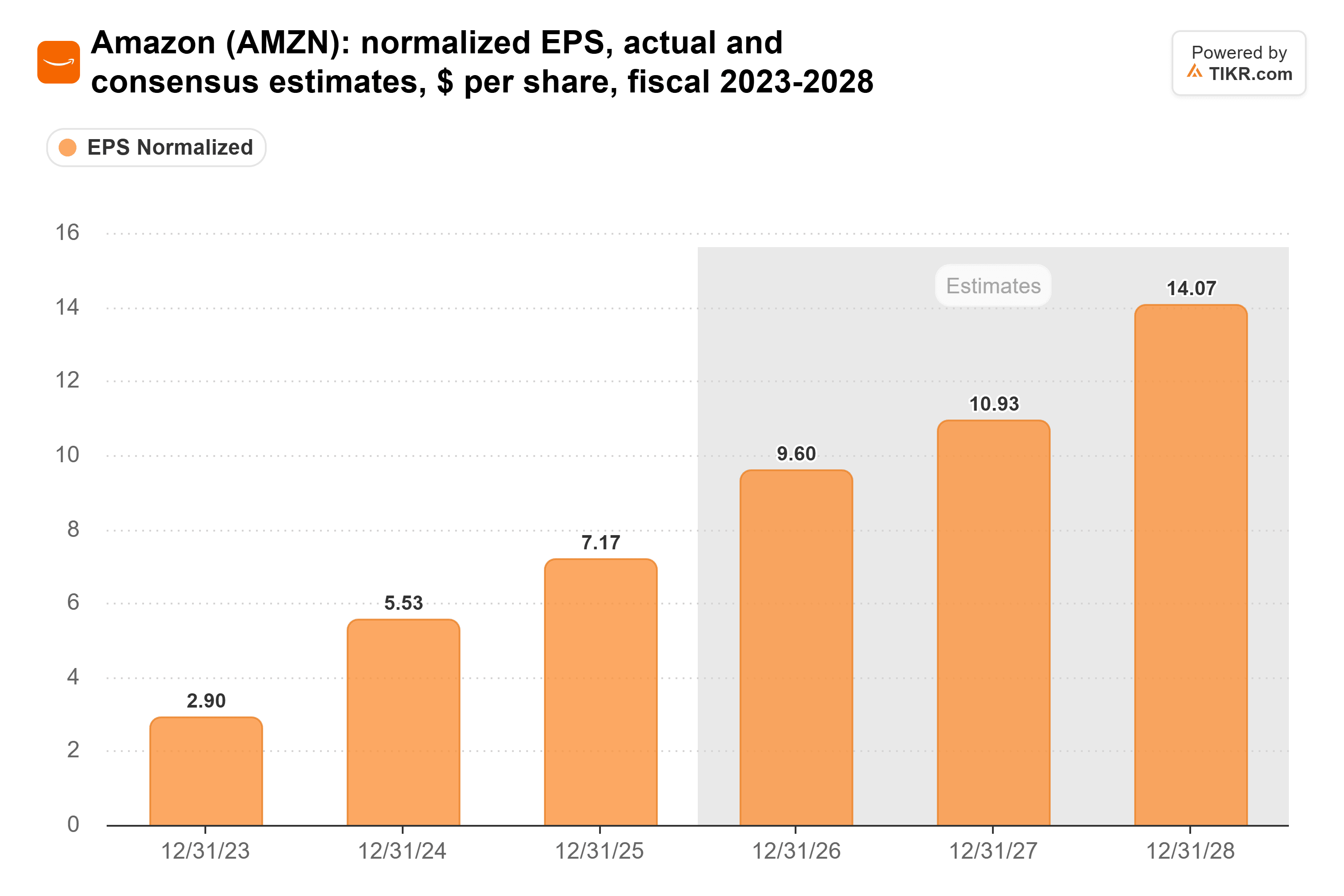
- Amazon’s forward P/E has fallen to about 24x, near its lowest in a decade, even as analysts expect its normalized EPS to nearly double from 2025 to 2028.
- Voters are turning against new data centers, which makes the capacity AWS already owns worth more.
- Amazon and Oracle are both borrowing to build, but Amazon’s operating cash covered its capex last year while Oracle’s capex was more than its revenue.
- Alphabet has the same head start, and Amazon’s 2027 capex outlook in early February is the next test of the cash turn analysts expect in 2028.
Amazon (AMZN) shareholders have had a rough week, as the AI selloff ran straight into Thanksgiving.
It has also pushed the stock’s valuation to levels few holders have seen. As TrendSpider put it on X: “Amazon $AMZN is now trading at its lowest P/E ever.”
Jim Cramer thinks that’s a gift. On Mad Money on Nov. 24, a caller asked whether he should add to his small Amazon position. Cramer didn’t hesitate:
“Amazon is going to prove to be the winner in this whole 40 out of 41 districts decided they hated data centers.”
Then, for good measure: “Can’t believe how cheap it is.”
Here’s what the numbers say.
Cheaper than it’s been in a decade
Amazon’s earnings aren’t falling apart. Analysts expect its normalized EPS to nearly double, from $7.17 in 2025 to $14.07 in 2028:
Yet Amazon trades at about 24x forward earnings, just above the 23x low it hit on Oct. 30 and far below its 10-year average of 74x:
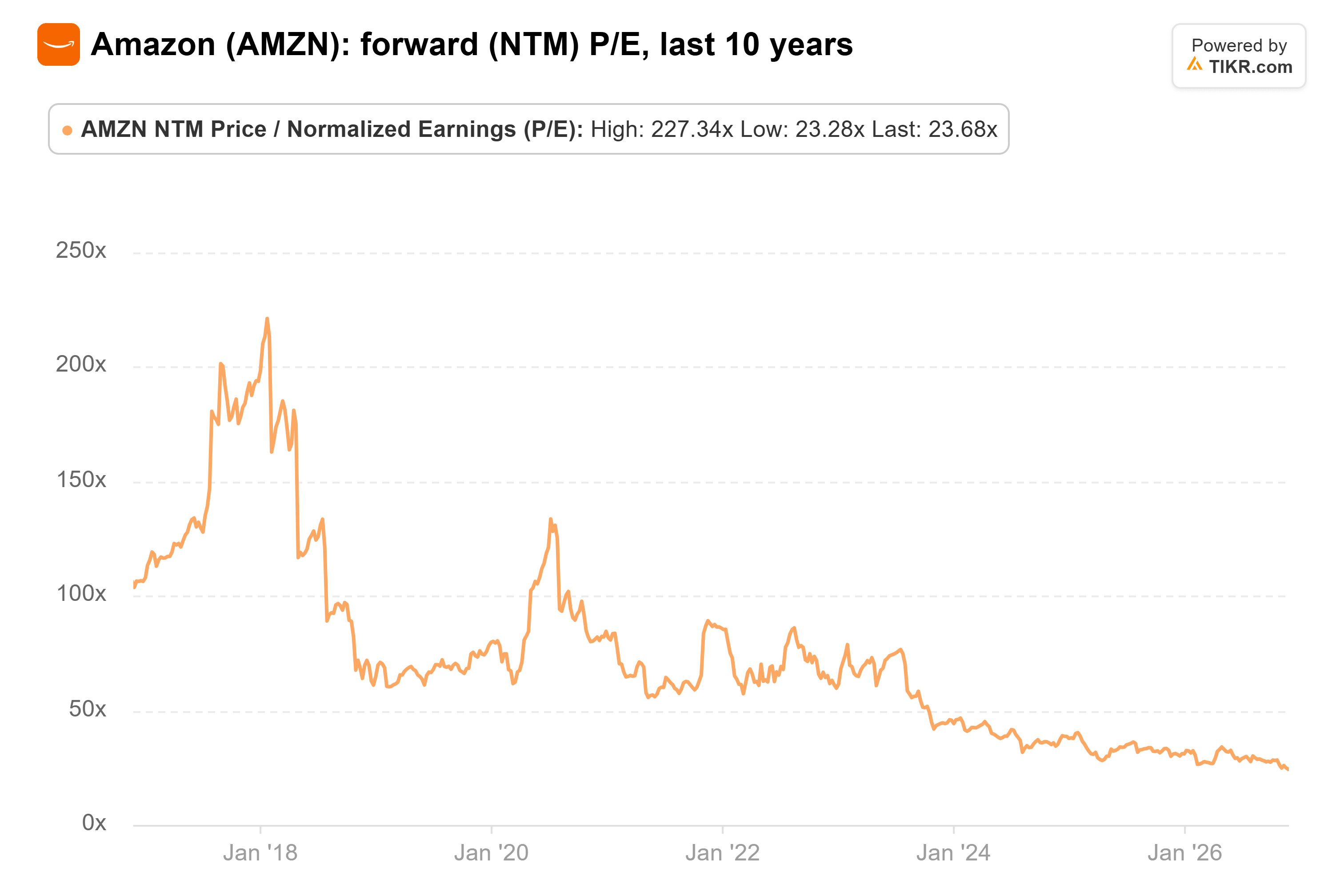
(At its peak in early 2018, it was 227x!)
The market is pricing the cash bill
The discount comes from what Amazon is spending. In 2025, it brought in $140 billion of cash from operations and spent $132 billion of it on capex:

This year’s bill is much bigger. Management guided to about $220 billion of cash capex for 2026 and reaffirmed it with third-quarter results on Oct. 29. Long-term debt has risen from $65.6 billion at the end of 2025 to $173.1 billion on Sept. 30. Analysts don’t expect free cash flow to turn positive again until 2028.
TIKR tracks 62 analysts on Amazon. How many say “Buy”?
See the full breakdown of Buy, Hold, and Sell ratings on Amazon, along with Wall Street’s revenue and earnings estimates, all in one place. More than 500,000 investors use TIKR to research stocks like this one. See Amazon’s Analyst Ratings
The buildings Amazon already has just got more valuable
Cramer’s “40 out of 41” refers to the Nov. 3 elections, when voters went against the data center industry in 40 of the 41 local ballot measures across 10 states.
If new sites get harder to approve, capacity that’s already built gets scarcer, and AWS has plenty of it. AWS revenue grew 39% to $46 billion in the third quarter, and its backlog of contracted revenue reached $578 billion.
Alphabet (GOOG) has that head start too: its Google Cloud revenue grew 103% to $30.7 billion in the third quarter, and Alphabet trades at about 20x forward earnings. Amazon isn’t safe from the backlash either. In Sunbury, Ohio, where AWS had proposed a $2 billion data center campus, nearly 80% of voters backed a ban on large data centers.
Amazon’s leverage looks nothing like Oracle’s
Amazon isn’t the only cloud giant borrowing to build. Oracle (ORCL) is too, but the two companies carry that debt very differently.
Amazon’s operating cash covered its capex last year. Oracle’s capex in the twelve months to Aug. 31 was $75.7 billion, more than its $71.8 billion of revenue, and S&P rates it BBB-, one notch above junk.
What would prove Cramer right
At about 24x, the market is pricing Amazon as if its AI spending won’t pay off, even with earnings expected to nearly double. The risks behind that discount are real. Amazon spent $175.7 billion on property and equipment in the first nine months of 2026 alone, and Anthropic, whose gains have padded Amazon’s reported earnings, closed below its $83 IPO price on Nov. 24.
The next test is Amazon’s fourth-quarter report in early February, which will include its 2027 capex outlook. Analysts expect about $278 billion, and CEO Andy Jassy has said he expects AWS to grow more than 40% in both 2027 and 2028. If spending comes in near that figure while AWS grows that fast, the 2028 cash turn looks a lot more believable.
So what is Amazon stock actually worth?
TIKR lets you forecast the future price of any stock in less than a minute. Just enter a few assumptions into TIKR’s valuation model and see what Amazon could be worth. Start from Wall Street consensus estimates, or adjust the inputs to reflect your own view of the business. It’s free to use.
Disclaimer:
Please note that the articles on TIKR are not intended to serve as investment or financial advice from TIKR or our content team, nor are they recommendations to buy or sell any stocks. We create our content based on TIKR Terminal’s investment data and analysts’ estimates. Our analysis might not include recent company news or important updates. TIKR has no position in any of the stocks mentioned. Thank you for reading, and happy investing!