Key Takeaways
- NVIDIA (NVDA) jumped 31.5% on Monday after its board reinstated Jensen Huang as CEO, but it still traded at about 11x forward earnings at the close.
- Altimeter Capital CEO Brad Gerstner says that multiple priced in shrinking growth for 2028 and 2029, while analysts expect revenue and earnings to keep climbing.
- The main risk is that hyperscalers have stopped raising their capex forecasts, which matters for Taiwan Semiconductor Manufacturing (TSM) and Advanced Micro Devices (AMD) too.
- The stock depends on its 2028 estimates holding, and the hyperscalers’ reports in late January and early February are the next test.
NVIDIA jumped 31.5% on Monday, Nov. 23, after its board reinstated Jensen Huang as CEO, less than two weeks after he resigned.
But Altimeter Capital CEO Brad Gerstner thinks the bigger story is how cheap the stock got before the jump.
On Monday’s Halftime Report, Gerstner said that as of that morning, “what was imputed into the NVIDIA multiple was actually negative growth for 2028 and 2029. I think it’s nuts.”
Wall Street expects the opposite.
And NVIDIA isn’t the only one with a lot riding on 2028. Taiwan Semiconductor Manufacturing (TSMC) and AMD need those years to hold too.
Wall Street still sees growth in both years
On CNBC’s Power Lunch, Deepwater Asset Management’s Gene Munster said the Street expects NVIDIA’s revenue to grow 72% in calendar 2027 and 29% in calendar 2028.
TIKR’s consensus has revenue more than doubling, from $424 billion in the year ending January 2027 to $927 billion in the year ending January 2029:
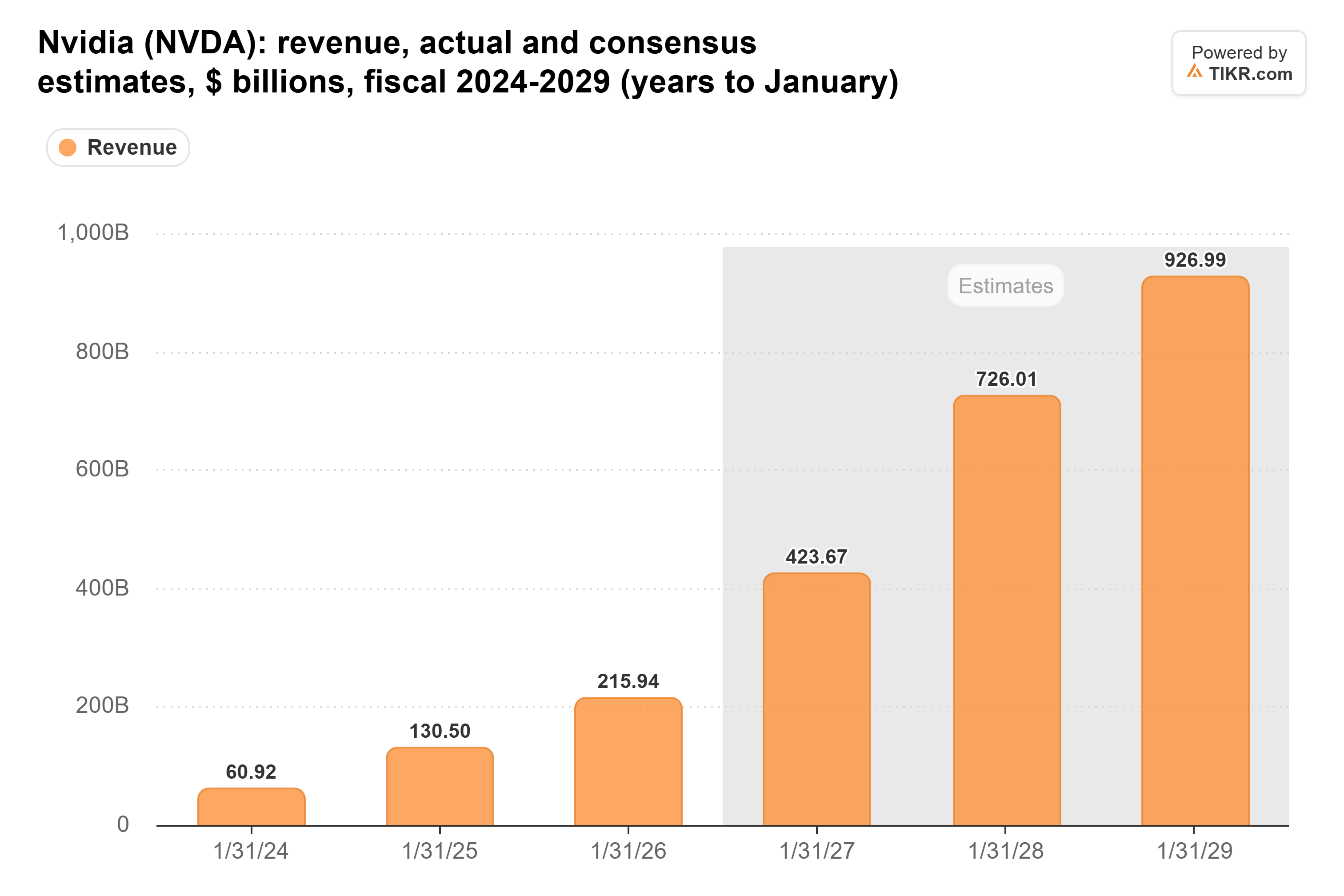
Earnings follow the same path. Analysts expect normalized EPS to climb 31%, from $16.61 in the year ending January 2028 to $21.77 the year after:

The market is priced for a peak
Now look at what investors pay for that growth. Even after Monday’s jump, NVIDIA traded at about 11x forward earnings at the close. That’s up from a five-year low of 8.7x on Friday, but far below its five-year average of 35x and its peak of nearly 70x in May 2023:
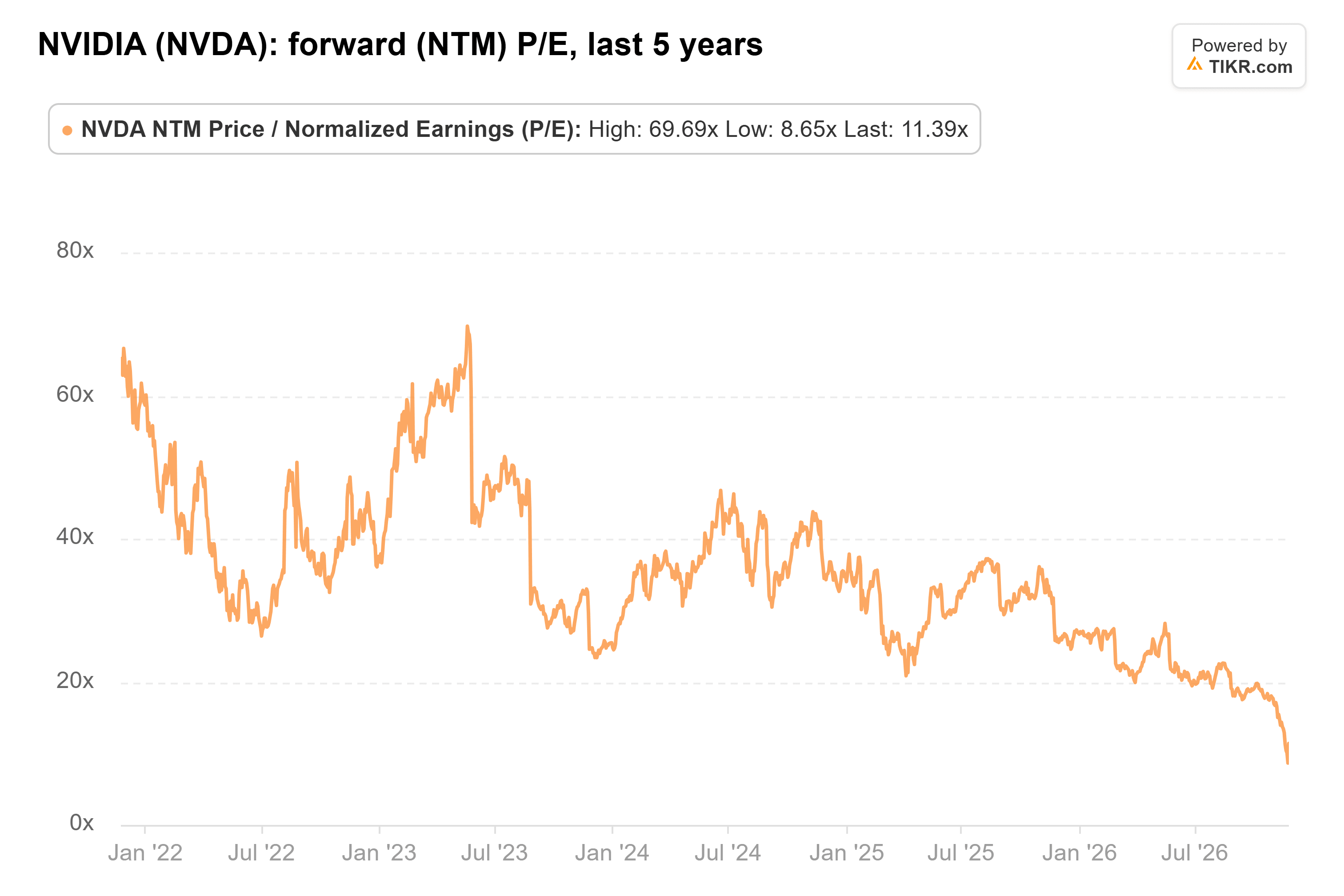
A multiple that low only makes sense if investors expect those 2028 estimates to be cut hard, as if this cycle peaks in 2027.
TIKR tracks 61 analysts on Nvidia. How many say “Buy”?
See the full breakdown of Buy, Hold, and Sell ratings on Nvidia, along with Wall Street’s revenue and earnings estimates, all in one place. More than 500,000 investors use TIKR to research stocks like this one. See Nvidia’s Analyst Ratings
Capex forecasts have stopped rising
The worry is NVIDIA’s customers. As Wedbush’s Matt Bryson put it on CNBC’s Closing Bell, “it feels like the entire AI trade is assuming that there’s deterioration either in 27 or 28.”
Analysts covering Amazon, Alphabet, Microsoft, Meta and Oracle didn’t raise their capex forecasts this earnings season. OnePoint BFG’s Peter Boockvar says expectations call for hyperscaler capex to grow about 50% in 2027, well short of the 71% revenue growth analysts expect from NVIDIA in the year ending January 2028.
Still, some of that spending may just come later. On Bloomberg Tech, Bloomberg Intelligence’s Mandeep Singh said hyperscalers can’t find the capacity to install chips right now, so some would shift spending into 2028 and 2029.
TSMC and AMD need 2028 too
Bryson’s “entire AI trade” covers more than NVIDIA. TSMC’s board approved about $40.9 billion of capital spending on Nov. 10, largely for advanced chipmaking and packaging capacity, new fabs, and 2027 research and development. That capacity comes online over the next few years, so TSMC is betting demand holds past 2027. It trades at about 14x forward earnings, and analysts expect its normalized EPS to rise 34% in 2027.
AMD carries even more of the 2027 risk. Its data center revenue rose 97% to $8.5 billion in the third quarter, and analysts expect normalized EPS to more than double, from $8.08 in 2026 to $17.62 in 2027. Yet investors pay about 30x forward earnings for AMD, against NVIDIA’s 11x. If the AI trade really assumes a slowdown in 2027 or 2028, AMD’s price doesn’t show it.
Gerstner’s right, but the proof comes next year
The market looks like it went too far on NVIDIA. At 11x, analysts could trim their estimates for the year ending January 2029, and the stock would still look cheap against its own history.
As Gerstner put it, investors are “going to have to wait until the cards are turned over.” The first cards come with the hyperscalers’ reports in late January and early February. If 2027 capex guidance holds near the roughly 50% growth now expected, and NVIDIA’s EPS estimate for the year ending January 2029 holds near $21.77, that backs Gerstner. If either gets cut, the market saw it first.
So what is NVIDIA stock actually worth?
TIKR lets you forecast the future price of any stock in less than a minute. Just enter a few assumptions into TIKR’s valuation model and see what NVIDIA could be worth. Start from Wall Street consensus estimates, or adjust the inputs to reflect your own view of the business. It’s free to use.
Disclaimer:
Please note that the articles on TIKR are not intended to serve as investment or financial advice from TIKR or our content team, nor are they recommendations to buy or sell any stocks. We create our content based on TIKR Terminal’s investment data and analysts’ estimates. Our analysis might not include recent company news or important updates. TIKR has no position in any of the stocks mentioned. Thank you for reading, and happy investing!