Key Takeaways
- Alibaba launched Qwen4-Max this week and sells it through a paid API, while only its smaller Qwen4 models will get open weights.
- Keeping its best model closed gives Alibaba Cloud something to sell on the computing capacity it’s spending heavily to build.
- Alibaba’s capital spending rose to RMB 126.1 billion in fiscal 2026 from RMB 32.1 billion in fiscal 2024, while its operating margin fell to 6.2%.
- U.S. chip curbs could limit how much Qwen4-Max Alibaba can serve, and this week’s report will show whether paid AI is lifting cloud margins.
Alibaba (BABA) launched Qwen4-Max this week, the most capable model in its Qwen family. It’s selling access on QwenCloud for $1.50 per million input tokens and $4.50 per million output tokens.
The launch post on X also promised that “the open weights of smaller Qwen4 models will be released.” The biggest model stays behind Alibaba’s own API.
Dmitri Alperovitch, co-founder and chairman of the Silverado Policy Accelerator, wrote on X: “Qwen4-Max won’t be open-weights. As I predicted earlier this year, quite soon we won’t have any new open weight releases of near-frontier models from China.”
For Alibaba shareholders, I think that’s good news.
Qwen already won the downloads
On Alibaba’s August earnings call, management said Qwen models had passed 3 billion downloads. But developers running open weights on their own machines, or another company’s cloud, skip Alibaba entirely.
Qwen4-Max can only be used through Alibaba, so every task a company runs on it is cloud revenue. Management says its AI products earn significantly higher gross margins than the cloud average, and they made up 35% of external cloud revenue in the June quarter. AI Cloud and Compute’s adjusted EBITA margin rose to 11.6% from 7.2% a year earlier.
Analysts expect total revenue to grow from RMB 1.02 trillion in fiscal 2026 (the year to March) to RMB 1.26 trillion in fiscal 2028:
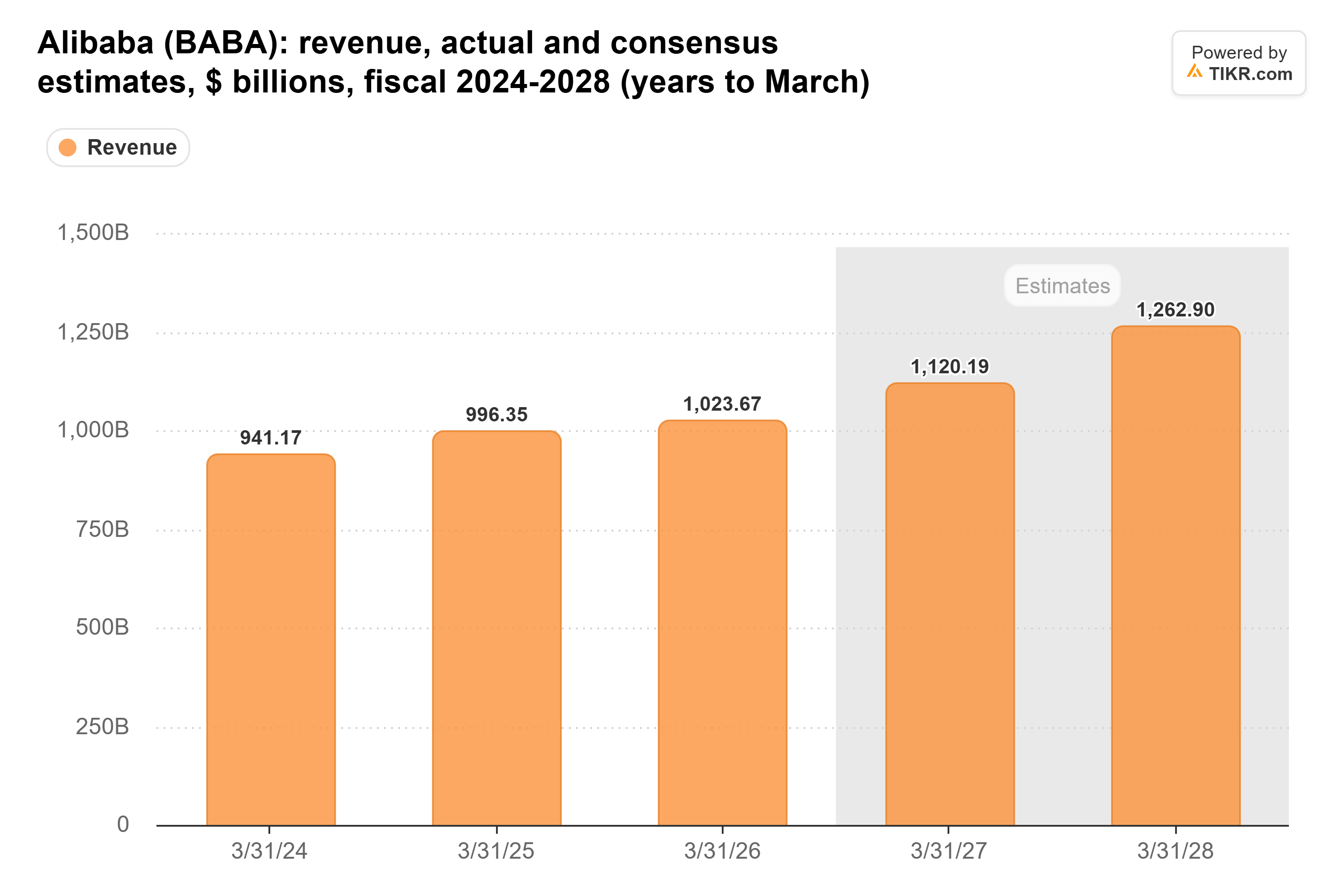
However, those estimates came before the launch. A paid Qwen4-Max should show up in cloud’s margin before it shows up in total revenue.
TIKR tracks 41 analysts on Alibaba. How many say “Buy”?
See the full breakdown of Buy, Hold, and Sell ratings on Alibaba, along with Wall Street’s revenue and earnings estimates, all in one place. More than 500,000 investors use TIKR to research stocks like this one. See Alibaba’s Analyst Ratings
Alibaba needs the paying customers
Alibaba has put its capital behind AI computing. Capital spending went from RMB 32.1 billion in fiscal 2024 to RMB 126.1 billion in fiscal 2026, nearly 4x in two years:
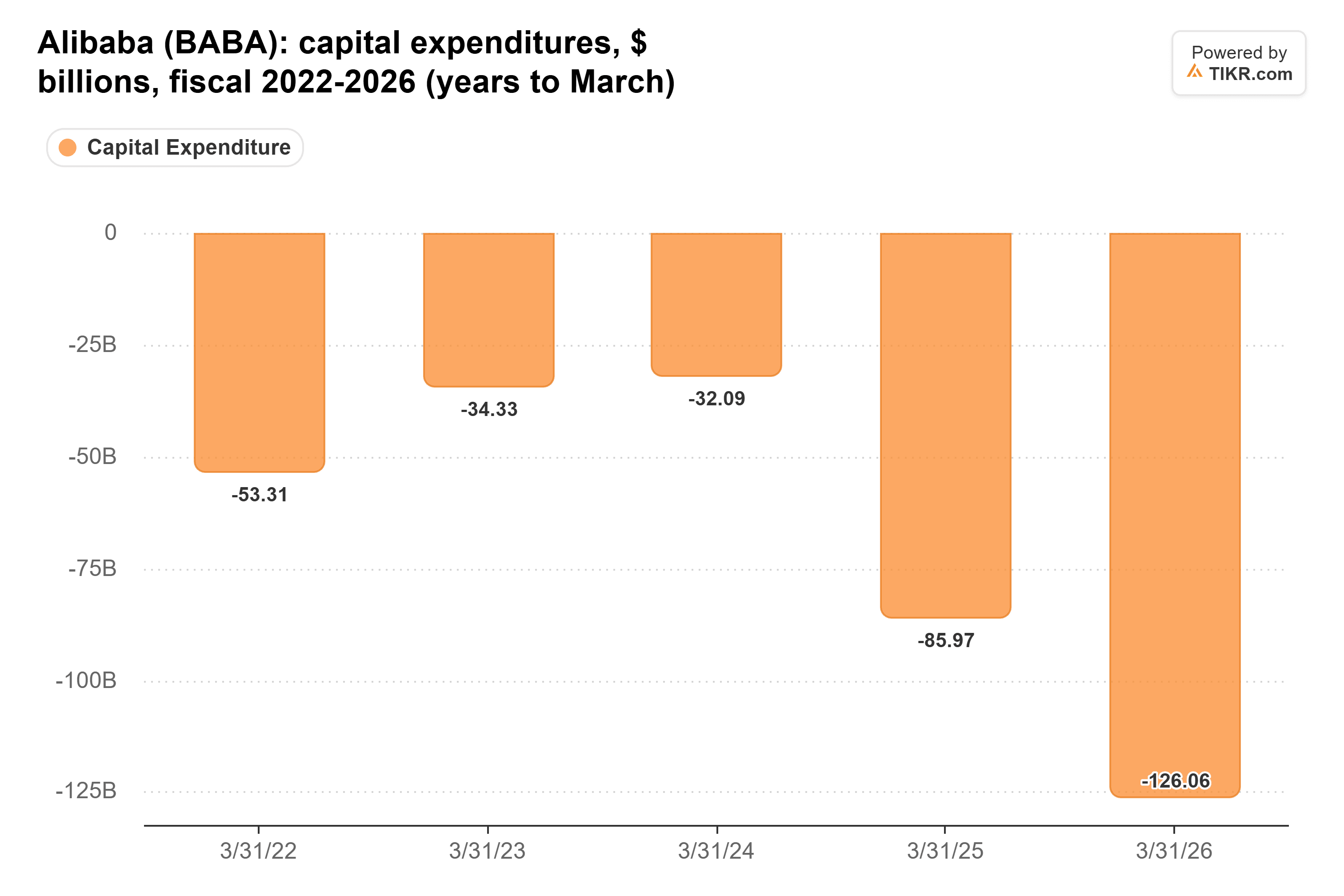
Cloud isn’t paying for that yet. Its fiscal 2026 adjusted EBITA plus depreciation came to RMB 43.2 billion.
Alibaba spent heavily on AI and on a costly push into quick commerce. As a result, its operating margin fell from 15.2% in fiscal 2025 to 6.2% in fiscal 2026:
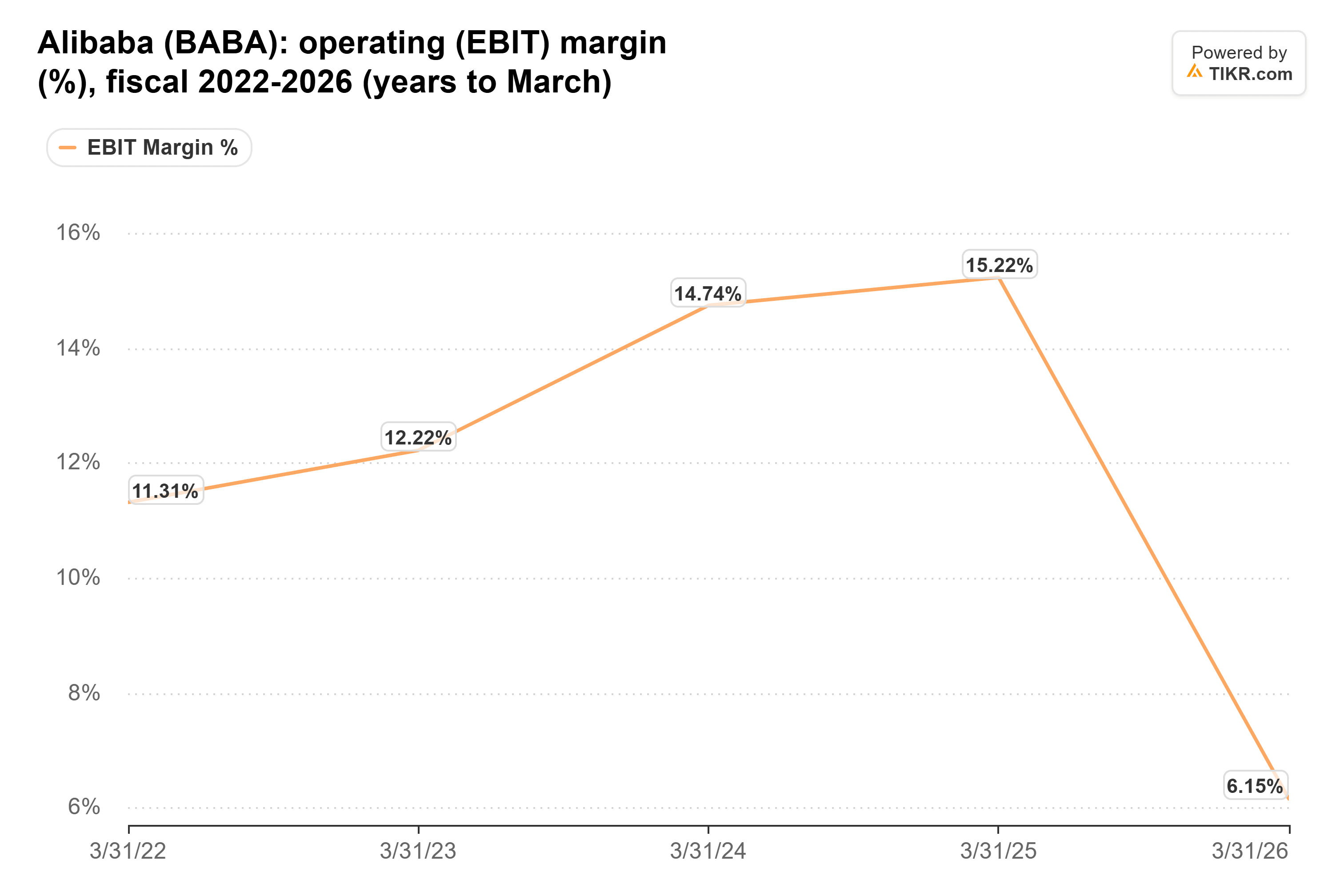
Giving Qwen away has been expensive too. Alibaba’s AI Labs and Applications unit lost RMB 13.9 billion on an adjusted EBITA basis in the June quarter, up from RMB 3.2 billion a year earlier. A model that customers pay for by the token is one way to start earning some of that back.
Developers and chips could still get in the way
Closing the weights could cost Qwen some developer goodwill. But with open weights still coming for the smaller Qwen4 models, developers keep a free way in, and Qwen4-Max becomes the upgrade they pay for.
Still, capacity is the bigger risk. A U.S. draft rule would require data center operators in Singapore, Malaysia, Thailand, Indonesia and Brazil to get a license before exporting advanced chips to customers there. Those exports have offered a route around existing curbs. The stock has already sunk as the U.S. readied those curbs.
Keeping Qwen4-Max closed is the right call. It’s the clearest reason to run AI on Alibaba Cloud, and it gives all that new capacity something to sell. Alibaba reports on Thursday, November 19. Management guided for AI-related annualized revenue approaching US$10 billion in the September quarter. A cloud margin above June’s 11.6% would show paid AI is pulling its weight. Of course, Qwen4-Max launched after that quarter ended, so its own revenue won’t show up before the December quarter.
So what is Alibaba stock actually worth?
TIKR lets you forecast the future price of any stock in less than a minute. Just enter a few assumptions into TIKR’s valuation model and see what Alibaba could be worth. Start from Wall Street consensus estimates, or adjust the inputs to reflect your own view of the business. It’s free to use.
Disclaimer:
Please note that the articles on TIKR are not intended to serve as investment or financial advice from TIKR or our content team, nor are they recommendations to buy or sell any stocks. We create our content based on TIKR Terminal’s investment data and analysts’ estimates. Our analysis might not include recent company news or important updates. TIKR has no position in any of the stocks mentioned. Thank you for reading, and happy investing!