Key Takeaways
- A 65-year-old with $1,250,000 split evenly across Kimberly-Clark, Prudential Financial and Clorox would collect about $59,800 a year in dividends, or about $4,980 a month.
- Prudential’s check is the safest of the three, since its dividend uses well under half of its earnings.
- Kimberly-Clark’s dividend is covered, but its Kenvue deal adds debt and new shares that all collect a dividend.
- Clorox paid out more than its free cash flow over the past year, and if it halved its dividend, the income would fall to about $49,800 a year.
If you’re 65 and living off your portfolio, three household names yielding 4.5% or more at today’s prices are hard to ignore. Kimberly-Clark (KMB), Prudential Financial (PRU) and Clorox (CLX) each fit that bill, and each has had a busy few weeks: Kimberly-Clark closed its roughly $48.7 billion Kenvue deal, Prudential agreed to sell two Latin American units, and Clorox named a new CEO.
So let’s take a hypothetical 65-year-old retiree who splits $1,250,000 evenly across the three. At each company’s current dividend rate, that buys about 3,740 shares of Kimberly-Clark, about 3,539 of Prudential and about 3,780 of Clorox.
Together, those dividend checks come to about $59,800 a year, or about $4,980 a month. That’s a 4.8% yield on this slice of the portfolio. (Of course, no one should ever own just three stocks.)
The checks are nearly equal in size, but the cash behind each one varies a lot:
| Stock | Shares | Cost | Income a year | Share of income | Coverage |
|---|---|---|---|---|---|
| Kimberly-Clark (KMB) | 3,916 | $416,584 | $20,050 | 34% | Cash dividend payout ratio: 87% (TTM) |
| Prudential Financial (PRU) | 3,539 | $416,646 | $19,818 | 33% | Payout ratio of normalized EPS: 37% (fiscal 2025), 41% (fiscal 2026 consensus) |
| Clorox (CLX) | 3,978 | $416,616 | $19,890 | 33% | Cash dividend payout ratio: 133% (TTM), 74% (fiscal 2027 consensus) |
| Total | $59,758 | 100% |
Sources: TIKR; each company’s current dividend rate, at today’s prices. TTM is the twelve months to Sept. 30, 2026.
6 safe dividend stocks paying retirees 6%+ yields
There are over 100 stocks paying 6%+ annual dividends today.
But after an extensive investment review leveraging TIKR’s proprietary data, we now believe only six of them are truly safe for retirees.
They’re all yours as part of our new investment report. Learn more about how to get access right here.
Kimberly-Clark just got a lot bigger
Kimberly-Clark has the longest record of the three. The company says it has paid a dividend for 92 consecutive years and raised it in each of the past 54. Over the twelve months to Sept. 30, its dividends took a tight 87% of free cash flow, and that ratio swings a lot from year to year:
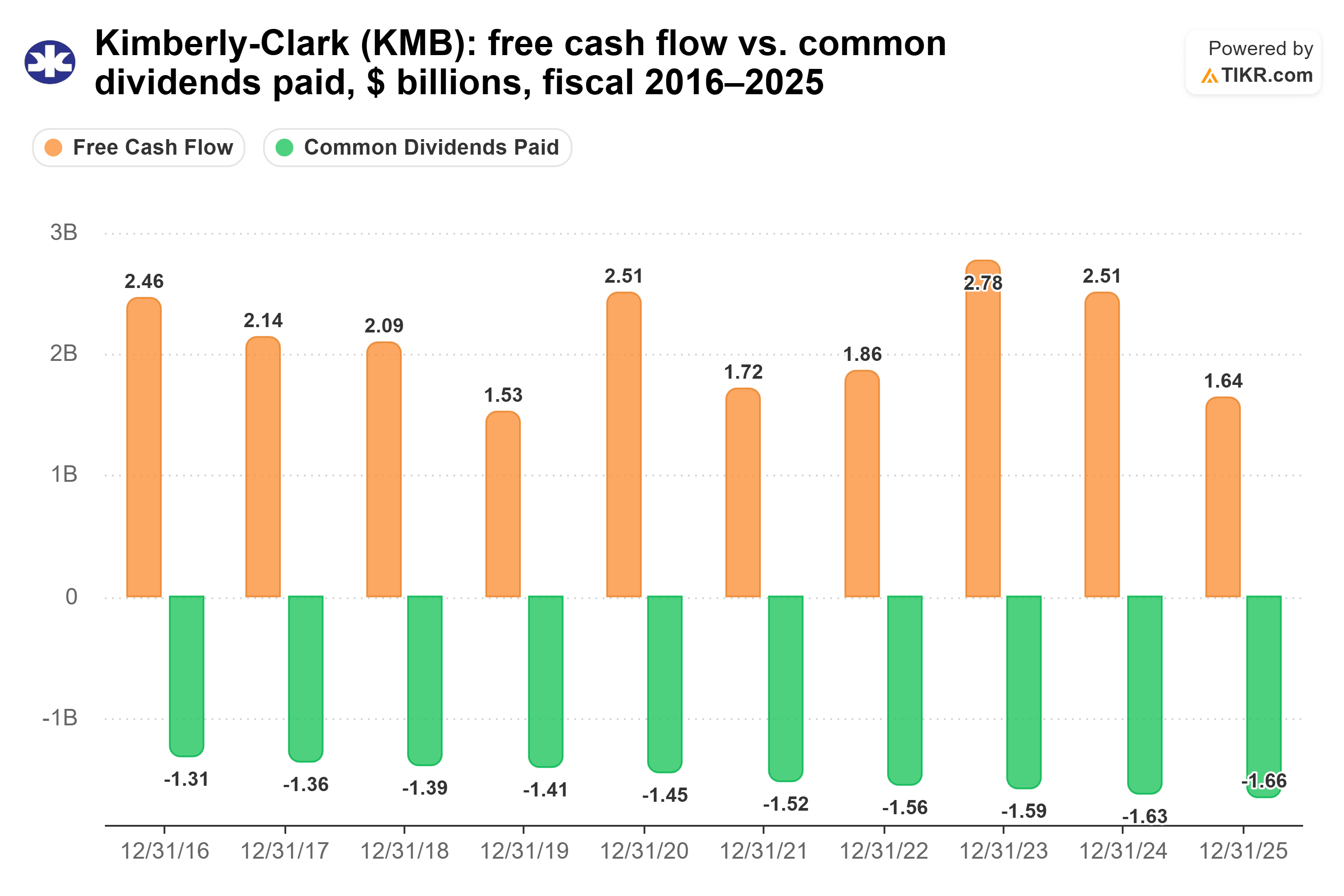
In fiscal 2025, dividends of $1.66 billion slightly topped free cash flow of $1.64 billion.
On Nov. 2, it closed its purchase of Kenvue, paying about $6.7 billion in cash, largely from $4.9 billion of new notes, and issuing about 281.1 million new shares, each collecting the same $1.28 a quarter. Kenvue’s $7.0 billion of bonds come onto its books too.
Management expects the deal to dilute 2027 earnings per share by a mid-single-digit percentage, then return to mid- to high-single-digit growth by 2028. It’s targeting about 2x leverage by the end of the deal’s second year.
Prudential has the most cushion
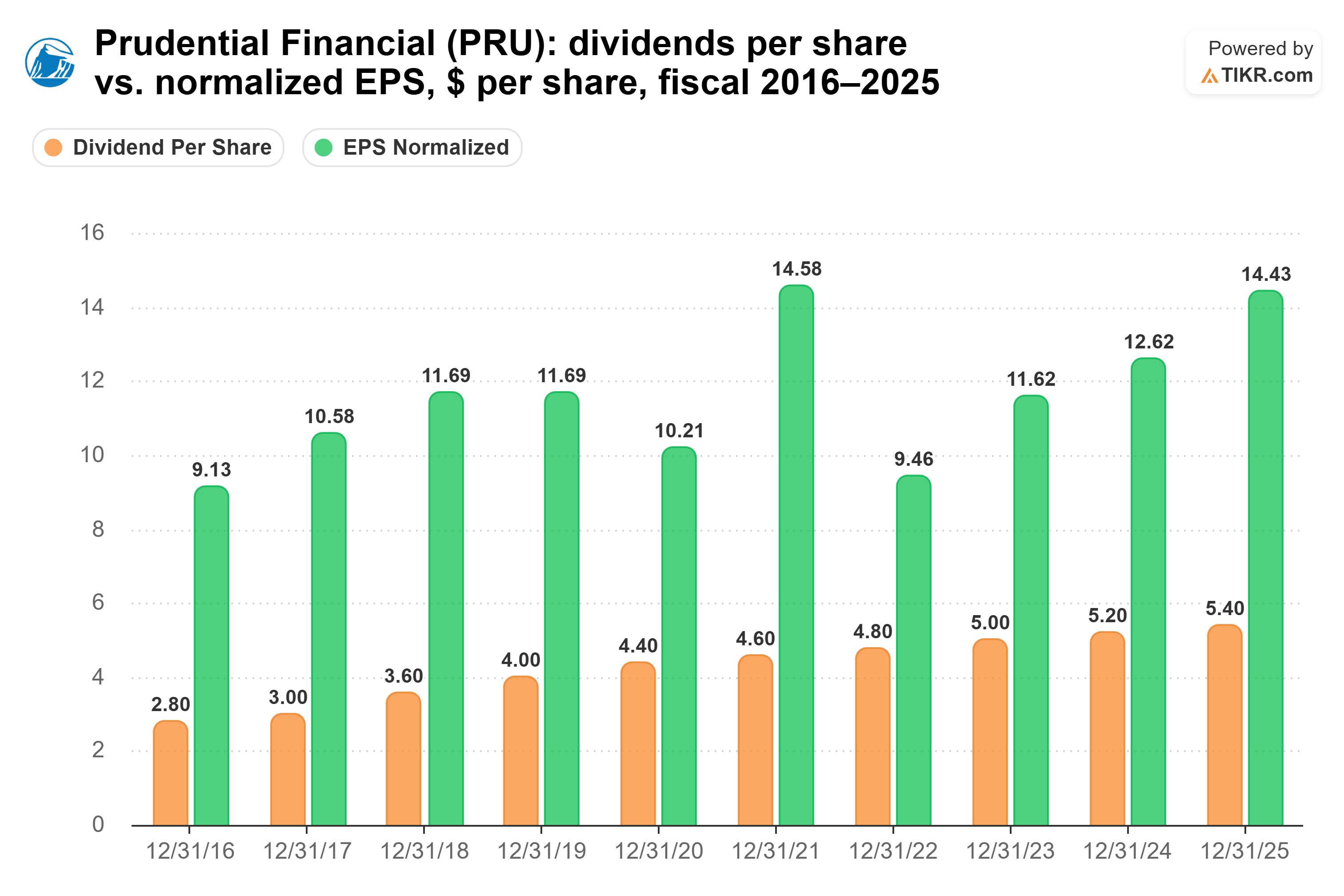
Prudential is an insurer, so it’s judged on its payout ratio of normalized EPS. In fiscal 2025, $5.40 of dividends a share took a well-covered 37% of $14.43 of normalized EPS, and analysts expect 41% for 2026. The dividend has climbed every year since fiscal 2016, even when earnings dipped:
Earnings are under pressure in Japan. On Oct. 9, Japan’s regulator extended a ban on Prudential of Japan selling new policies through Jan. 31, 2027, over misconduct by sales employees. Prudential expects the suspension to cut about $500 million from Prudential of Japan’s earnings this year, and sales resume in phases from Feb. 1.
Management laid out its priorities on the third-quarter call: “It starts with maintaining our AA strength and strengthening the balance sheet, investing in our organic growth in the business and then the deployment to the buyback and to dividends.” Dividends come last on that list. At around 40% of earnings, though, they don’t need much.
Clorox has some rebuilding to do
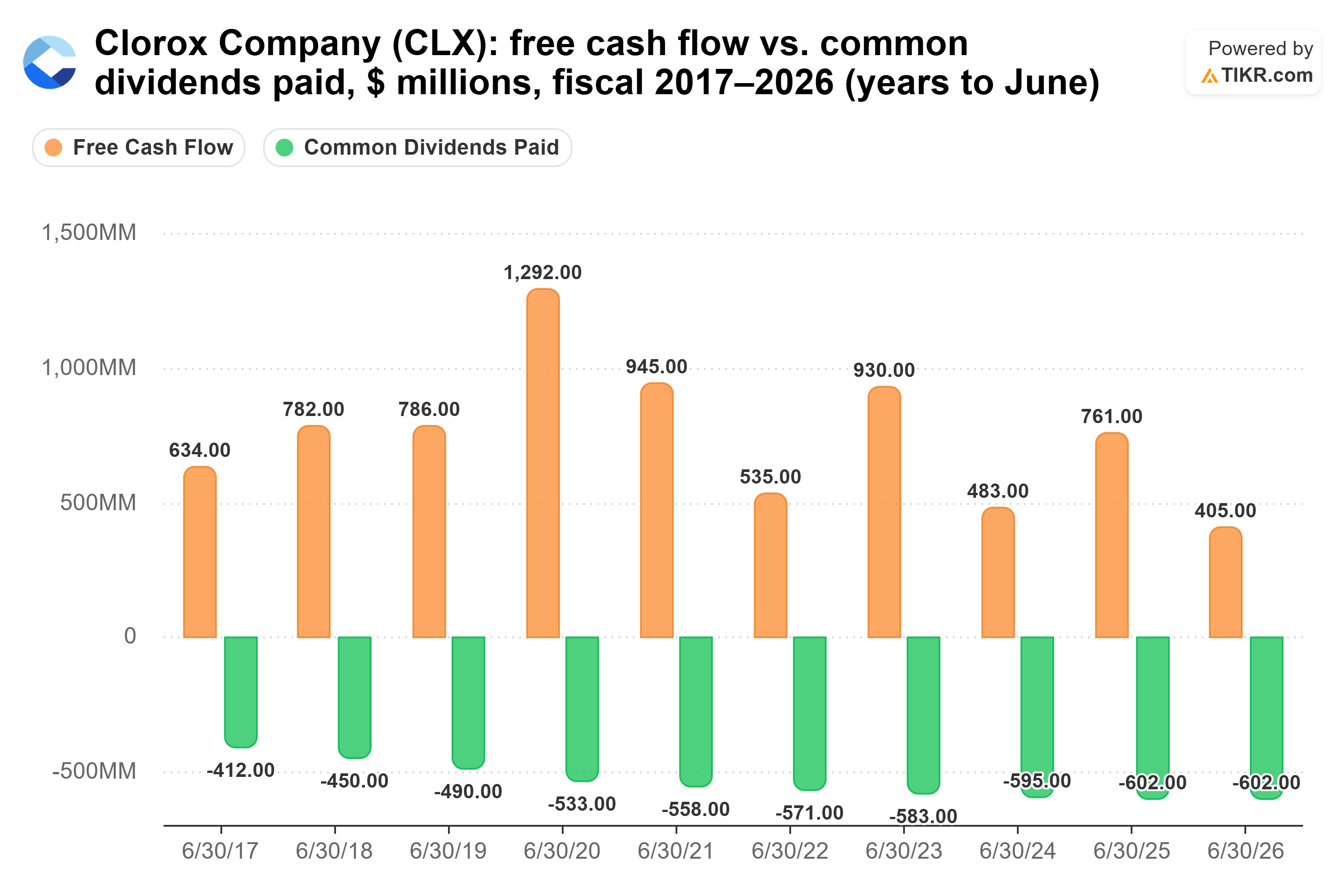
Clorox’s check rests on the least cash. Over the twelve months to Sept. 30, it paid $602 million in dividends against $453 million of free cash flow, a risky 133% cash dividend payout ratio. It has paid out more than its free cash flow in three of the last five fiscal years, which end in June:
Management says the gap won’t last: “the current payout is a bit elevated, but we see this as something more transitory as we rebuild our gross margin and not something structural.”
Analysts see a 74% ratio for fiscal 2027, which needs free cash flow to roughly double from fiscal 2026’s $405 million. But on Nov. 2, Clorox raised its estimate of this year’s input-cost inflation to about $240 million, cut its gross margin outlook to about 41.5%, and said adjusted EPS should land nearer the low end of its $5.70-$6.00 range. A new CEO is coming in as well: Fabian Garcia, president of Unilever Personal Care, takes over on Jan. 5, 2027.
Two checks I’d count on, and one I’d watch
Prudential’s check is the safest of the three to me. It uses around 40% of earnings, and the Japan hit is a sized, time-limited cost with a restart date. Kimberly-Clark’s comes next. Coverage is tight and the Kenvue debt is real, but I’d expect a company 54 years into its raises to protect that dividend while it pays the debt down.
Clorox is the least covered, so it’s the most at risk, though management calls the elevated payout transitory. Still, if Clorox halved its dividend, this retiree’s income would fall to about $49,800 a year, and to about $39,900 if it stopped paying altogether.
I’d be comfortable living on the first two checks, but I’d want to see Clorox’s free cash flow actually recover before I counted on the third. The next tests come early in 2027: Garcia’s start at Clorox, Prudential’s capital plans, and Kimberly-Clark’s first full report with Kenvue, which will show how much of that new debt the combined business can carry.
Forget Prudential Financial: 6 safe 6%+ dividend yields you can buy right now
Dividends can hold the key to enormous wealth. But only if you buy the right ones.
Picking the right high-yield dividend stock can be the difference between a dream retirement…and scraping by every month, waiting for the next Social Security check to clear.
We’ve identified six stocks yielding 6%+ that we believe every retiree should know about right now. (And Prudential Financial isn’t one of them.)
Disclaimer:
Please note that the articles on TIKR are not intended to serve as investment or financial advice from TIKR or our content team, nor are they recommendations to buy or sell any stocks. We create our content based on TIKR Terminal’s investment data and analysts’ estimates. Our analysis might not include recent company news or important updates. TIKR has no position in any of the stocks mentioned. Thank you for reading, and happy investing!