Key Takeaways
- A hypothetical $400,000 portfolio split evenly across T. Rowe Price, ONEOK and UDR pays about $20,200 a year in dividends at today’s prices, a 5.0% yield.
- ONEOK’s dividend is the best covered of the three, with distributable cash flow at 2.25x the dividend in fiscal 2025 and its guidance rising.
- UDR pays out the largest share of its cash, 77% of AFFO, but if it halved its dividend the portfolio would still pay about $16,900 a year.
- T. Rowe Price’s dividend is well covered today, and its client outflows are the trend to watch.
If you’re retired and living off your portfolio, a yield near 5% is hard to ignore. The hard part is knowing which dividend checks you can count on.
So let’s take a hypothetical $400,000 portfolio, split evenly across T. Rowe Price Group (TROW), ONEOK (OKE) and UDR (UDR). Together, at today’s prices, they pay about $20,200 a year, or about $1,680 a month. That’s a 5.0% yield on this part of the portfolio. (Of course, no one should ever own just three stocks.)
| Stock | Shares | Cost | Income a year | Share of income | Coverage, last reported |
|---|---|---|---|---|---|
| T. Rowe Price Group (TROW) | 1,320 | $133,307 | $6,864 | 33% | 71% of free cash flow (TTM) |
| ONEOK (OKE) | 1,580 | $133,305 | $6,762 | 33% | 2.25x distributable cash flow (fiscal 2025) |
| UDR (UDR) | 3,761 | $133,327 | $6,544 | 33% | 77% of AFFO (fiscal 2025) |
| Total | $20,171 | 100% |
Source: TIKR. Today’s prices; dividends at each company’s current annual rate.
6 safe dividend stocks paying retirees 6%+ yields
There are over 100 stocks paying 6%+ annual dividends today.
But after an extensive investment review leveraging TIKR’s proprietary data, we now believe only six of them are truly safe for retirees.
They’re all yours as part of our new investment report. Learn more about how to get access right here.
T. Rowe Price has cash in the bank and clients heading for the door
T. Rowe Price’s problem is the money leaving it. Clients pulled a net $28.3 billion in the third quarter and another $10.8 billion in October. Even so, net revenue rose 5.9% from a year earlier to $2.00 billion in the quarter, and management expects outflows to ease in the fourth quarter while staying elevated.
Over the twelve months to Sept. 30, the dividend took a comfortable 71% of free cash flow. Free cash flow has covered it in every fiscal year since 2018 but one, fiscal 2023, when T. Rowe Price paid out $1.12 billion against $910 million of free cash flow:
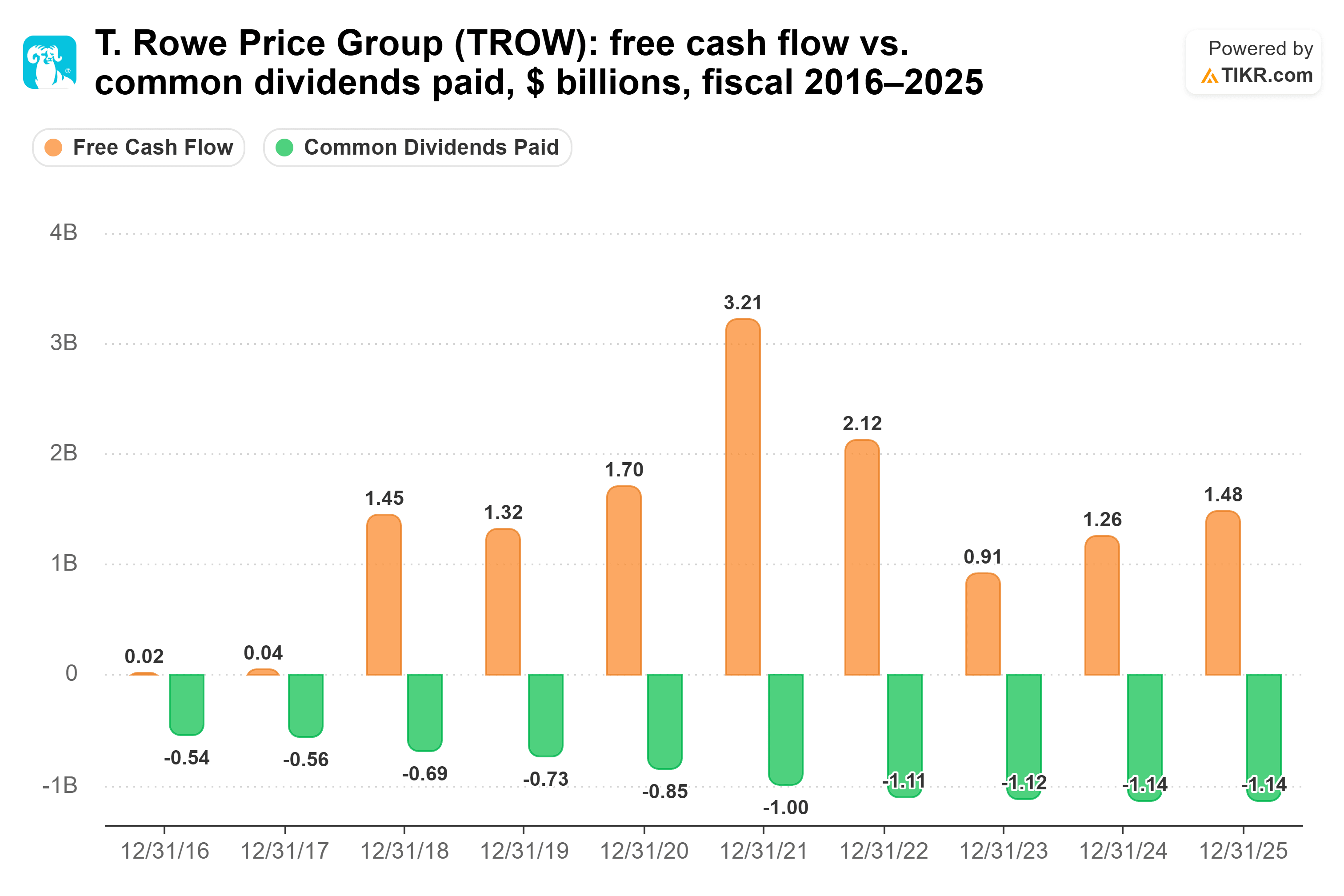
The backstop is the balance sheet: T. Rowe Price has more cash than debt. And on the third-quarter call, CFO Jen Dardis put the dividend ahead of buybacks: “Our goals are to maintain financial strength, invest in the business, make sure we have seed capital available to be able to invest for growth, support the dividend and then return excess capital to stockholders over time.” On Nov. 4, its board declared another $1.30 quarterly dividend, or $5.20 a year against the $5.08 it paid in fiscal 2025.
ONEOK has room to spare
ONEOK’s business is moving the other way. Adjusted EBITDA rose 6% from a year earlier to $2.24 billion in the third quarter on record Permian volumes, and the company raised its full-year adjusted EBITDA guidance to $8.5 billion-$8.6 billion, up $200 million at the midpoint.
Distributable cash flow covered the dividend 2.25x in fiscal 2025, and analysts expect 2.30x in fiscal 2026. That room opened up because ONEOK held its dividend at $3.74 a share from fiscal 2020 through fiscal 2022, while distributable cash flow per share climbed from $4.36 in fiscal 2020 to $9.25 in fiscal 2025:
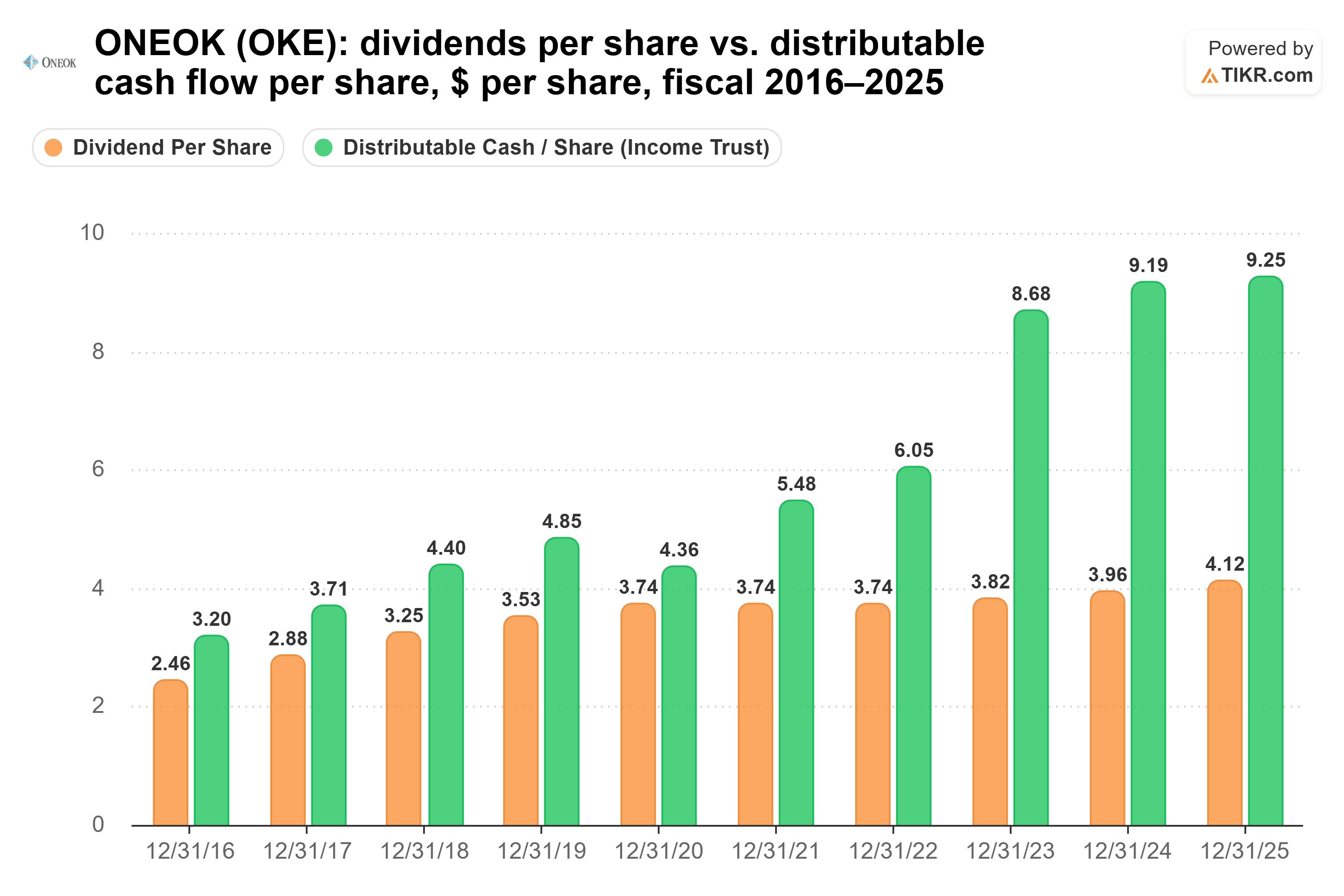
Debt is the risk, at 3.68x EBITDA net of cash, though ONEOK paid off nearly $5.5 billion of it in September. The $1.07 quarterly dividend it declared in October matches what it’s paid all year, $4.28 annualized against $4.12 in fiscal 2025, and ONEOK has said its Brazos Midstream purchase, closed Oct. 6, gives it more flexibility to raise the dividend or buy back stock.
UDR pays out the most, as usual
UDR’s check comes monthly, at $0.145 a share, and its rents are growing slowly. Same-store revenue rose 1.8% from a year earlier in the third quarter, and on Nov. 2, UDR raised its full-year guidance for the second time this year, lifting same-store revenue growth to 1.4%-1.8% from 0.75%-2.00%.
UDR paid out 77% of AFFO in fiscal 2025, and analysts expect 79% in fiscal 2026, as AFFO per share slips to $2.20 from $2.22 while the dividend rises to $1.74 from $1.72. That’s the highest payout of the three, but it’s right where UDR has run for a decade, between 71% and 80%:
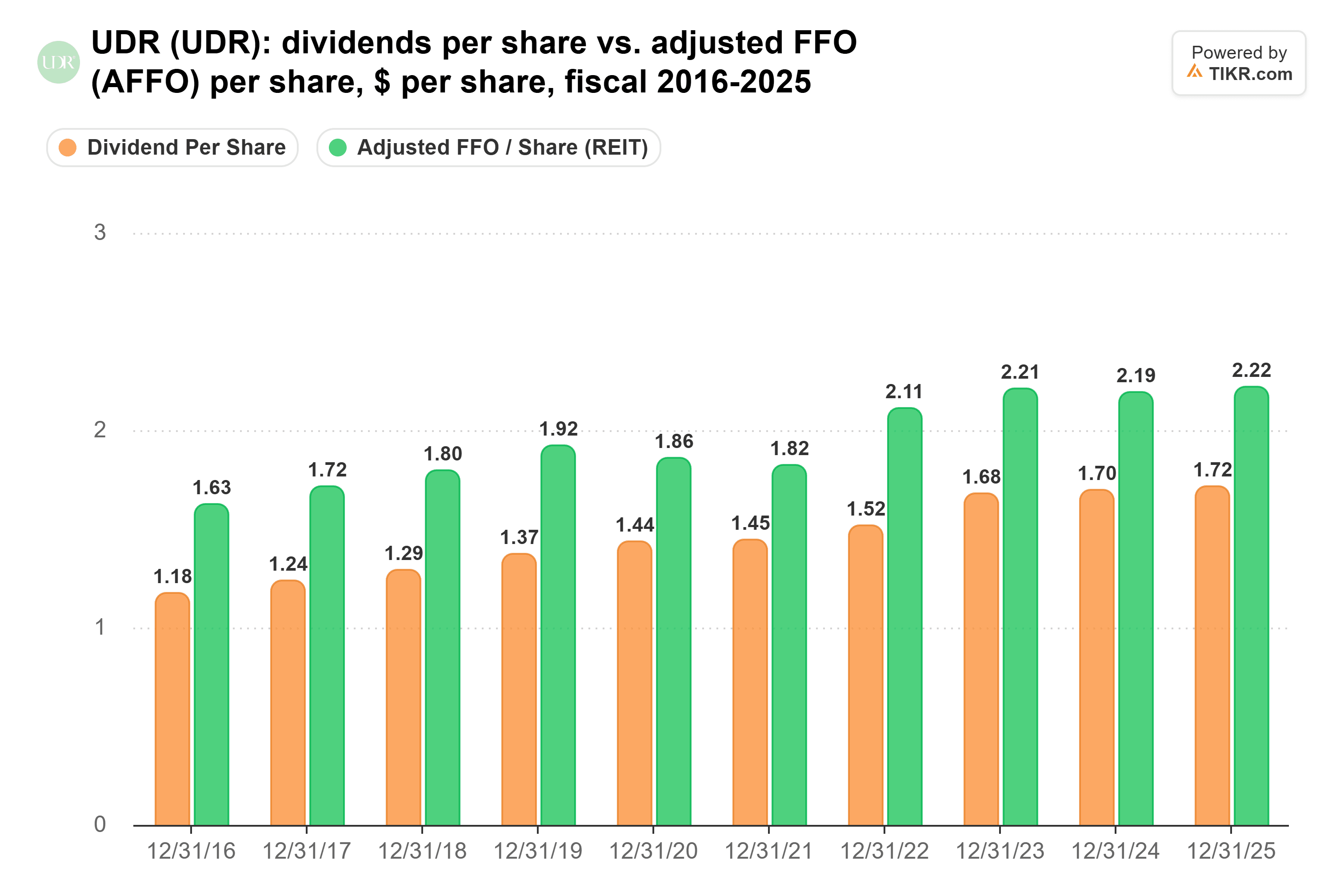
It even kept raising through fiscal 2020 and 2021, when AFFO per share dipped to $1.86 and then $1.82, though the raises are small now: the third quarter’s dividend was 1.2% above a year earlier. Its main risk is leverage, at 5.72x net debt to EBITDA.
So which check could shrink?
The cut test goes to UDR, since it pays out the largest share of its cash on its own measure. If it halved its dividend, this portfolio’s income would fall from about $20,200 a year to about $16,900, and to about $13,600 if it stopped paying altogether. I don’t see that happening: UDR’s payout sits right in its usual range, and its guidance is going up.
The way I see it, ONEOK’s check is safe and growing, and UDR’s is safe but slow. T. Rowe Price’s is the one I’d keep an eye on: its coverage is fine today, but a shrinking client base is a slow leak, and free cash flow has fallen short of the dividend before.
The next test is T. Rowe Price’s monthly asset report in December: November outflows well below October’s $10.8 billion would back management’s call for a better fourth quarter.
Enjoy your retirement in style with these safe 6%+ dividend yields
Dividends can hold the key to enormous wealth. But only if you buy the right ones.
Picking the right high-yield dividend stock can be the difference between a dream retirement…and scraping by every month, waiting for the next Social Security check to clear.
We’ve identified six stocks yielding 6%+ that we believe every retiree should know about right now.
Disclaimer:
Please note that the articles on TIKR are not intended to serve as investment or financial advice from TIKR or our content team, nor are they recommendations to buy or sell any stocks. We create our content based on TIKR Terminal’s investment data and analysts’ estimates. Our analysis might not include recent company news or important updates. TIKR has no position in any of the stocks mentioned. Thank you for reading, and happy investing!