Key Takeaways
- A $300,000 portfolio split evenly across ONEOK, Hormel Foods and Newell Brands pays about $14,700 a year in dividends at today’s prices, or about $1,230 a month.
- ONEOK’s dividend is the best covered of the three, with distributable cash flow at 2.25x its dividend in fiscal 2025.
- Hormel Foods raised its dividend for a 61st straight year on Nov. 23, but Newell Brands paid out 240% of its free cash flow over the last twelve months.
- If Newell halved its dividend, the portfolio’s income would fall to about $12,400 a year, and to about $10,000 if it stopped paying.
A 5% yield is only as good as the business paying it.
So let’s take a hypothetical retiree who splits $300,000 evenly across ONEOK (OKE), Hormel Foods (HRL) and Newell Brands (NWL). Together, they pay about $14,700 a year in dividends, or about $1,230 a month. That’s a 4.9% yield on this part of the portfolio. (Of course, no one should ever own just three stocks.) Here’s how each dividend check breaks down:
| Stock | Shares | Cost | Income a year | Share of income | Coverage |
|---|---|---|---|---|---|
| ONEOK (OKE) | 1,156 | $99,936 | $4,948 | 34% | 2.25x distributable cash flow coverage (fiscal 2025) |
| Hormel Foods (HRL) | 4,330 | $99,980 | $5,066 | 33% | 82% cash dividend payout ratio (TTM) |
| Newell Brands (NWL) | 16,835 | $100,000 | $4,714 | 33% | 240% cash dividend payout ratio (TTM) |
Source: TIKR, at today’s prices; dividends at each company’s current annual rate.
6 safe dividend stocks paying retirees 6%+ yields
There are over 100 stocks paying 6%+ annual dividends today.
But after an extensive investment review leveraging TIKR’s proprietary data, we now believe only six of them are truly safe for retirees.
They’re all yours as part of our new investment report. Learn more about how to get access right here.
ONEOK has more than twice the cash it needs
ONEOK’s business is growing, led by record volumes in the Permian Basin. Third-quarter adjusted EBITDA rose 6% to $2.24 billion, and ONEOK raised its 2026 adjusted EBITDA guidance to $8.5 billion-$8.6 billion.
Distributable cash flow per share has grown far faster than the dividend over the past decade:
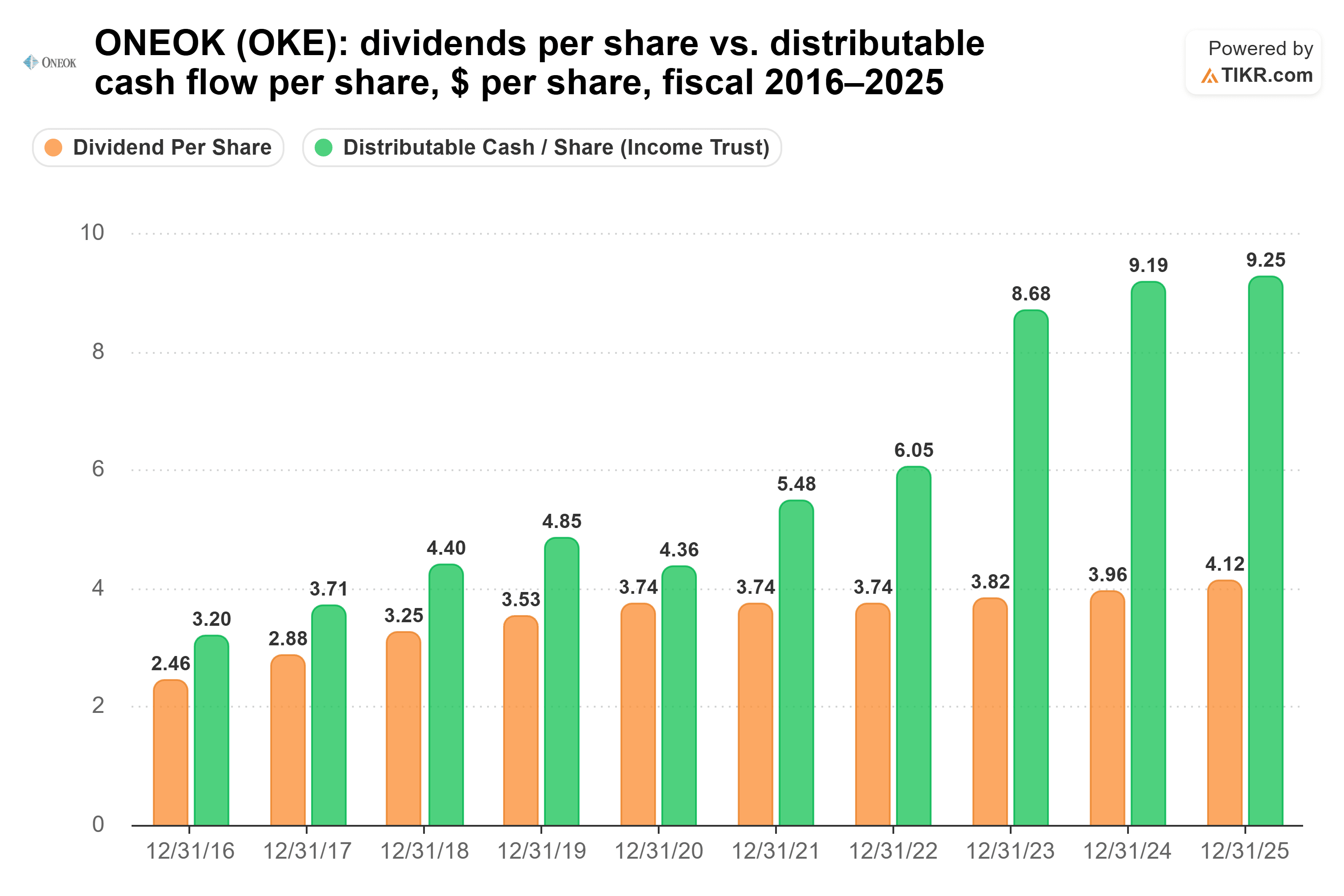
In fiscal 2025, distributable cash flow came to $9.25 a share against $4.12 of dividends, a roomy 2.25x coverage, up from 1.30x in fiscal 2016. Analysts expect 2.30x in fiscal 2026.
The board held the quarterly dividend at $1.07 a share on Oct. 14, but there’s plenty of cash behind it. CFO Walter Hulse said on the third-quarter call that capital spending should run around $3 billion in 2027 and $2.5 billion-$3 billion after that, “which will still leave us with quite a bit of free cash flow to return capital to shareholders.” The main risk is the one every pipeline carries: its volumes depend on producers’ drilling, which follows energy prices.
Hormel raised again, but the cushion is thinner
Hormel’s check runs on a much tighter margin than ONEOK’s, though it comes with a long record. On Nov. 23, it raised its quarterly dividend 1% to $0.295 a share, for what it counts as its 61st straight year of raises.
In the quarter to July 26, net sales slipped to $2.96 billion from $3.03 billion as retail volumes fell. Management still raised its fiscal 2026 adjusted EPS guidance to $1.45-$1.51.
Free cash flow covered Hormel’s dividends in every year of the past decade except fiscal 2025:

That year, $633 million of dividends ran past $534 million of free cash flow. Over the twelve months to July 26, 2026, the payout ratio was back to a tight but covered 82%.
The bigger change is Brakebush Brothers. Hormel closed its $1.06 billion cash purchase of the chicken company on Nov. 16, after taking out a $700 million term loan on Nov. 13. Before the deal, net debt was a low 1.19x EBITDA, so Hormel can carry the loan, but the interest comes out of the same cash as the dividend. John Ghingo, who became CEO on Oct. 26, said on the August call: “Certainly, the dividend continues to be very important to us.”
Newell’s check is the one to test
Newell’s check is shakier than Hormel’s, and the company has cut it before: it paid $0.92 a share in fiscal 2020 and $0.28 in fiscal 2025.
Free cash flow fell well short of even that smaller dividend in fiscal 2025:
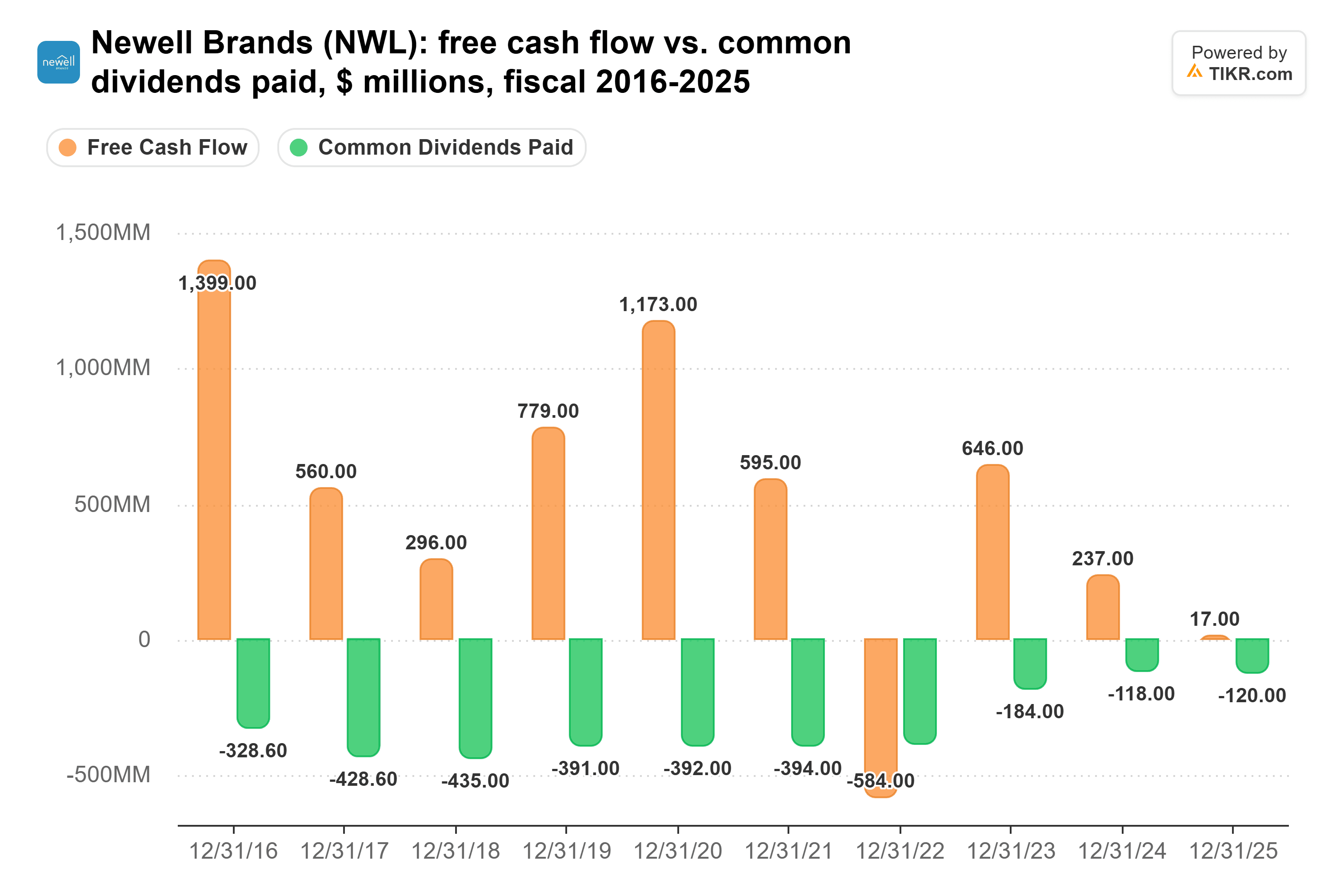
Newell generated $17 million of free cash flow that year against $120 million of dividends. Over the twelve months to Sept. 30, 2026, dividends took 240% of free cash flow, a level Newell can’t keep up for long.
Sales are finally turning. Third-quarter net sales rose 3.7% to $1.9 billion, and Newell raised its full-year sales outlook to 2%-3% growth from 1%-2%.
Cash is still the problem. Newell cut its 2026 operating cash flow outlook to about $150 million from $400 million on one-time items. CFO Mark Erceg said on the third-quarter call that for 2027, “we don’t see any reason why we wouldn’t be projecting out somewhere in the $400 million-plus range for the operating cash flow.”
If one cuts, it’s probably Newell
Newell is the one I’d test for a cut, since it’s the least covered of the three. If it halved its dividend, this portfolio’s income would fall to about $12,400 a year. If it stopped paying altogether, it’d drop to about $10,000.
The dividend cost Newell $127 million over the last twelve months, well under the operating cash flow it expects for 2027. So I’d call Newell’s check stretched, and I’d want to see that cash show up before counting on it.
ONEOK’s check looks safe and growing. Hormel’s looks safe but slow until Brakebush shows up in the numbers. If I were living on this income, ONEOK’s is the check I’d lean on most.
Newell’s fourth-quarter report, early next year, is the next test: operating cash flow near $150 million for 2026, and a 2027 outlook that holds that $400 million-plus, would make me a lot more comfortable with its check.
Forget ONEOK: 6 safe 6%+ dividend yields you can buy right now
Dividends can hold the key to enormous wealth. But only if you buy the right ones.
Picking the right high-yield dividend stock can be the difference between a dream retirement…and scraping by every month, waiting for the next Social Security check to clear.
We’ve identified six stocks yielding 6%+ that we believe every retiree should know about right now. (And ONEOK isn’t one of them.)
Disclaimer:
Please note that the articles on TIKR are not intended to serve as investment or financial advice from TIKR or our content team, nor are they recommendations to buy or sell any stocks. We create our content based on TIKR Terminal’s investment data and analysts’ estimates. Our analysis might not include recent company news or important updates. TIKR has no position in any of the stocks mentioned. Thank you for reading, and happy investing!