
Key Takeaways
- A $1.5 million portfolio split evenly across T. Rowe Price, AT&T and Fidelity National Financial pays about $72,000 a year in dividends, or about $6,000 a month.
- T. Rowe Price’s dividend is the least covered of the three, taking 71% of its free cash flow over the last 12 months while clients keep pulling money out.
- If T. Rowe Price halved its dividend, the income would fall to about $59,800 a year. If it stopped paying, the income would fall to about $47,600.
- Fidelity National Financial just raised its dividend 4%, and AT&T plans to keep its dividend flat at $1.11 a share.
Three stocks yielding about 5% apiece can turn a nest egg into a pretty comfortable paycheck.
Let’s take a hypothetical retiree with $1.5 million, split evenly between T. Rowe Price Group (TROW), AT&T (T) and Fidelity National Financial (FNF). At today’s prices, $500,000 buys about 4,820 shares of T. Rowe Price, about 22,400 shares of AT&T and about 11,440 shares of Fidelity National.
Together, the three pay about $72,000 a year in dividend checks, or about $6,000 a month. That’s a 4.8% yield on this part of the portfolio. (Of course, no one should ever own just three stocks.)
Here’s how each check breaks down:
| Stock | Shares | Cost | Yield | Income a year | Share of income | Coverage |
|---|---|---|---|---|---|---|
| T. Rowe Price Group (TROW) | 4,691 | $499,920 | 4.8% | $24,393 | 34% | 71% of free cash flow (TTM) |
| AT&T (T) | 21,542 | $499,920 | 4.8% | $23,912 | 33% | 44% of free cash flow (TTM); 46% (fiscal 2026 consensus) |
| Fidelity National Financial (FNF) | 10,969 | $499,967 | 4.9% | $23,693 | 33% | 41% of normalized EPS (fiscal 2025); 43% (fiscal 2026 consensus) |
Source: TIKR and StockAnalysis, at today’s prices. Dividends are at each company’s current rate.
6 safe dividend stocks paying retirees 6%+ yields
There are over 100 stocks paying 6%+ annual dividends today.
But after an extensive investment review leveraging TIKR’s proprietary data, we now believe only six of them are truly safe for retirees.
They’re all yours as part of our new investment report. Learn more about how to get access right here.
T. Rowe Price’s clients keep heading for the exits
T. Rowe Price pays $5.20 a share a year, up from $5.08 in fiscal 2025.
The pressure is on the business behind that check. Clients pulled a net $28.3 billion in the third quarter and another $10.8 billion in October, as money keeps moving from active stock funds to lower-fee products. Still, net revenues rose 5.9% from a year earlier to $2.0 billion in the third quarter, and adjusted diluted EPS edged up to $2.86 from $2.81.
T. Rowe’s free cash flow has swung far more than its dividend bill. The bill more than doubled, from $0.54 billion in fiscal 2016 to $1.14 billion in fiscal 2025:
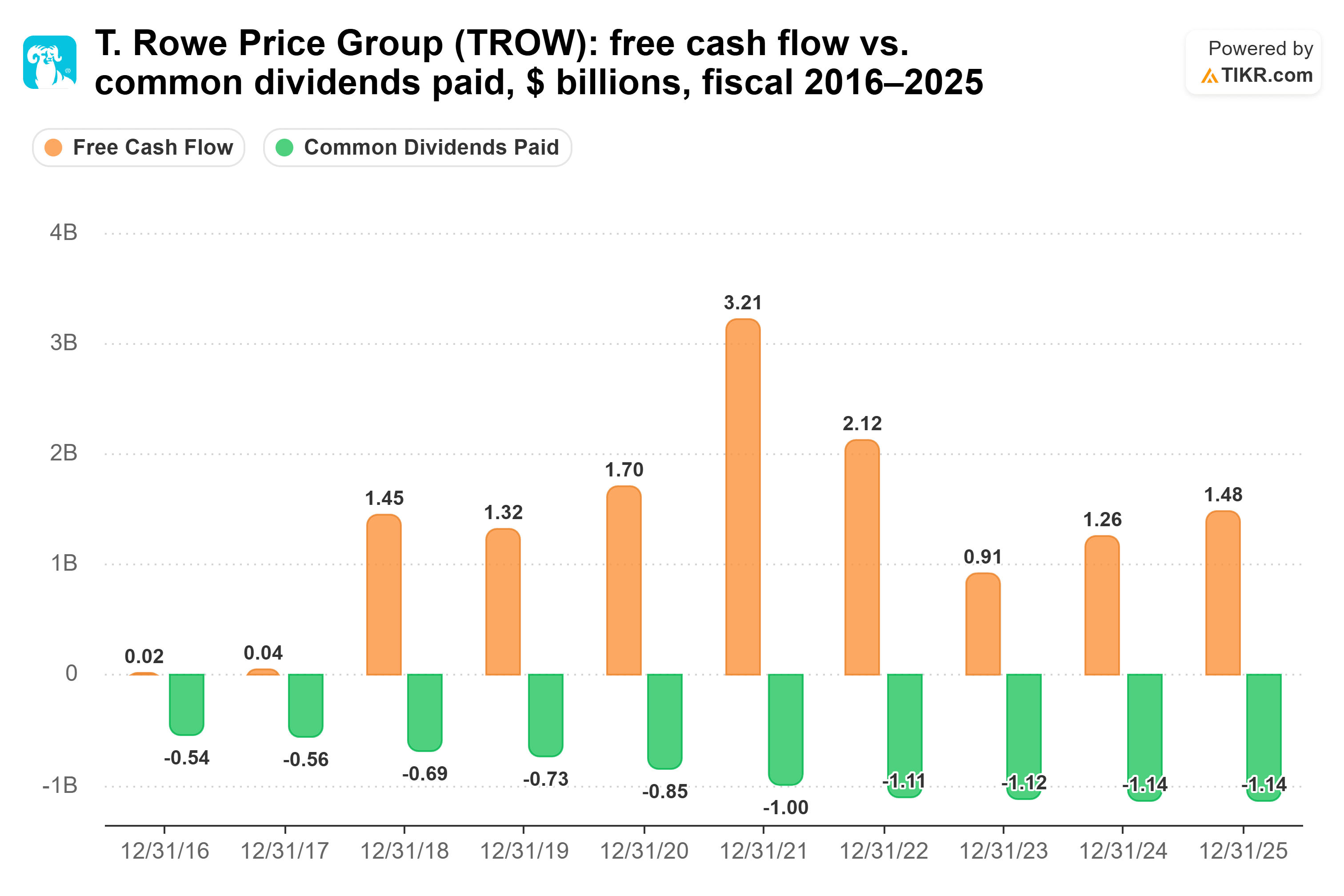
The dividend took 123% of free cash flow in fiscal 2023. That has come down to a more manageable 71% over the twelve months to Sept. 30, 2026. T. Rowe also paused buybacks in the third quarter after $500 million in the first half.
AT&T’s check is flat but well covered
AT&T shareholders spent October worrying about SpaceX. Bernstein downgraded the stock on Oct. 13 over SpaceX’s move into wireless, and the shares lost more than 14% in the month.
The business had a solid quarter anyway. Third-quarter revenue rose 5.3% to $32.3 billion, with a record 769,000 internet net adds across fiber and fixed wireless.
AT&T paid $2.08 a share in dividends in fiscal 2020 and $1.11 in fiscal 2025. Free cash flow has covered that smaller bill easily since fiscal 2023:
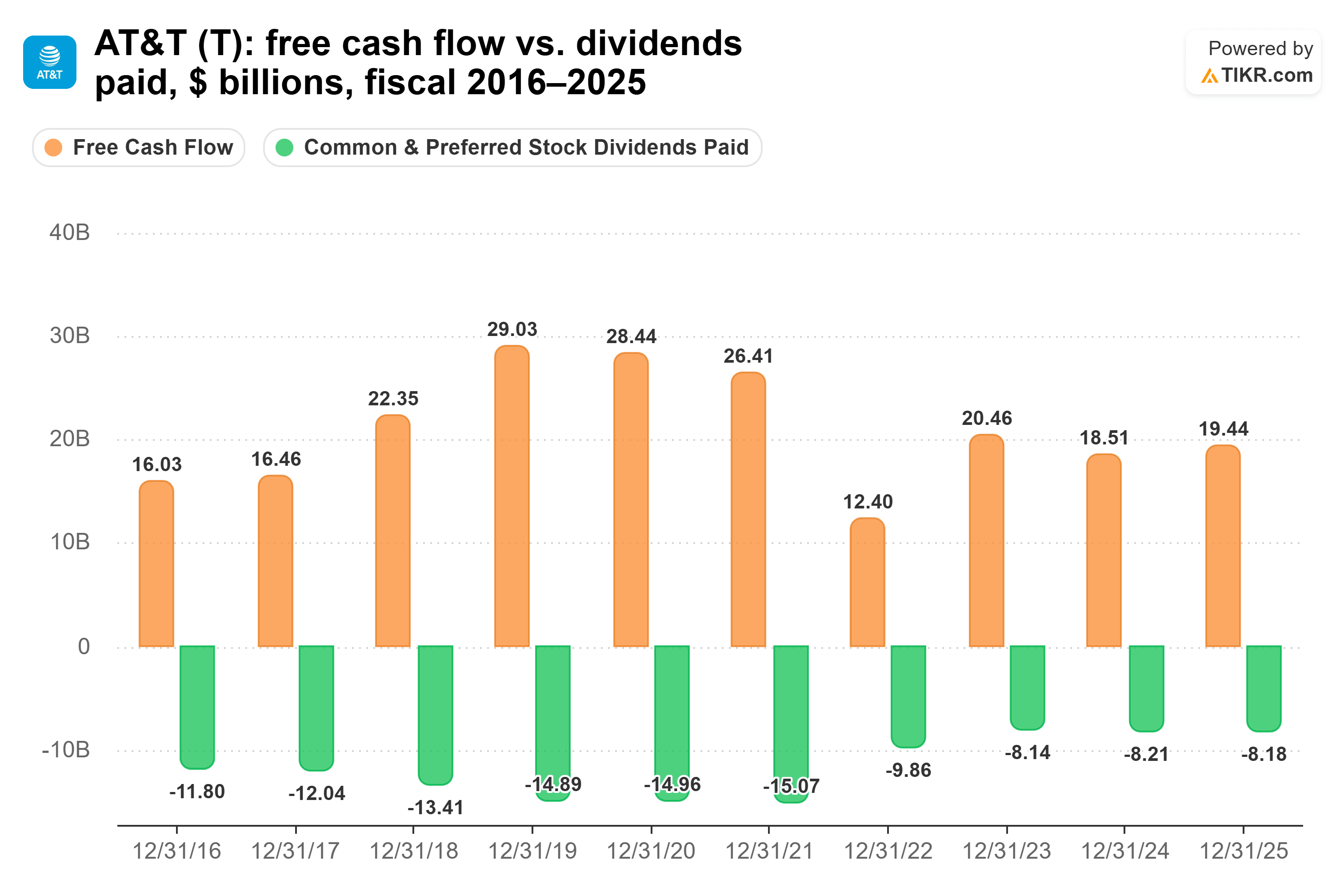
The dividend took a well-covered 44% of free cash flow over the twelve months to Sept. 30, 2026, and consensus has 46% for fiscal 2026. AT&T expects more than $18 billion of free cash flow this year, rising to more than $21 billion in 2028. It plans to keep the dividend at $1.11 a share. Debt is the main risk: net debt runs 3.3x EBITDA, and AT&T doesn’t expect to get back to its 2.5x target until 2029. And for a retiree, a check that never grows buys a little less every year.
Fidelity National just raised its check
Fidelity National’s housing business is soft, and its board raised the quarterly dividend anyway: on Nov. 6, it lifted it 4% to $0.54 a share from $0.52. Third-quarter revenue fell to $3.58 billion from $4.03 billion a year earlier, and adjusted EPS fell to $1.32 from $1.63. October orders ran at 4,700 a day, down 17% from a year earlier.
As an insurer, Fidelity National is judged on its normalized EPS. That figure swung from $7.90 in fiscal 2021 to $3.55 in fiscal 2023, while the dividend rose every year, from $0.88 a share in fiscal 2016 to $2.02 in fiscal 2025:
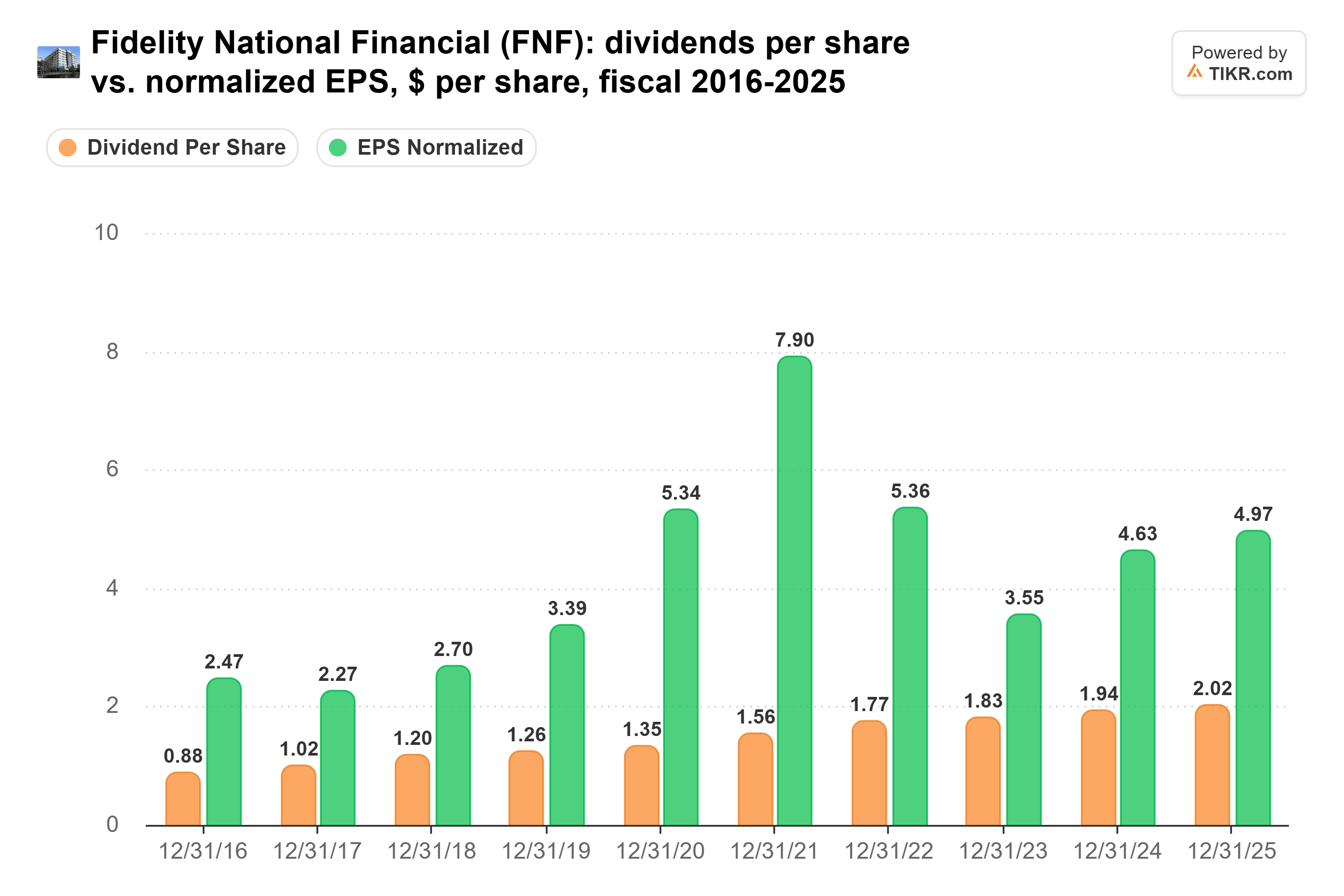
The dividend took a comfortable 41% of normalized EPS in fiscal 2025, and consensus has 43% for fiscal 2026. Management expects the title margin to slip toward the low end of its 15% to 20% normal range in the fourth quarter. A title waiver program could also eat into refinance orders.
If one cuts, T. Rowe Price is the one to watch
T. Rowe Price is the one to watch, since its dividend takes the biggest share of its cash, at 71% of free cash flow. If it halved its dividend, this portfolio’s income would fall to about $59,800 a year. If it stopped paying entirely, the income would fall to about $47,600.
Frankly, I don’t expect either. The least covered of three can still be in decent shape, and T. Rowe is: it holds more cash than debt, and its revenue and adjusted EPS grew last quarter. But with clients still pulling money out, I wouldn’t count on big raises from here. Fidelity National’s check looks safe and growing, and AT&T’s looks safe but flat.
I’ll be watching T. Rowe’s fourth-quarter flows, due early next year, and whether AT&T delivers the roughly $6 billion of free cash flow it expects for the quarter.
Enjoy your retirement in style with these safe 6%+ dividend yields
Dividends can hold the key to enormous wealth. But only if you buy the right ones.
Picking the right high-yield dividend stock can be the difference between a dream retirement…and scraping by every month, waiting for the next Social Security check to clear.
We’ve identified six stocks yielding 6%+ that we believe every retiree should know about right now.
Disclaimer:
Please note that the articles on TIKR are not intended to serve as investment or financial advice from TIKR or our content team, nor are they recommendations to buy or sell any stocks. We create our content based on TIKR Terminal’s investment data and analysts’ estimates. Our analysis might not include recent company news or important updates. TIKR has no position in any of the stocks mentioned. Thank you for reading, and happy investing!