Key Takeaways
- A Tema ETFs strategist says $150 billion of Anthropic’s Nvidia-tied compute can be ended on short notice within 12 months.
- Anthropic’s CEO says it buys little compute ahead of time.
- While compute stays scarce, SpaceX’s two-way exit clause lets it push for higher prices.
- If supply catches up, CoreWeave, with $46.9 billion of borrowings, has the most to lose.
Anthropic is expected to start trading on Nov. 19, two days after NVIDIA (NVDA) reports. But much of its NVIDIA-powered compute is less locked in than its headline commitments suggest.
That compute reaches Anthropic through clouds renting out NVIDIA’s chips. SpaceX (SPCX) rents it capacity on NVIDIA GPUs in Memphis, and CoreWeave (CRWV) signed a multi-year deal in April on a range of NVIDIA chips.
How Much of Anthropic’s Compute Can Walk
Paisley Nardini, head of investment strategy at Tema ETFs, said on the Nov. 13 Bloomberg Tech:
“about 250 billion of Anthropic’s compute deals are tied to Nvidia. 150 billion of those can be ended on short notice within the next 12 months”
That’s 60% of the NVIDIA-tied total. She didn’t say which side holds the exit, but SpaceX’s deal shows the shape: Anthropic’s Nov. 10 amended S-1 lets either party cancel on 90 days’ notice once its non-cancelable periods end in early 2027.
Anthropic Buys on the Low Side by Design
The filing puts committed spend at about $900.9 billion. Yet CEO Dario Amodei told JPMorgan’s Jamie Dimon on Nov. 13 that it holds back, as CNBC’s Kate Rooney relayed on Closing Bell:
“we tend to buy on the low side and then buy relatively little compute for relatively low cost ahead of time”
If growth slows, short-notice deals let its bill shrink.
What NVIDIA Needs to Stay Booked
Analysts expect NVIDIA’s revenue to nearly double from $215.9 billion in the year ended January 2026 to about $412 billion, then reach $689 billion the year after.
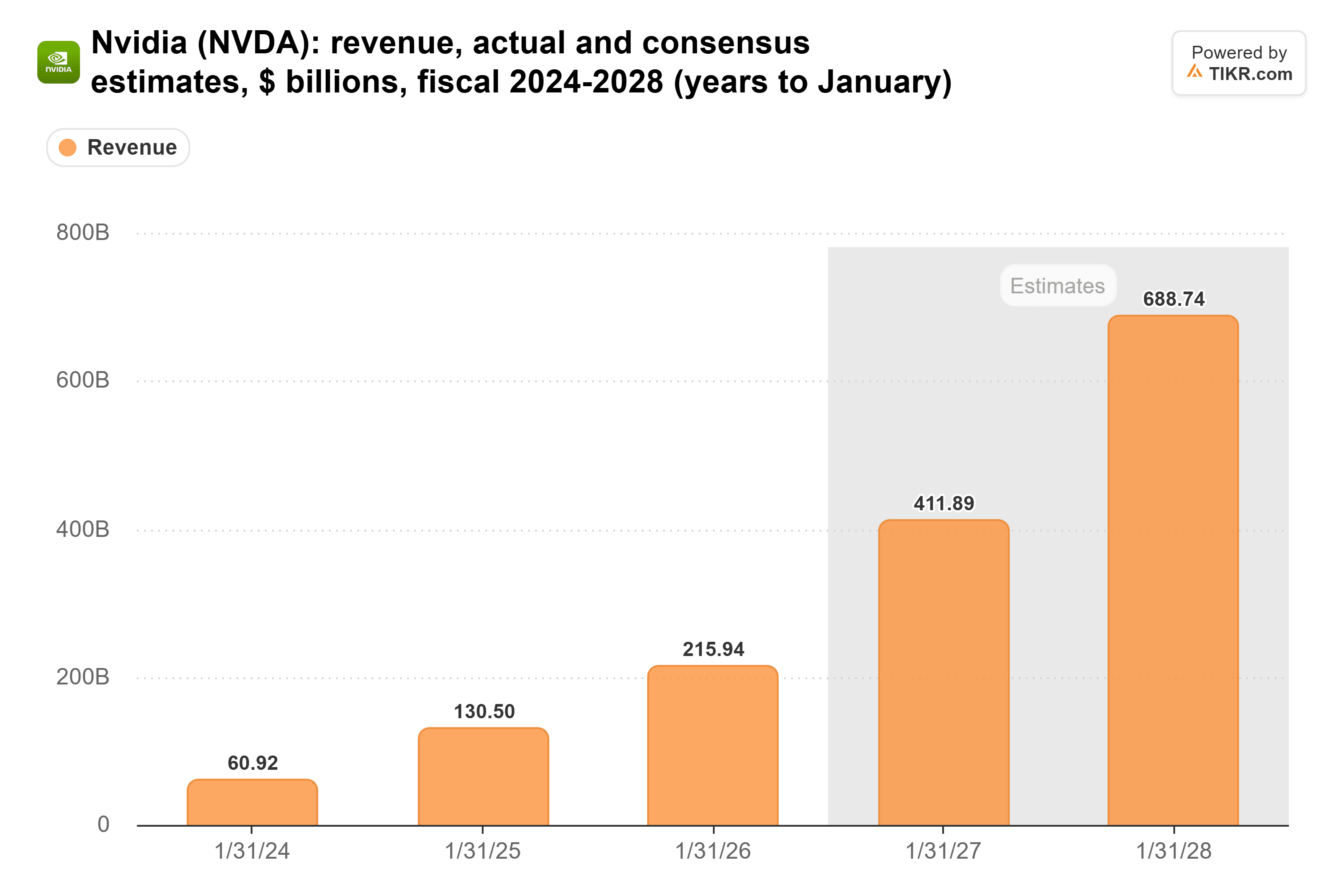
On the August earnings call, CFO Colette Kress said AI labs NVIDIA expects to back with its balance sheet should make up roughly a quarter of next year’s business. She’s now interim CEO after Jensen Huang resigned on Nov. 11.
TIKR Tracks 62 Analysts on NVIDIA. How Many Say “Buy”?
See the full breakdown of Buy, Hold, and Sell ratings on NVIDIA, along with Wall Street’s revenue and earnings estimates, all in one place. More than 500,000 investors use TIKR to research stocks like this one. See NVIDIA’s Analyst Ratings
CoreWeave Carries the Most Risk
CoreWeave’s third-quarter release put its backlog at about $132.5 billion, roughly 10 times the midpoint of its 2026 revenue guidance. Analysts expect revenue to double to $27.1 billion in 2027.
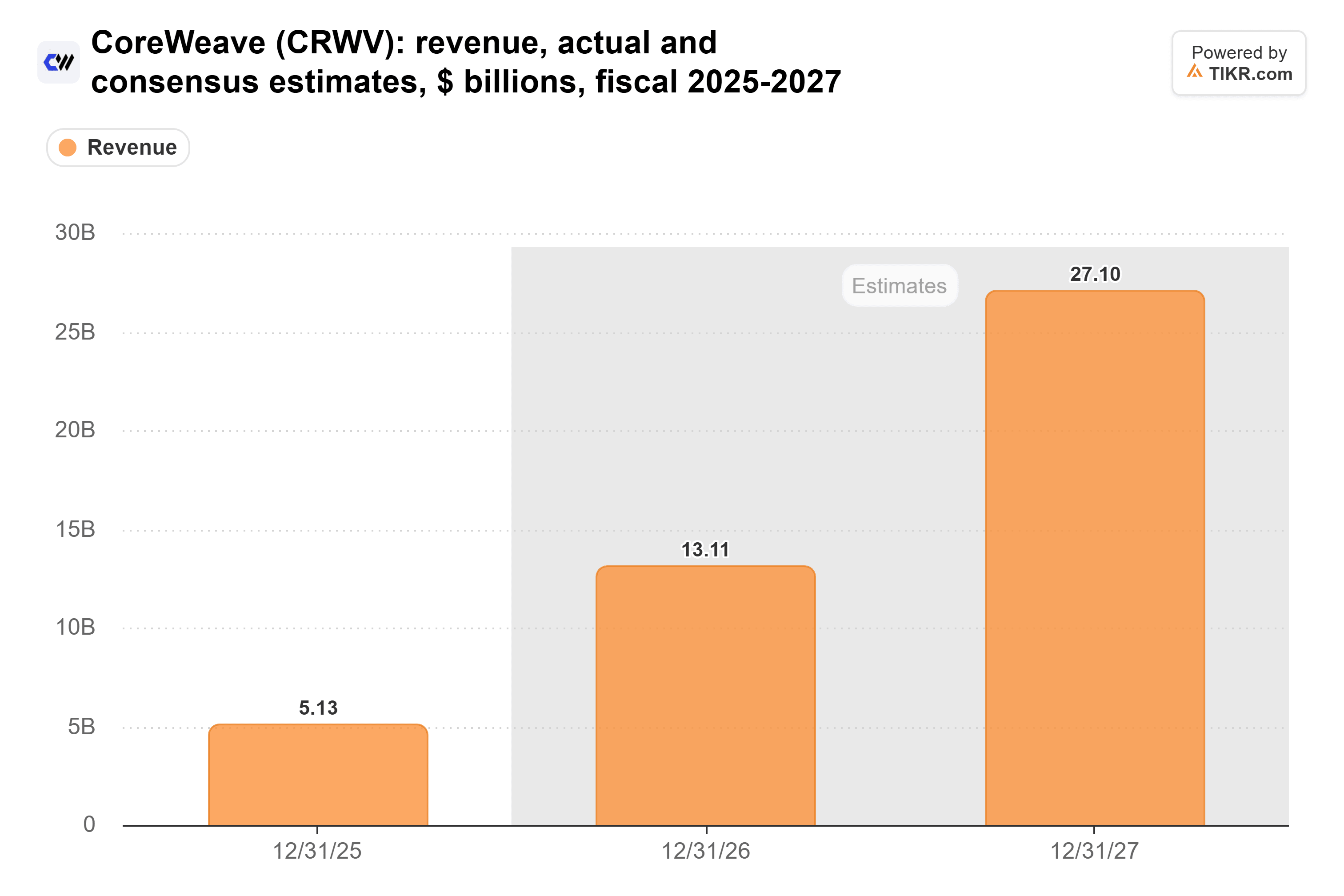
Debt funded most of it: $29.8 billion at the end of 2025, against $3.16 billion of cash and short-term investments.
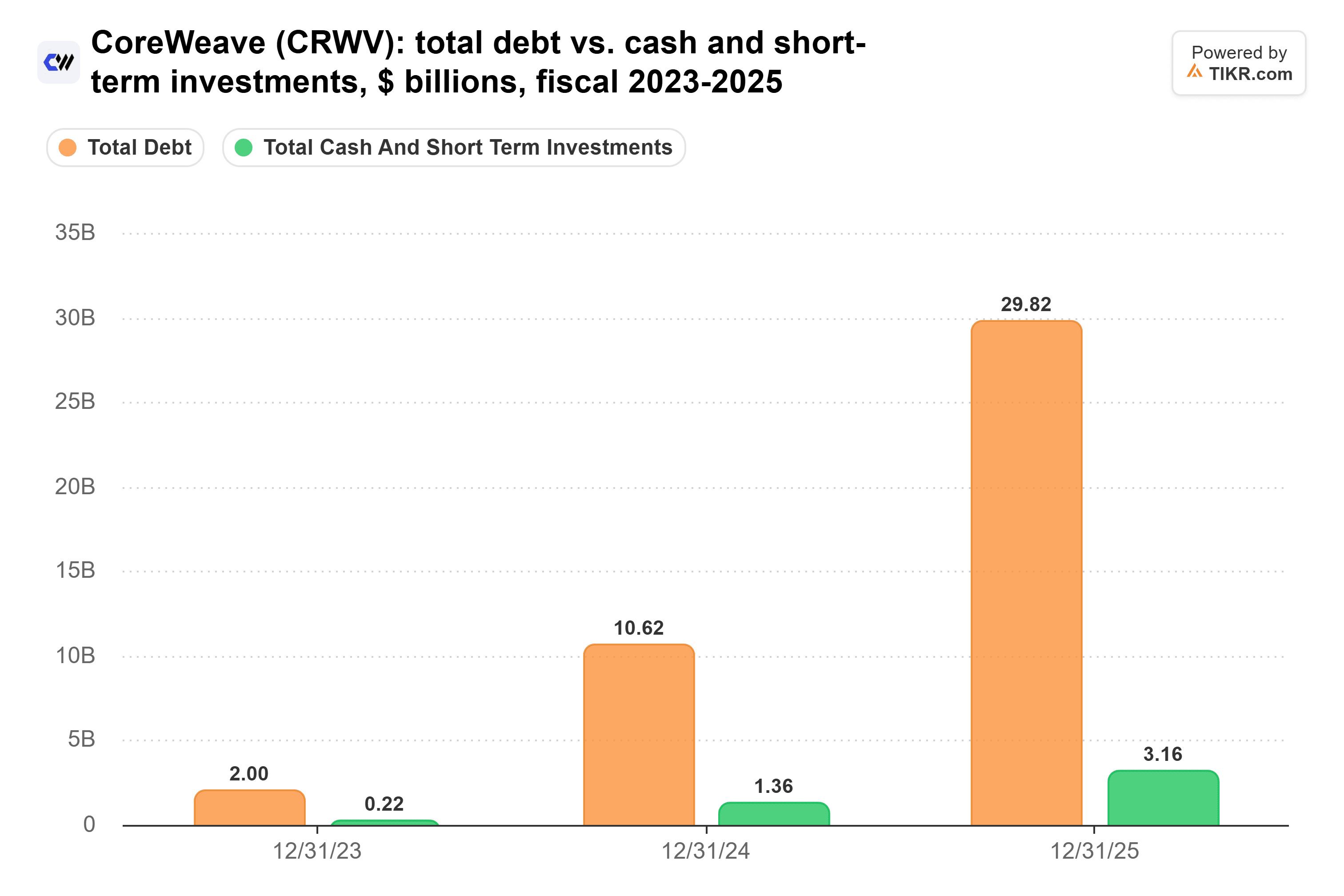
Counting borrowings alone, debt more than doubled from $21.4 billion at year-end to $46.9 billion at Sept. 30, per its 10-Q.
For Now, SpaceX Holds the Cards
Chamath Palihapitiya argued SpaceX could end its Anthropic deal and bring it back at 2x to 3x the price. For CoreWeave, scarcity shows up in pricing: CEO Michael Intrator says it has 10 times as much qualified demand as capacity through 2027.
Flexibility costs Anthropic: $5 billion of pricier short-term compute was a main driver of its $567 million operating loss last quarter. Elon Musk conceded the flip side: “If compute becomes plentiful and cheap, SpaceX revenue will drop.”
Conclusion
While the shortage lasts, a canceled contract is capacity a cloud can re-rent for more. Once supply catches up, CoreWeave would sign new contracts and renewals for less while still owing $46.9 billion, and NVIDIA would feel it next.
CoreWeave’s $132.5 billion backlog rests on committed contracts, so its exposure is what the next contracts fetch. NVIDIA’s estimates look safe only while the shortage holds. NVIDIA reports Nov. 17, and Anthropic is expected to price the next day.
So What Is NVIDIA Stock Actually Worth?
TIKR lets you forecast the future price of any stock in less than a minute. Just enter a few assumptions into TIKR’s valuation model and see what NVIDIA could be worth. Start from Wall Street consensus estimates, or adjust the inputs to reflect your own view of the business. It’s free to use.
Disclaimer:
Please note that the articles on TIKR are not intended to serve as investment or financial advice from TIKR or our content team, nor are they recommendations to buy or sell any stocks. We create our content based on TIKR Terminal’s investment data and analysts’ estimates. Our analysis might not include recent company news or important updates. TIKR has no position in any of the stocks mentioned. Thank you for reading, and happy investing!